
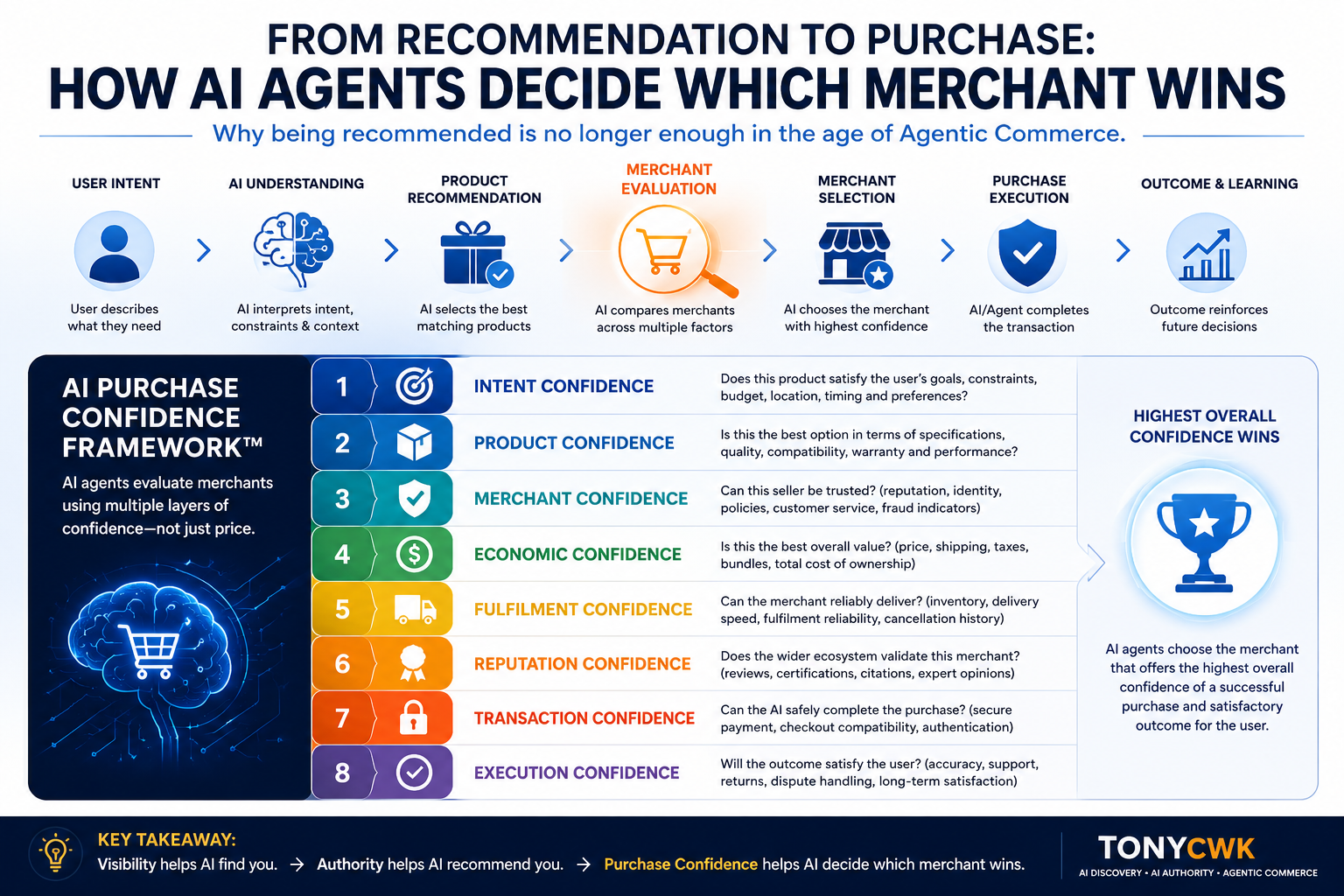
Why being recommended is no longer enough in the age of Agentic Commerce
For decades, digital marketing has focused on helping customers discover businesses.
SEO helped people find websites.
Google Ads generated clicks.
Content marketing built awareness.
Conversion optimization increased purchases.
But AI purchasing agents are changing the buying journey.
Increasingly, AI systems won’t just recommend products—they will compare merchants, evaluate transaction risks, and help users decide where to buy. In many situations, they may even complete purchases on behalf of users after receiving permission.
This represents a fundamental shift.
The future of commerce isn’t simply about being found or even being recommended.
It’s about becoming the merchant that AI agents are confident enough to choose.
The Next Evolution of Digital Commerce
Traditional commerce followed a relatively simple path:
Search → Click → Compare → Buy
Humans performed every step.
Agentic commerce introduces a new workflow:
Intent → AI Understanding → Product Recommendation → Merchant Evaluation → Purchase Decision → Transaction Execution
Notice the difference.
The recommendation is no longer the final destination.
It becomes the starting point for another evaluation process.
Recommendation Doesn’t Guarantee the Sale
Imagine three retailers selling exactly the same laptop.
An AI assistant determines that the laptop perfectly matches the user’s requirements.
Now another question appears:
Which merchant should complete the purchase?
The answer depends on far more than price.
The AI may evaluate:
- Which seller has the item in stock?
- Which merchant has the strongest reputation?
- Which return policy best protects the user?
- Which delivery estimate is most reliable?
- Which checkout process is easiest and safest?
- Which merchant consistently fulfills orders successfully?
This is where many businesses will begin competing in entirely new ways.
Introducing the AI Purchase Confidence Framework™
Recommendation answers:
“Which product should the user buy?”
Purchase answers:
“Which merchant should complete the transaction?”
I call this decision process the AI Purchase Confidence Framework™.
It consists of eight confidence layers that purchasing agents are increasingly likely to evaluate.
1. Intent Confidence
Does this product actually solve the user’s problem?
The AI evaluates whether the product satisfies the user’s goals, preferences, budget, location, timing, and constraints.
2. Product Confidence
Is this technically the best option?
The AI compares:
- specifications
- compatibility
- quality
- durability
- warranty
- expected performance
3. Merchant Confidence
Can this seller be trusted?
Signals may include:
- merchant reputation
- verified business identity
- customer support quality
- return policies
- historical fulfillment performance
- fraud indicators
4. Economic Confidence
Is this genuinely the best value?
The AI evaluates more than price alone.
It may consider:
- shipping costs
- taxes
- warranty value
- bundled offers
- future ownership costs
- total cost of ownership
5. Fulfilment Confidence
Can the merchant reliably deliver?
This includes:
- inventory availability
- delivery speed
- fulfilment reliability
- cancellation history
- geographic coverage
For urgent purchases, fulfilment confidence may outweigh a small price difference.
6. Reputation Confidence
Does the wider ecosystem validate this merchant?
Potential signals include:
- expert reviews
- independent testing
- recognised certifications
- authoritative citations
- industry reputation
- trusted third-party references
This moves beyond marketing claims into ecosystem credibility.
7. Transaction Confidence
Can the AI safely complete the purchase?
Future purchasing agents may evaluate:
- checkout compatibility
- secure payment infrastructure
- authentication
- transaction reliability
- machine-readable commerce interfaces
- policy transparency
Recommendation alone is no longer sufficient.
The transaction itself must inspire confidence.
8. Execution Confidence
Will the outcome satisfy the user?
The final layer considers:
- successful delivery
- product accuracy
- post-purchase support
- returns experience
- dispute handling
- long-term customer satisfaction
Every completed purchase becomes new evidence for future decisions.
The New Merchant Selection Process
The future purchasing journey increasingly resembles this sequence:
User Need
↓
AI Understands Intent
↓
AI Selects Products
↓
AI Compares Merchants
↓
AI Evaluates Confidence
↓
AI Recommends Merchant
↓
Purchase Completed
↓
Outcome Reinforces Future Decisions
Notice that merchants compete long after the product recommendation has already been made.
Why This Matters for Businesses
For years, marketers have focused on:
- search rankings
- impressions
- clicks
- conversions
These metrics remain important, but they are becoming only part of the equation.
Businesses must now optimise for machine confidence.
That means investing in:
- structured product information
- accurate inventory
- reliable fulfilment
- transparent pricing
- trusted business identity
- consistent customer experience
- verifiable reputation
- transaction readiness
The businesses that consistently demonstrate these qualities will become increasingly attractive to AI purchasing agents.
From AI Authority to AI Purchase Confidence
This article extends the ideas introduced in the AI Authority Pyramid™, AI Confidence Framework™, Recommendation Readiness™, Delegation Confidence™, and Agentic Commerce Readiness™.
Those frameworks explain why AI recommends a business.
The AI Purchase Confidence Framework™ explores what happens next.
It explains how AI agents may decide which merchant ultimately receives the order.
In the age of agentic commerce, recommendation is no longer the finish line.
It is the beginning of a second competition.
Final Thoughts
Digital marketing is entering a new phase.
Businesses are no longer competing only for human attention.
They are increasingly competing for AI confidence.
The brands that succeed won’t simply be the most visible.
They will be the merchants that AI agents consistently judge to be the safest, most reliable, and most capable of delivering successful outcomes.
Because in the future of commerce, recommendation creates opportunity.
Purchase confidence determines who wins.
Key Takeaway
Visibility helps AI find you. Authority helps AI recommend you. Purchase Confidence helps AI decide which merchant wins.
Tony Chan (TonyCWK)
Researching AI Discovery, AI Authority, and Agentic Commerce.
Frequently Asked Questions
What is the AI Purchase Confidence Framework™?
The AI Purchase Confidence Framework™ is a TonyCWK framework explaining how AI purchasing agents may evaluate products, merchants, transaction conditions, and expected outcomes before deciding where to complete a purchase on behalf of a user.
It includes eight confidence areas: Intent Confidence, Product Confidence, Merchant Confidence, Economic Confidence, Fulfilment Confidence, Reputation Confidence, Transaction Confidence, and Execution Confidence.
How do AI agents decide which merchant to choose?
AI agents may compare merchants using factors such as product availability, total price, seller reputation, delivery reliability, return policies, payment security, checkout compatibility, customer support, and the likelihood of a successful purchase outcome.
The merchant offering the highest overall confidence may be selected even when it does not offer the lowest advertised price.
Will AI purchasing agents always choose the cheapest seller?
No. Price will remain important, but AI agents may also consider shipping costs, taxes, warranties, delivery speed, return conditions, merchant reliability, product authenticity, and total cost of ownership.
A slightly more expensive merchant may win when it provides stronger fulfilment, protection, or transaction confidence.
What is Merchant Confidence?
Merchant Confidence represents an AI agent’s assessment of whether a seller is legitimate, reliable, and capable of serving the user properly.
Possible signals include verified business identity, customer reviews, return policies, service quality, fraud indicators, dispute history, and previous fulfilment performance.
What is Transaction Confidence?
Transaction Confidence measures whether an AI agent can complete a purchase safely and reliably.
It may depend on secure payment systems, authentication, checkout compatibility, transparent policies, accurate order information, and machine-readable commerce infrastructure.
What is Execution Confidence?
Execution Confidence concerns what happens after the purchase has been approved.
It reflects the likelihood that the correct product will be delivered on time, the merchant will provide adequate support, and any return, refund, or dispute will be handled successfully.
How is Purchase Confidence different from Recommendation Confidence?
Recommendation Confidence concerns whether an AI system has enough evidence to recommend a product, brand, or business.
Purchase Confidence goes further. It concerns whether the AI agent has enough confidence to select a merchant and proceed with the transaction.
A business may therefore be recommended but still lose the sale to a merchant with stronger pricing, availability, fulfilment, or transaction capabilities.
How can businesses prepare for AI-driven purchasing?
Businesses should improve the quality and accessibility of their product information, maintain accurate pricing and inventory, strengthen merchant identity signals, provide transparent policies, support reliable fulfilment, and ensure that their checkout systems are secure and compatible with emerging agentic-commerce infrastructure.
They should also monitor post-purchase outcomes because successful transactions may influence future AI recommendations and merchant selection.
Does traditional SEO still matter in agentic commerce?
Yes. Technical SEO, crawlability, structured data, content quality, entity clarity, and authority signals continue to help AI systems discover and understand businesses and products.
However, agentic commerce introduces additional requirements beyond visibility, including merchant confidence, transaction readiness, fulfilment reliability, and verifiable execution.
What is the main takeaway from the AI Purchase Confidence Framework™?
Visibility helps AI find a business. Authority helps AI recommend it. Purchase Confidence helps AI decide which merchant should receive the order.
In agentic commerce, being recommended creates the opportunity, but confidence in the merchant, transaction, and expected outcome determines who wins the purchase.
Leave a Reply