
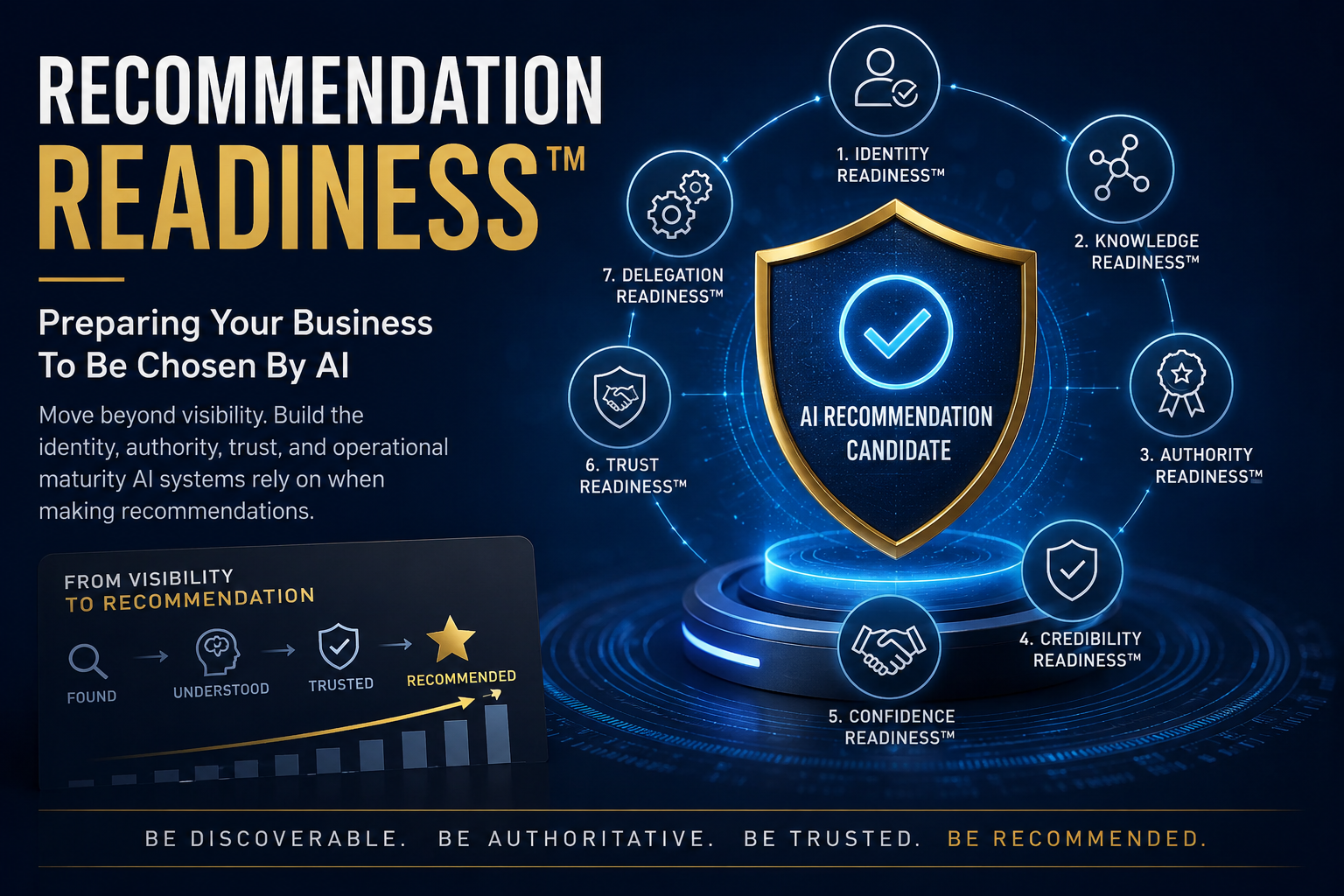
Recommendation Readiness™ is part of the TonyCWK AI Authority™ research series, which examines how organizations evolve from AI visibility to AI recommendation, confidence, trust, and ultimately delegated decision-making. Each framework builds upon the previous one as part of a progressive, evidence-based body of research rather than isolated concepts.
Introduction
For years, digital marketing has focused on one objective:
Be found.
Search engine optimization helped websites become discoverable. Content marketing increased visibility. Paid advertising expanded reach.
In the age of AI-powered search and conversational assistants, visibility remains important—but it is no longer sufficient.
Today’s AI systems increasingly answer questions directly, compare alternatives, recommend products and services, and influence purchasing decisions before users ever visit a website.
This creates a new challenge.
Can AI confidently recommend your organization when it matters?
That question introduces a new concept:
Recommendation Readiness™
Recommendation Readiness™ measures how prepared an organization is to become a reliable recommendation candidate within AI-driven discovery and decision-support systems.
It is the operational state that exists before recommendation occurs.
Just as cybersecurity organizations assess security readiness before responding to attacks, businesses should evaluate recommendation readiness before expecting AI systems to recommend them consistently.
Visibility Does Not Equal Recommendation
Many organizations assume that ranking well automatically leads to AI recommendations.
That assumption is becoming increasingly inaccurate.
Consider the progression:
- Visibility means AI can find you.
- Understanding means AI knows what you do.
- Authority means AI recognizes expertise.
- Recommendation means AI is willing to surface you as a suitable answer.
Between authority and recommendation lies preparation.
That preparation is Recommendation Readiness™.
Without readiness, even authoritative organizations may be inconsistently recommended because important signals remain incomplete or contradictory.
What Recommendation Readiness™ Really Means
Recommendation Readiness™ is the degree to which an organization’s digital ecosystem provides sufficient evidence for AI systems to confidently evaluate it as an appropriate recommendation.
It is not a single ranking factor.
Instead, it represents the combined strength of multiple trust-building components working together.
Examples include:
- Consistent entity identity
- Structured knowledge architecture
- Topical expertise
- Third-party validation
- Citation quality
- Content completeness
- Business credibility
- Freshness
- Experience signals
- Semantic relationships
Recommendation Readiness™ asks one simple question:
“If an AI had to recommend only three organizations, would yours confidently qualify?”
The Seven Pillars of Recommendation Readiness™
1. Identity Readiness™
AI must first understand exactly who you are.
This includes:
- consistent business identity
- entity reconciliation
- author identity
- organizational relationships
- brand consistency across platforms
Without identity clarity, recommendation confidence decreases.
2. Knowledge Readiness™
AI needs structured knowledge rather than isolated webpages.
This requires:
- topic clusters
- semantic relationships
- structured data
- internal knowledge architecture
- comprehensive content coverage
Organizations become easier for AI to understand as complete knowledge ecosystems.
3. Authority Readiness™
Expertise must be demonstrated consistently.
Signals include:
- original research
- educational content
- expert insights
- specialized knowledge
- subject depth
Authority provides evidence that recommendations are deserved rather than merely visible.
4. Credibility Readiness™
AI increasingly evaluates external validation.
Examples include:
- citations
- reputable mentions
- reviews
- partnerships
- awards
- independent recognition
Third-party evidence strengthens recommendation confidence.
5. Confidence Readiness™
Confidence develops through repeated consistency.
Important factors include:
- accurate information
- reliable updates
- factual consistency
- stable messaging
- predictable expertise
Confidence is accumulated rather than declared.
6. Trust Readiness™
Trust extends beyond information quality.
Organizations must demonstrate:
- transparency
- accountability
- governance
- security
- privacy
- ethical practices
As AI systems become more agentic, these factors become increasingly influential.
7. Delegation Readiness™
Future AI systems will increasingly perform actions rather than simply recommend.
Organizations should prepare for:
- machine-readable policies
- verified identities
- transactional trust
- structured product information
- service reliability
- operational transparency
Delegation Readiness™ prepares organizations for AI-assisted purchasing and autonomous transactions.
Recommendation Readiness™ Is Not An SEO Checklist
Traditional SEO often asks:
“Can Google crawl this page?”
Recommendation Readiness™ asks a much broader question:
“Would multiple AI systems independently reach the conclusion that this organization deserves to be recommended?”
That distinction changes optimization priorities.
Rather than optimizing isolated pages, organizations begin optimizing the entire evidence ecosystem that supports AI decision-making.
How Recommendation Readiness™ Fits Within The TonyCWK AI Authority™ Progression
Recommendation Readiness™ is not an isolated framework.
It naturally extends the progression developed throughout the TonyCWK AI Authority™ research series.
The evolution follows this sequence:
- AI Search Visibility™ — Become discoverable.
- AI Discovery Strategy™ — Improve discoverability across AI ecosystems.
- AI Authority Pyramid™ — Build recognized expertise.
- AI Trust Systems™ — Strengthen confidence through governance and credibility.
- Recommendation Readiness™ — Prepare to become a recommendation candidate.
- Recommendation Confidence™ — Increase the likelihood of repeated recommendations.
- Delegation Confidence™ — Enable AI agents to act with greater certainty.
- Agentic Commerce Readiness™ — Support autonomous decision-making and transactions.
Each stage builds upon the previous one, forming a cumulative model rather than disconnected marketing tactics.
Why Recommendation Readiness™ Matters
AI is steadily shifting from retrieving information to evaluating choices.
In this environment:
- websites become evidence sources
- entities become decision candidates
- authority becomes comparative evaluation
- trust becomes recommendation confidence
Organizations that proactively improve Recommendation Readiness™ are better positioned for this shift because they optimize not only for discoverability, but also for AI selection.
The future competitive advantage will belong to businesses that are prepared before recommendations are made.
Final Thoughts
The future of AI visibility is not simply about appearing in search results.
It is about becoming recommendation-ready.
Recommendation Readiness™ provides a practical way to evaluate whether your organization has developed the identity, knowledge, authority, credibility, confidence, trust, and operational maturity that AI systems increasingly rely upon when making recommendations.
Visibility may introduce your business.
Authority may qualify it.
But Recommendation Readiness™ determines whether your organization is truly prepared to be chosen.
As AI evolves from answering questions to supporting—and eventually making—decisions, preparation will become as important as presence.
Because in the next generation of AI search, being found is only the beginning. Being recommendation-ready is what truly matters.
FAQ
1. What is Recommendation Readiness™?
Recommendation Readiness™ is the degree to which an organization is prepared to be confidently recommended by AI systems. It evaluates whether the business has enough identity clarity, knowledge depth, authority, credibility, confidence, trust, and operational readiness to become a reliable recommendation candidate.
2. Is Recommendation Readiness™ the same as SEO?
No. SEO focuses mainly on discoverability, crawlability, rankings, and search visibility. Recommendation Readiness™ goes further by asking whether AI systems have enough evidence to evaluate, compare, and recommend an organization.
3. Why does Recommendation Readiness™ matter in AI search?
AI search is moving from retrieving information to supporting decisions. This means businesses must prepare not only to be found, but also to be selected, trusted, and recommended in AI-generated answers.
4. What are the main pillars of Recommendation Readiness™?
The seven pillars are Identity Readiness™, Knowledge Readiness™, Authority Readiness™, Credibility Readiness™, Confidence Readiness™, Trust Readiness™, and Delegation Readiness™.
5. How can a business improve Recommendation Readiness™?
A business can improve Recommendation Readiness™ by clarifying its entity identity, building structured knowledge, publishing expert content, strengthening third-party credibility, maintaining consistent information, demonstrating trust signals, and preparing machine-readable business data.
6. Does Recommendation Readiness™ guarantee AI recommendations?
No. Recommendation Readiness™ does not guarantee selection by AI systems. It improves the conditions that make recommendation more likely by reducing ambiguity and strengthening the evidence AI systems can use.
7. How does Recommendation Readiness™ fit into AI Authority™?
Recommendation Readiness™ fits between AI Trust Systems™ and Recommendation Confidence™. It prepares an organization to become a stronger recommendation candidate before repeated AI selection can occur.
Leave a Reply