
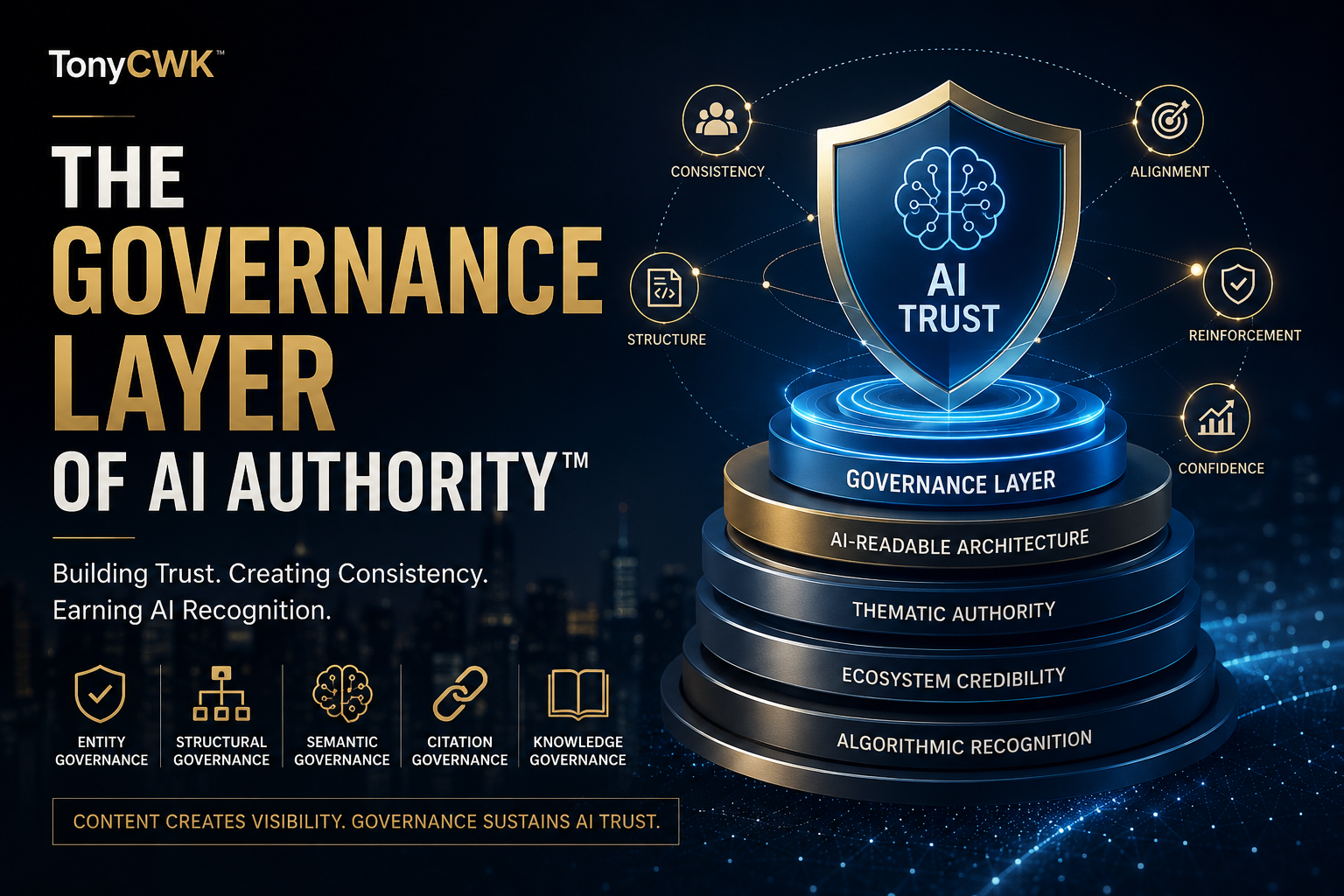
Why AI Trust Is No Longer Built Through Content Alone
For years, digital marketing rewarded visibility through volume.
More content.
More keywords.
More backlinks.
More campaigns.
But the rise of generative AI is quietly changing the architecture of visibility itself.
In the age of AI-driven discovery, recommendation engines, retrieval systems, and conversational search, content alone is no longer the primary competitive advantage.
Because AI systems do not merely evaluate pages.
They evaluate ecosystems.
This is the emerging reality many organizations still fail to recognize:
AI trust is increasingly governed through structural coherence, machine-readable consistency, entity alignment, and digital ecosystem integrity.
And this introduces a new strategic layer:
The Governance Layer of AI Authority™
The Shift From Content Competition to Ecosystem Evaluation
Traditional SEO largely focused on optimizing isolated assets.
A page ranked based on:
- keyword relevance
- backlinks
- topical optimization
- engagement signals
- crawlability
But AI systems operate differently.
Modern AI retrieval systems increasingly evaluate:
- cross-platform consistency
- entity reinforcement
- semantic stability
- source alignment
- citation coherence
- contextual trustworthiness
- structured machine interpretability
This means AI systems are no longer only asking:
“Is this content relevant?”
They are increasingly asking:
“Is this ecosystem consistently trustworthy?”
That distinction changes everything.
Because fragmented ecosystems create uncertainty.
And uncertainty weakens retrieval confidence.
What Is the Governance Layer of AI Authority™?
The Governance Layer of AI Authority™ refers to the systems, structures, and operational consistency mechanisms that help AI systems interpret, validate, trust, and reinforce a digital entity over time.
It is the layer responsible for maintaining:
- machine-readable coherence
- structural consistency
- entity alignment
- semantic continuity
- citation integrity
- ecosystem stability
In simpler terms:
Content may create visibility.
But governance sustains AI trust.
Why Governance Matters in AI Discovery
AI systems increasingly rely on probabilistic trust evaluation.
They attempt to determine:
- whether information is reliable
- whether an entity is authoritative
- whether signals are consistent across environments
- whether a brand can be confidently recommended
This is critical because AI systems must compress enormous information spaces into concise recommendations.
And recommendation systems inherently prioritize confidence.
The higher the interpretive confidence:
- the higher the likelihood of retrieval
- the higher the likelihood of citation
- the higher the likelihood of recommendation
- the higher the likelihood of repeated selection
This is why governance becomes strategically important.
Because poorly governed ecosystems generate interpretive friction.
The Problem With Fragmented Digital Ecosystems
Many organizations unknowingly create AI trust instability through fragmentation.
Examples include:
- inconsistent brand positioning across platforms
- conflicting service descriptions
- outdated schema structures
- broken internal linking systems
- disconnected content clusters
- inconsistent author attribution
- weak entity reinforcement
- duplicated semantic narratives
- scattered citation references
- contradictory topical relationships
Humans may overlook these inconsistencies.
AI systems often do not.
Because machine interpretation depends heavily on pattern consistency.
And inconsistency reduces certainty.
The Five Core Pillars of the Governance Layer
1. Entity Governance
AI systems increasingly rely on entity recognition.
This means your brand must exist as:
- a coherent digital entity
- a consistently reinforced knowledge object
- a stable semantic identity
Entity governance includes:
- consistent naming conventions
- aligned author identity
- unified organization references
- semantic consistency across platforms
- stable topical positioning
Without strong entity governance, AI systems may struggle to confidently associate authority signals together.
2. Structural Governance
AI systems require interpretable architecture.
This includes:
- logical content hierarchy
- structured internal linking
- schema consistency
- crawlable architecture
- semantic organization
- machine-readable formatting
Structure influences:
- retrievability
- contextual understanding
- topic relationships
- AI extraction efficiency
In the AI era, architecture itself becomes part of visibility.
3. Semantic Governance
Semantic governance ensures conceptual consistency across the ecosystem.
This includes:
- stable terminology
- reinforced thematic relationships
- aligned conceptual framing
- contextual continuity
- semantic precision
If one article positions a company as a “digital agency,” another as an “AI consultancy,” and another as a “marketing automation provider,” AI systems may reduce interpretive confidence.
Governance aligns semantic identity.
4. Citation Governance
AI systems increasingly rely on reinforcement patterns.
This includes:
- citations
- mentions
- references
- external corroboration
- contextual reinforcement
Citation governance ensures:
- references remain aligned
- authority signals compound coherently
- trust pathways strengthen over time
Future AI visibility may depend less on isolated mentions and more on cumulative citation coherence.
5. Knowledge Governance
AI systems increasingly favor structured knowledge environments.
This includes:
- evergreen authority systems
- organized topic clusters
- retrieval-friendly frameworks
- interconnected educational structures
- durable knowledge architecture
Knowledge governance transforms content from isolated assets into interpretable systems.
And systems scale better than pages.
Why Governance Will Become a Competitive Moat
Most brands are still optimizing for publication.
But future AI competition may increasingly reward:
- ecosystem stability
- interpretive consistency
- semantic reliability
- retrieval confidence
- citation durability
This creates a powerful asymmetry.
Because publishing more content is relatively easy.
Maintaining a highly coherent digital ecosystem at scale is not.
Governance therefore becomes a strategic moat.
The Emerging AI Trust Equation
In traditional search:
- visibility was often driven by discoverability
In AI systems:
- visibility increasingly depends on interpretability
And interpretability depends on governance.
This creates a new equation:
AI Authority = Content + Trust + Governance
Without governance:
- trust becomes unstable
Without trust:
- recommendations weaken
Without recommendation confidence:
- visibility compounds more slowly
Governance and the Future of AI Recommendation Systems
The future of AI discovery may increasingly depend on:
- confidence scoring
- retrieval certainty
- contextual consistency
- source reliability
- reinforcement stability
This means AI systems may progressively favor:
- coherent ecosystems
- stable entities
- semantically aligned structures
- reinforced knowledge networks
Not merely high-volume publishers.
This is why many organizations may eventually discover:
Their biggest AI visibility problem was never content quantity.
It was ecosystem inconsistency.
The Governance Layer and AI Authority Pyramid™
Within the broader AI Authority Pyramid™, the Governance Layer acts as a cross-layer stabilizer.
It strengthens:
- Authority Content Foundations
- AI-Readable Knowledge Architecture
- Thematic Authority Development
- Ecosystem Credibility Signals
- Algorithmic Authority Recognition
Governance is therefore not a separate optimization tactic.
It is the operational infrastructure that allows authority to persist.
Why Governance Will Matter More Over Time
As AI systems evolve:
- retrieval becomes more contextual
- recommendations become more selective
- ranking becomes less deterministic
- AI memory becomes more relational
- trust evaluation becomes more probabilistic
This means inconsistencies that were previously ignored may become increasingly costly.
Because future AI systems may not simply retrieve information.
They may continuously evaluate ecosystem reliability.
And governance directly affects that evaluation.
The Future Belongs to Governed Ecosystems
The AI era is shifting digital competition from:
- isolated optimization
toward:
The winners may not be:
- the brands that publish the most
- the brands that generate the most traffic
- the brands that produce the most content
The winners may increasingly become:
- the brands whose ecosystems remain the most coherent
- the entities that AI systems interpret most confidently
- the organizations that sustain machine-readable trust over time
Because in the age of AI discovery:
Visibility is no longer only earned through publishing.
It is sustained through governance.
Final Thought
Most organizations still believe AI visibility is primarily a content problem.
But the future may reveal something deeper:
AI systems do not merely rank information.
They evaluate the integrity of entire digital ecosystems.
And as AI recommendation systems become more sophisticated, governance may evolve into one of the most important invisible layers of competitive authority.
Because the future of AI visibility may not belong to the loudest publishers.
It may belong to the most governable ecosystems.
FAQ: The Governance Layer of AI Authority™
1. What is the Governance Layer of AI Authority™?
The Governance Layer of AI Authority™ refers to the systems, structures, and consistency mechanisms that help AI systems interpret, validate, and trust a brand’s digital ecosystem over time.
2. Why does governance matter in AI Authority?
Governance matters because AI systems do not evaluate content in isolation. They increasingly interpret patterns across websites, profiles, schema, citations, author signals, and external references.
3. Is AI Authority only about publishing more content?
No. Content is important, but AI Authority also depends on consistency, structure, entity clarity, citation reliability, and machine-readable trust signals.
4. What is digital ecosystem governance?
Digital ecosystem governance is the practice of keeping a brand’s online presence consistent, structured, updated, and semantically aligned across all major digital touchpoints.
5. How does poor governance affect AI visibility?
Poor governance can create conflicting signals, reduce interpretive confidence, weaken entity recognition, and make it harder for AI systems to retrieve or recommend a brand confidently.
6. What are examples of weak governance?
Examples include inconsistent brand descriptions, outdated schema, broken internal links, duplicate positioning, unclear author identity, weak content hierarchy, and conflicting service pages.
7. How is governance different from SEO?
SEO focuses mainly on discoverability and search performance. Governance focuses on maintaining digital coherence so that both search engines and AI systems can interpret a brand reliably.
8. Does schema markup play a role in governance?
Yes. Schema markup helps provide structured machine-readable information about entities, authors, organizations, articles, FAQs, products, and services.
9. What is entity governance?
Entity governance ensures that a brand, person, organization, or topic is represented consistently across digital platforms, content assets, metadata, and structured data.
10. What is semantic governance?
Semantic governance ensures that terminology, topic relationships, positioning, and conceptual framing remain consistent across a brand’s content ecosystem.
11. What is citation governance?
Citation governance refers to managing how a brand is referenced, mentioned, linked, or cited across external sources so that authority signals remain coherent and trustworthy.
12. Why do AI systems prefer consistency?
AI systems rely on patterns to interpret credibility. Consistent signals reduce ambiguity and increase the likelihood that a brand will be understood, retrieved, cited, or recommended.
13. Can governance improve AI recommendations?
Governance can support stronger AI recommendations by improving entity clarity, reducing conflicting signals, and strengthening the trust structure around a brand.
14. Is governance important for small businesses?
Yes. Small businesses can benefit greatly from governance because consistent positioning and structured digital signals can help AI systems understand them more clearly.
15. What are the main pillars of the Governance Layer?
The main pillars include entity governance, structural governance, semantic governance, citation governance, and knowledge governance.
16. How does internal linking support governance?
Internal linking helps connect related topics, clarify content hierarchy, reinforce authority clusters, and guide both users and machines through a structured knowledge ecosystem.
17. How often should governance be reviewed?
Governance should be reviewed regularly, especially after major website changes, rebranding, new service launches, content updates, schema edits, or platform profile changes.
18. Can AI Authority decline without governance?
Yes. Even strong content can lose effectiveness if the surrounding ecosystem becomes inconsistent, outdated, fragmented, or difficult for AI systems to interpret.
19. What is the relationship between governance and trust?
Governance strengthens trust by making a brand’s digital signals more stable, coherent, verifiable, and machine-readable across time.
20. What is the future of AI Authority governance?
The future of AI Authority governance will likely involve stronger entity management, structured knowledge systems, citation monitoring, semantic consistency, and AI visibility measurement.
Suggested Further Reading
- The AI Authority Pyramid™
- The AI Discovery Flywheel™
- Citation Engineering™
- The AI Citation Layer™
- Why AI Doesn’t Trust Content — It Trusts Systems
- Entity Persistence in the Age of LLMs
- How AI Systems Build Trust
- Algorithmic Authority Recognition
- The New Visibility Model: Why Being Found Is No Longer Enough in the Age of AI
Written by Tony Chan (TonyCWK)
AI Authority & Digital Strategy Researcher
Leave a Reply