
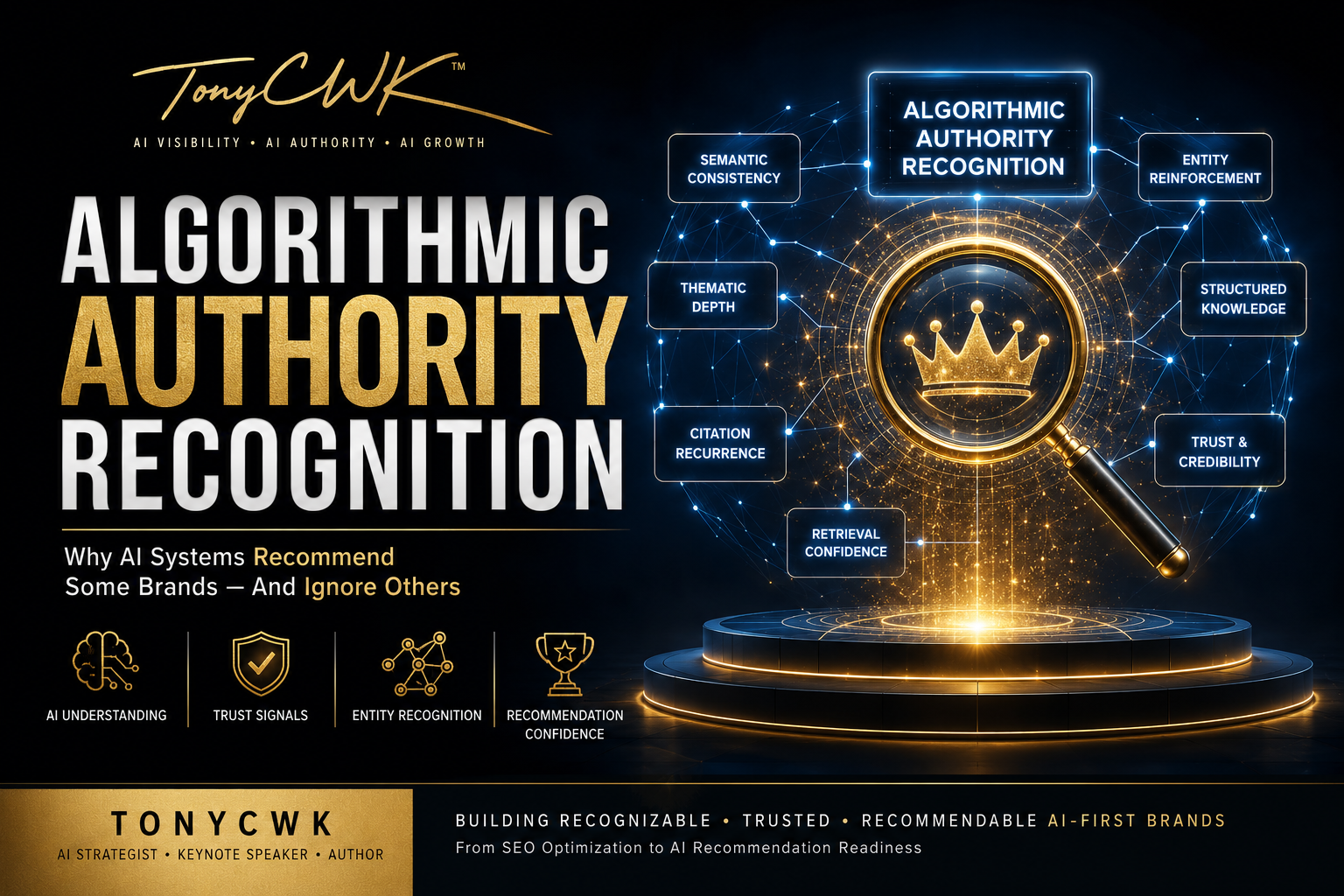
Why AI Systems Recommend Some Brands — And Ignore Others
By TonyCWK
Introduction
For years, digital visibility was largely determined by rankings.
If a webpage ranked highly on search engines, it received traffic.
If a brand produced enough optimized content, it became discoverable.
But the age of AI is changing the visibility equation entirely.
Modern AI systems are no longer simply retrieving information.
They are evaluating, filtering, prioritizing, compressing, summarizing, and recommending.
This shift introduces a new strategic reality:
Visibility is no longer only about discoverability.
It is increasingly about algorithmic recognition.
In the emerging AI ecosystem, brands are not merely indexed.
They are interpreted.
AI systems now attempt to determine:
- Which entities are trustworthy
- Which sources are consistently reliable
- Which brands demonstrate thematic depth
- Which organizations possess semantic coherence
- Which content ecosystems are structurally extractable
- Which entities deserve recommendation confidence
This emerging process can be described as:
Algorithmic Authority Recognition™
Algorithmic Authority Recognition is the process by which AI systems identify, validate, prioritize, and repeatedly select entities that demonstrate sustained authority signals across the digital ecosystem.
This is one of the most important strategic shifts in the future of digital marketing.
Because in AI-driven environments:
Being visible is no longer enough.
You must become algorithmically recognizable.
What Is Algorithmic Authority Recognition?
Algorithmic Authority Recognition refers to the way AI systems progressively identify certain brands, people, organizations, or knowledge ecosystems as authoritative entities worthy of recommendation.
Unlike traditional SEO ranking systems, this process is not solely based on:
- backlinks
- keyword density
- metadata optimization
- ranking signals
- page-level optimization
Instead, AI systems evaluate:
- semantic consistency
- contextual trust
- entity relationships
- thematic specialization
- structured knowledge architecture
- ecosystem-wide reinforcement
- citation recurrence
- retrieval confidence
- extractable clarity
The result is not merely ranking.
The result is recognition.
And recognition changes everything.
The Shift From Ranking Systems to Recognition Systems
Traditional search engines primarily answered:
“Which webpage is most relevant?”
AI systems increasingly ask:
“Which entity is most trustworthy to recommend?”
This is a fundamentally different paradigm.
| Traditional SEO | AI Authority Recognition |
|---|---|
| Rank pages | Recognize entities |
| Optimize keywords | Evaluate semantic meaning |
| Focus on discoverability | Focus on recommendation confidence |
| Reward page relevance | Reward ecosystem coherence |
| Page-level competition | Entity-level evaluation |
| Click-driven | Selection-driven |
| Traffic visibility | Recommendation visibility |
This transition represents one of the biggest transformations in digital marketing history.
Why AI Systems Need Authority Recognition
AI systems operate differently from traditional search engines.
Search engines mainly organize webpages.
AI systems must generate responses.
To generate reliable answers, AI systems require:
- confidence
- consistency
- compressed understanding
- probabilistic trust
- semantic reliability
This creates a massive challenge.
The internet contains:
- misinformation
- duplicated content
- shallow AI-generated pages
- contradictory narratives
- low-trust affiliate ecosystems
- fragmented expertise
AI systems therefore need mechanisms to determine:
“Which sources deserve higher recommendation confidence?”
This is where Algorithmic Authority Recognition becomes critical.
The Core Signals Behind Algorithmic Authority Recognition
AI systems likely evaluate authority using multiple overlapping layers of signals.
1. Semantic Consistency
Strong authority ecosystems maintain:
- consistent messaging
- stable positioning
- aligned terminology
- recurring conceptual structures
When AI systems repeatedly encounter coherent narratives across multiple content assets, trust increases.
For example:
If a brand consistently publishes content around:
- AI Authority
- AI Discovery
- Retrieval Confidence
- Selection Systems
- Algorithmic Trust
…AI systems begin associating the entity with that thematic domain.
Consistency becomes recognizability.
2. Thematic Depth
AI systems increasingly value:
- topic ecosystems
- content clusters
- layered expertise
- interconnected frameworks
One shallow article rarely establishes authority.
But a deeply connected ecosystem does.
Authority emerges when AI systems observe:
- sustained expertise
- breadth + depth
- structured topic expansion
- internal semantic reinforcement
This is why topical authority is evolving into something much larger:
AI Authority Ecosystems™
3. Entity Reinforcement Signals
AI systems rely heavily on entity relationships.
Recognition strengthens when entities repeatedly appear across:
- websites
- social platforms
- podcasts
- interviews
- citations
- industry mentions
- structured profiles
- business listings
- knowledge graphs
The more an entity consistently exists across the ecosystem, the stronger its recognition potential becomes.
This is why fragmented branding weakens AI recognition.
4. Retrieval Confidence
AI systems must determine whether information can be safely retrieved and synthesized.
This depends on:
- structural clarity
- information hierarchy
- semantic organization
- low ambiguity
- high contextual alignment
Entities with clearer knowledge structures become easier for AI systems to interpret.
And easier interpretation increases recommendation likelihood.
5. Citation Recurrence
Repeated mentions matter.
If an entity consistently appears across:
- trusted sources
- discussions
- references
- summaries
- educational content
- industry conversations
…AI systems gain reinforcement confidence.
Repeated retrieval becomes a trust amplifier.
Why Traditional SEO Alone Is No Longer Enough
SEO remains important.
But SEO alone is increasingly insufficient.
Because AI systems do not simply retrieve pages anymore.
They synthesize knowledge.
This means brands must optimize for:
- extractability
- semantic coherence
- entity persistence
- recommendation probability
- machine interpretability
- ecosystem-wide trust
The future belongs to brands that become:
Recognizable systems of authority.
Not isolated content producers.
The Rise of Selectability™
In AI-driven environments, visibility increasingly depends on whether a brand becomes selectable.
Selectability™ refers to the likelihood that AI systems choose an entity during answer generation and recommendation processes.
This is different from ranking.
A brand may rank highly yet still not be selected by AI systems.
Why?
Because ranking visibility does not automatically equal recommendation trust.
Selection depends on:
- authority recognition
- contextual trust
- semantic clarity
- ecosystem consistency
- retrieval confidence
- recommendation suitability
This is the future of digital visibility.
Algorithmic Recognition Is a Compounding Advantage
One of the most important aspects of Algorithmic Authority Recognition is compounding reinforcement.
When AI systems repeatedly retrieve and reference an entity:
- confidence increases
- familiarity strengthens
- recommendation probability grows
- retrieval frequency rises
- ecosystem reinforcement expands
This creates a flywheel effect.
The recognized become increasingly recognizable.
And over time:
Recognition compounds faster than traffic.
Why SMEs May Benefit More Than Large Corporations
Interestingly, the AI era may reduce some traditional advantages held by large enterprises.
Large corporations often suffer from:
- fragmented messaging
- disconnected departments
- diluted positioning
- inconsistent expertise
- slow content coordination
Smaller businesses can sometimes outperform larger brands through:
- sharper thematic focus
- clearer positioning
- tighter semantic consistency
- faster ecosystem alignment
- niche authority specialization
In AI recommendation systems:
clarity often beats scale.
The Future of Digital Marketing
The future of marketing is no longer just about:
- generating impressions
- driving clicks
- maximizing rankings
- publishing more content
Instead, the future revolves around:
- becoming recognizable
- becoming trusted
- becoming extractable
- becoming selectable
- becoming recommendable
This marks the transition from:
Attention Economy
to
Recommendation Economy
And within this new environment:
Algorithmic Authority Recognition becomes a strategic survival layer.
The TonyCWK Perspective
At TonyCWK, Algorithmic Authority Recognition is viewed as one of the foundational pillars of future AI visibility strategy.
This concept connects directly with:
- AI Authority™
- AI Discovery
- Retrieval Confidence™
- AI Selection Systems™
- Selectability™
- Entity Persistence
- Recommendation Visibility
- Semantic Ecosystem Design
Together, these form part of a larger transition:
From SEO optimization
to AI recommendation readiness.
Final Thoughts
The internet is entering a new era.
An era where AI systems increasingly decide:
- what gets surfaced
- what gets summarized
- what gets cited
- what gets recommended
- what gets trusted
This means future visibility will no longer depend solely on being searchable.
It will depend on being algorithmically recognizable.
The brands that succeed in the AI era will not simply create more content.
They will build:
- coherent authority systems
- semantically aligned ecosystems
- structurally extractable knowledge
- recommendation-ready entities
Because in the future of AI-driven discovery:
The winners will not merely be ranked.
They will be recognized.
FAQ for “Algorithmic Authority Recognition”
1. What is Algorithmic Authority Recognition?
Algorithmic Authority Recognition is the process by which AI systems identify, validate, and prioritize trusted entities that consistently demonstrate authority across content, structure, citations, and digital credibility signals.
2. Why is Algorithmic Authority Recognition important?
It matters because AI systems are moving beyond ranking webpages. They increasingly decide which brands, sources, and entities are trustworthy enough to recommend.
3. How is Algorithmic Authority Recognition different from SEO?
SEO focuses mainly on search visibility and rankings. Algorithmic Authority Recognition focuses on whether AI systems understand, trust, and select an entity during answer generation.
4. Does Algorithmic Authority Recognition replace SEO?
No. SEO remains important, but it is no longer enough by itself. Brands must also build semantic clarity, entity trust, content depth, and AI-readable authority signals.
5. What signals influence Algorithmic Authority Recognition?
Key signals include semantic consistency, topical depth, structured content, credible mentions, entity reinforcement, citation recurrence, and retrieval confidence.
6. Why do AI systems need authority recognition?
AI systems need authority recognition because they must decide which sources are reliable enough to summarize, cite, or recommend in generated answers.
7. What is the role of semantic consistency?
Semantic consistency helps AI systems understand what a brand is about. When messaging, terminology, and expertise remain consistent, recognition becomes stronger.
8. What is retrieval confidence?
Retrieval confidence refers to how easily and reliably AI systems can retrieve, understand, and use information from a brand or content ecosystem.
9. How does thematic depth affect AI Authority?
Thematic depth shows sustained expertise. A connected ecosystem of related articles, frameworks, FAQs, and structured content helps AI systems recognize authority more confidently.
10. What is entity reinforcement?
Entity reinforcement happens when a person, brand, or organization is consistently mentioned across trusted platforms, profiles, articles, citations, and external references.
11. Can small businesses benefit from Algorithmic Authority Recognition?
Yes. Small businesses can benefit if they build focused, consistent, and well-structured authority around a specific niche or expertise area.
12. Why is content structure important for AI recognition?
Structured content makes it easier for AI systems to extract, interpret, summarize, and connect information accurately.
13. What is the connection between Algorithmic Authority Recognition and AI Authority?
Algorithmic Authority Recognition is one mechanism through which AI Authority is built. It explains how AI systems may recognize certain entities as more trustworthy and recommendable.
14. How does this affect digital marketing?
Digital marketing must evolve from traffic acquisition to authority building. Future success depends on whether brands are discoverable, trusted, and selectable by AI systems.
15. What does “selectability” mean in this context?
Selectability refers to the likelihood that an AI system chooses a brand, source, or entity when generating answers or recommendations.
16. Can a brand rank well but still not be selected by AI?
Yes. A page may rank in search results but still lack the authority, clarity, or trust signals needed for AI systems to recommend it.
17. How can brands improve Algorithmic Authority Recognition?
Brands can improve it by publishing authoritative content, building topic clusters, using structured data, maintaining consistent messaging, earning credible mentions, and strengthening entity signals.
18. Is Algorithmic Authority Recognition measurable?
It can be measured indirectly through AI visibility checks, citation frequency, branded mention consistency, search presence, knowledge graph signals, and AI-generated answer inclusion.
19. Why does authority compound in AI systems?
Authority compounds because repeated mentions, citations, and retrieval patterns can strengthen recognition over time, making a brand more likely to be selected again.
20. What is the future of Algorithmic Authority Recognition?
The future of digital visibility will increasingly depend on whether AI systems can recognize, trust, and recommend a brand as an authoritative entity.
Suggested Further Reading
1. What Is AI Authority™?
Explore how AI systems evaluate trust, expertise, and recommendation-worthiness beyond traditional SEO rankings. 👉 https://tonycwk.com/what-is-ai-authority/
2. AI Selection Systems™
Understand how modern AI engines increasingly choose which brands, entities, and sources deserve recommendation visibility. 👉 https://tonycwk.com/ai-selection-systems/
3. Retrieval Confidence™
Learn why AI systems prioritize structurally extractable and semantically reliable information ecosystems.
4. Selectability™
Discover why future digital visibility depends not only on discoverability — but on whether AI systems choose your brand during answer generation.
5. The AI Discovery Flywheel™
A strategic framework explaining how authority compounds through ecosystem reinforcement, recommendation visibility, and AI recognition. 👉 https://tonycwk.com/ai-discovery-flywheel/
6. Entity Persistence in the Age of LLMs
Explore how consistent entity signals help brands remain recognizable across AI systems and large language models. 👉 https://tonycwk.com/entity-persistence-in-the-age-of-llms/
7. Why AI Doesn’t Trust Content — It Trusts Systems
A deeper look into why AI increasingly evaluates ecosystems, semantic consistency, and credibility structures instead of isolated content pieces. 👉https://tonycwk.com/why-ai-doesnt-trust-content-it-trusts-systems/
8. Recommendation Visibility: The New Digital Battleground
Learn why the future of visibility is shifting from rankings and clicks toward AI recommendations and synthesized answers.
9. SEO Alone Is No Longer Enough
Understand why traditional SEO strategies must evolve toward AI-readable authority ecosystems and recommendation readiness. 👉 https://tonycwk.com/seo-alone-is-no-longer-enough/
10. The New Visibility Model: From Rankings to Recommendations
Explore how AI systems are transforming the mechanics of digital visibility and reshaping the future of search.
11. AI Authority Systems™
A comprehensive framework on how authority ecosystems are built for AI-native discovery and recommendation environments. 👉 https://tonycwk.com/ai-authority-systems/
12. Semantic Consistency and AI Recognition
Learn how recurring thematic structures, aligned messaging, and contextual coherence strengthen AI authority recognition.
13. AI Recommendation Systems and Digital Marketing
Explore how recommendation engines may redefine branding, discoverability, and future marketing competitiveness.
14. Why SMEs Can Outperform Large Brands in AI Discovery
Understand how focused thematic authority and semantic clarity may outperform scale in AI recommendation systems. 👉 https://tonycwk.com/why-smes-can-outperform-corporates-in-ai-discovery/
15. The Future of Search Is Recommendation, Not Retrieval
A strategic analysis of how AI systems are moving from information retrieval toward delegated decision-making and trusted recommendations.
Leave a Reply