
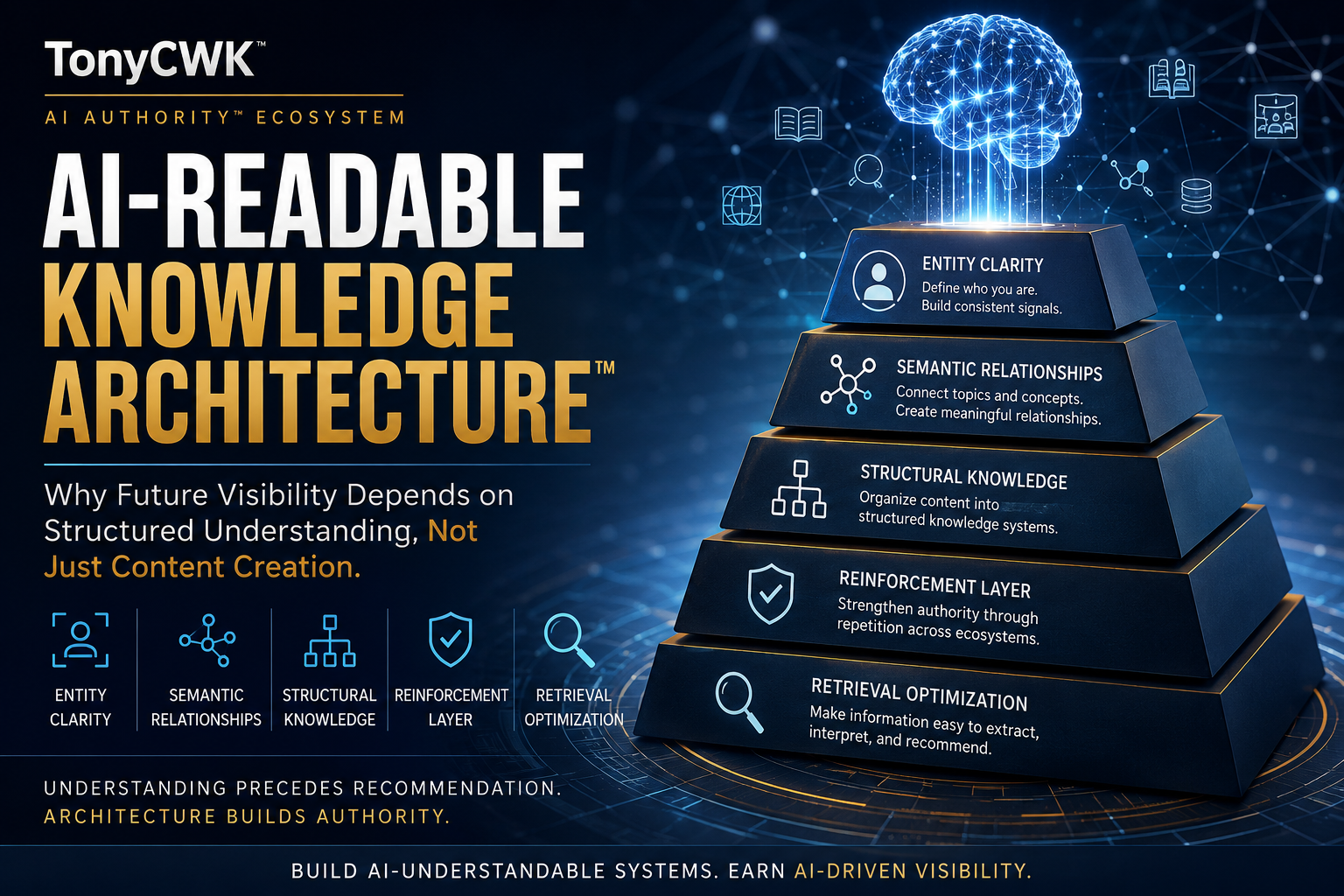
Why Future Visibility Depends on Structured Understanding, Not Just Content Creation
For over two decades, digital marketing largely revolved around one dominant objective:
getting discovered by search engines.
Brands optimized pages, inserted keywords, improved backlinks, refined technical SEO, and attempted to rank higher inside retrieval-based systems.
But the AI era is changing the architecture of discovery itself.
Today, visibility is no longer determined purely by whether search engines can crawl your website.
Increasingly, it depends on whether AI systems can:
- interpret your expertise
- understand your relationships
- recognize your authority
- connect your concepts
- retrieve your information contextually
- and confidently recommend your brand inside conversational environments
This changes everything.
Because in AI-driven discovery systems:
content alone is insufficient.
The future belongs to brands that build:
AI-Readable Knowledge Architecture™.
The Shift From Pages to Knowledge Systems
Traditional SEO primarily optimized:
- pages
- keywords
- links
- metadata
- rankings
But AI systems operate differently.
Large language models, recommendation engines, retrieval systems, and agentic search frameworks increasingly interpret the web through:
- semantic relationships
- contextual reinforcement
- entity consistency
- structured meaning
- thematic depth
- ecosystem coherence
This means AI does not merely “read” content.
AI attempts to:
understand systems of knowledge.
And that distinction is becoming one of the most important competitive shifts in digital marketing.
What Is AI-Readable Knowledge Architecture™?
AI-Readable Knowledge Architecture™ refers to the strategic structuring of digital information so AI systems can:
- interpret expertise accurately
- connect related concepts
- understand topical relationships
- identify authority signals
- retrieve information contextually
- reinforce trust across interactions
- and persistently recognize a brand within a knowledge ecosystem
It is the evolution from:
publishing information
to
engineering machine-understandable authority systems.
In traditional SEO:
content was often treated as isolated assets.
In AI discovery ecosystems:
content increasingly functions as interconnected semantic infrastructure.
Why AI Systems Require Structured Knowledge
AI systems face a massive challenge:
the internet contains overwhelming amounts of fragmented information.
To deliver useful recommendations, AI models increasingly prioritize:
- contextual clarity
- consistency
- reinforcement
- structure
- semantic relationships
- cross-source validation
This means brands with fragmented ecosystems may become:
- partially retrievable
- inconsistently interpreted
- weakly reinforced
- contextually diluted
- or semantically invisible
Meanwhile, brands with strong AI-readable architectures become easier for AI systems to:
The future competitive advantage may not come from publishing more content.
It may come from building more understandable knowledge systems.
The Five Layers of AI-Readable Knowledge Architecture™
1. Entity Clarity Layer
AI systems first need to understand:
who you are.
This includes:
- brand identity consistency
- author consistency
- business categorization
- expertise positioning
- topical specialization
- structured profile reinforcement
When entities are fragmented across platforms, AI confidence weakens.
But when signals align consistently across:
- websites
- social profiles
- interviews
- articles
- citations
- and external mentions
AI systems gain stronger retrieval confidence.
This is why entity consistency is becoming foundational to AI Authority™.
2. Semantic Relationship Layer
AI increasingly interprets knowledge through relationships between concepts.
For example:
A cybersecurity expert may consistently connect with themes like:
- Zero Trust
- SOC operations
- threat detection
- SIEM
- governance
- endpoint protection
Similarly, a digital marketing strategist may repeatedly connect with:
- AI discovery
- recommendation systems
- semantic visibility
- authority reinforcement
- trust ecosystems
The stronger and more coherent these relationships become, the easier AI systems can contextualize expertise.
This transforms isolated content into:
semantic knowledge ecosystems.
3. Structural Knowledge Layer
AI readability is heavily influenced by structure.
This includes:
- topic clustering
- internal linking
- hierarchical organization
- schema markup
- semantic headings
- contextual reinforcement
- modular information architecture
Many websites still publish disconnected articles with weak thematic cohesion.
But AI systems increasingly reward:
structured depth over isolated publication volume.
The future may favor websites designed like:
knowledge networks
rather than
content libraries.
4. Reinforcement Layer
AI confidence increases through repetition across environments.
This includes reinforcement across:
- websites
- YouTube
- podcasts
- guest articles
- citations
- interviews
- reviews
- and ecosystem mentions
When the same expertise patterns consistently appear across multiple trusted environments, AI systems strengthen confidence in those associations.
This creates:
And persistence increasingly compounds into recommendation probability.
5. Retrieval Optimization Layer
Traditional SEO optimized for rankings.
AI-readable architectures optimize for:
contextual retrieval.
This means information should be:
- extractable
- quotable
- semantically clear
- contextually complete
- modular
- structured for summarization
- and easy for AI systems to interpret accurately
The future visibility layer may depend less on:
“How high do you rank?”
And more on:
“How confidently can AI retrieve and explain your expertise?”
Why Most Brands Are Not AI-Readable Yet
Many businesses still operate with fragmented digital ecosystems.
Common problems include:
- inconsistent messaging
- disconnected topics
- weak internal linking
- shallow thematic depth
- conflicting positioning
- unclear expertise signals
- random publishing behavior
- and poor semantic reinforcement
This creates a major AI interpretation problem.
Because AI systems depend heavily on:
consistency + context + reinforcement.
Without those layers, visibility becomes unstable.
A brand may occasionally appear in AI outputs —
but fail to become persistently recommended.
The Rise of Machine-First Digital Architecture
Historically, websites were primarily designed for humans.
Now, websites increasingly need to communicate effectively to:
humans AND machines simultaneously.
This creates the rise of:
machine-first digital architecture.
Future-ready brands may increasingly optimize for:
- AI comprehension
- semantic extraction
- retrieval efficiency
- recommendation confidence
- and authority persistence
This does not replace human-centered marketing.
Instead, it adds a second strategic layer:
machine interpretability.
AI-Readable Knowledge Architecture™ and the Future of SEO
SEO is not disappearing.
But SEO is evolving.
The future may increasingly shift from:
search engine optimization
to
knowledge architecture optimization.
Traditional SEO asked:
“How do we rank higher?”
AI Authority™ asks:
“How do we become structurally understandable and contextually recommendable?”
That is a fundamentally different objective.
Because recommendation systems require deeper trust than retrieval systems.
The Competitive Advantage of Structured Authority
As AI-generated content becomes abundant, raw publishing volume loses differentiation.
Almost anyone can now generate:
- articles
- summaries
- social posts
- landing pages
- FAQs
- and basic informational content
This means future competitive advantages may increasingly come from:
- ecosystem coherence
- authority reinforcement
- semantic depth
- knowledge consistency
- contextual reliability
- and AI readability
The brands that structure knowledge effectively may become:
more retrievable,
more memorable,
more citable,
and more recommendable.
The Future Belongs to Understandable Brands
The next era of digital visibility may no longer belong solely to the loudest publishers.
It may belong to the most understandable systems.
Because AI cannot reliably recommend what it cannot confidently interpret.
And interpretation increasingly depends on:
AI-Readable Knowledge Architecture™.
The future of visibility is no longer just about producing information.
It is about engineering structured understanding.
And in the AI era:
understandability becomes authority.
Conclusion
The AI era is transforming digital marketing from a visibility game into an interpretability game.
Future-winning brands may not simply publish more.
They may instead build:
clearer,
deeper,
more reinforced,
and more machine-readable knowledge ecosystems.
Because in AI-driven discovery systems:
understanding precedes recommendation.
And recommendation increasingly defines visibility.
FAQ
1. What is AI-Readable Knowledge Architecture™?
AI-Readable Knowledge Architecture™ is the strategic structuring of digital content so AI systems can clearly understand a brand’s expertise, topics, relationships, trust signals, and authority.
2. Why is AI-readable structure important for digital marketing?
Because AI systems increasingly influence discovery, recommendations, summaries, and buying journeys. If your brand is difficult for AI to interpret, it may be less likely to appear in AI-generated answers.
3. Is AI-Readable Knowledge Architecture™ the same as SEO?
No. SEO helps search engines crawl, index, and rank content. AI-Readable Knowledge Architecture™ goes further by organizing content into structured, contextual, machine-understandable knowledge systems.
4. How does this help AI systems understand a brand?
It creates clearer entity signals, consistent topical relationships, structured content clusters, internal links, schema markup, and repeated authority signals across the digital ecosystem.
5. What are the main layers of AI-Readable Knowledge Architecture™?
The key layers are entity clarity, semantic relationships, structural knowledge, reinforcement, and retrieval optimization.
6. Can small businesses use AI-Readable Knowledge Architecture™?
Yes. Small businesses can benefit by clearly defining their expertise, building topic clusters, using consistent messaging, improving internal links, adding schema, and reinforcing authority across platforms.
7. Does AI-readable content replace human-focused content?
No. The best content serves both humans and AI systems. It should be useful, clear, trustworthy, and structured enough for machines to interpret accurately.
8. How is this connected to AI Authority™?
AI-Readable Knowledge Architecture™ supports AI Authority™ by making expertise easier to retrieve, verify, connect, and recommend inside AI-driven discovery systems.
9. What happens if a brand has poor knowledge architecture?
The brand may appear fragmented, inconsistent, or weakly understood by AI systems, reducing its chances of being cited, retrieved, or recommended.
10. What is the future of AI-readable digital strategy?
Future digital strategy will likely shift from simply creating content to building structured knowledge ecosystems that improve AI comprehension, trust, and recommendation confidence.
Suggested Reading
- The AI Authority Pyramid™
- The AI Discovery Flywheel™
- Why AI Doesn’t Trust Content — It Trusts Systems
- The Governance Layer of AI Authority™™
- Hyperlocal AI Authority™
- Decision Delegation Flow™
- AI Visibility Measurement Framework™
- The Rise of Agentic Search
Written by Tony Chan (TonyCWK)
AI Authority & Digital Strategy Researcher
Leave a Reply