
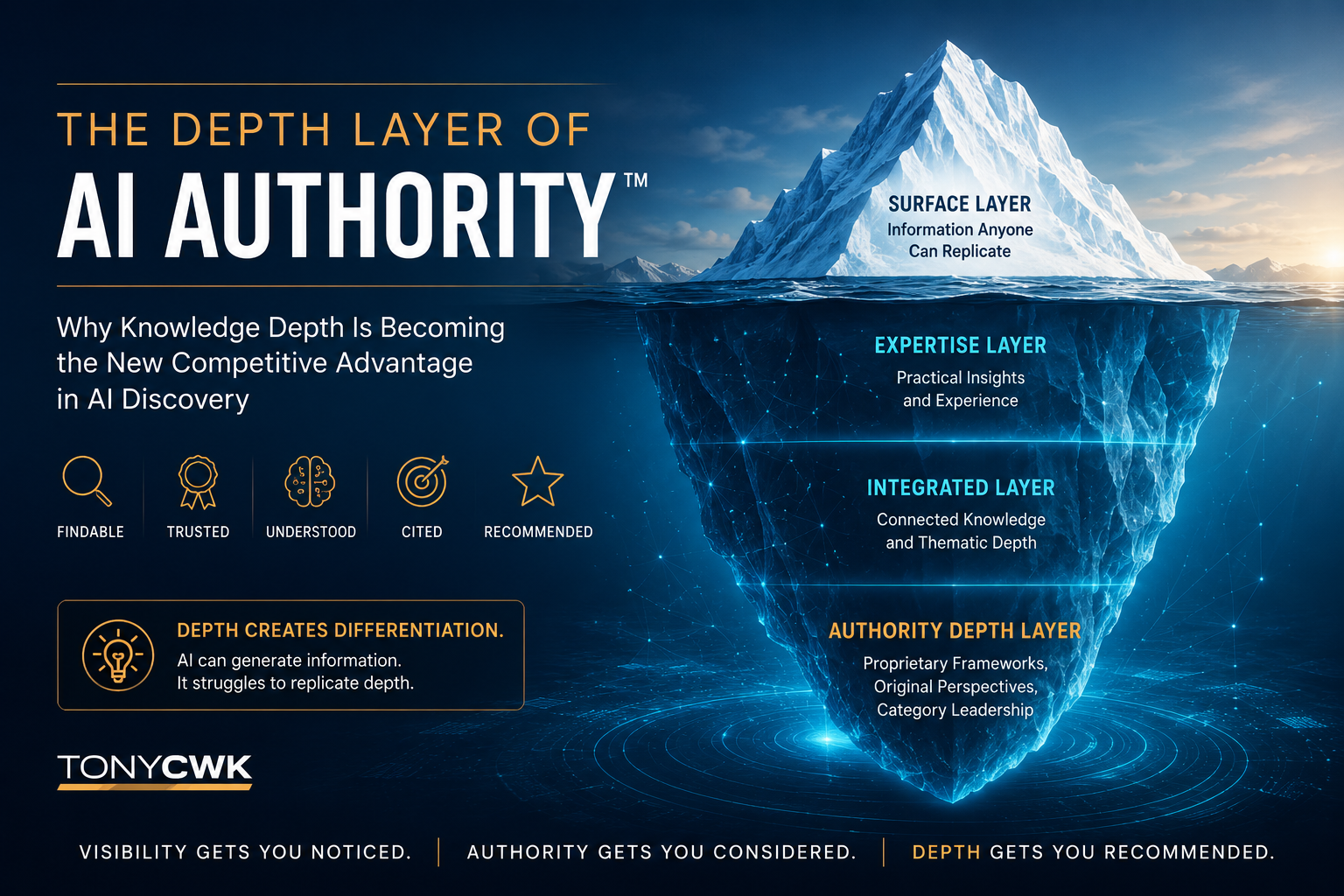
Why Knowledge Depth Is Becoming the New Competitive Advantage in AI Discovery
For more than two decades, digital visibility was largely governed by retrieval.
Search engines evaluated whether content could be:
- found
- indexed
- ranked
- clicked
This created an internet optimized for discoverability.
Brands competed to:
- rank higher
- publish more
- capture search volume
- maximize traffic acquisition
But the AI era is quietly changing the nature of visibility itself.
Because AI systems increasingly reduce the need for users to manually browse surface-level information.
Simple informational queries are becoming increasingly commoditized.
AI can now generate:
- summaries
- explanations
- definitions
- comparisons
- basic recommendations
- introductory educational content
faster than most websites can publish them.
This changes the competitive landscape fundamentally.
The future challenge may no longer be:
The more important question increasingly becomes:
“Does your knowledge ecosystem contain enough depth for AI systems to trust, cite, and recommend repeatedly?”
This is where a new strategic layer emerges:
The Depth Layer of AI Authority™
Because in the AI era:
visibility increasingly belongs to brands that develop deeper knowledge systems — not merely larger content libraries.
The Commoditization of Surface-Level Content
Traditional SEO rewarded informational accessibility.
As long as content:
- matched keywords
- satisfied search intent
- followed optimization best practices
- accumulated backlinks
it could compete effectively.
But AI systems are changing how information is consumed.
Today, users increasingly ask:
- nuanced questions
- contextual questions
- multi-variable decision questions
- comparative questions
- recommendation-oriented prompts
Instead of:
- “What is CRM?”
Users now ask:
- “What is the best CRM for a 20-person B2B company with cybersecurity compliance requirements?”
Instead of:
- “What is digital marketing?”
Users ask:
- “Which digital marketing strategies remain defensible in the age of AI-generated content?”
These are no longer simple retrieval tasks.
They are:
- contextual evaluation tasks
- decision-support tasks
- recommendation tasks
- interpretation tasks
And this changes what AI systems require from content ecosystems.
Why AI Systems Need Depth
AI systems can synthesize generic knowledge.
But they struggle with:
- originality
- contextual judgment
- experiential nuance
- strategic interpretation
- proprietary frameworks
- organizational memory
- cross-domain synthesis
This creates an important competitive divide.
Surface Content Is Replicable
AI can easily reproduce:
- definitions
- beginner guides
- generic summaries
- templated articles
- broad informational explanations
As AI-generated publishing scales globally, surface-level content becomes increasingly interchangeable.
Which means:
surface visibility alone becomes less defensible.
Depth Creates Differentiation
Depth introduces characteristics that are harder to replicate:
- layered expertise
- thematic consistency
- contextual interpretation
- strategic nuance
- proprietary methodologies
- interconnected knowledge systems
- reinforcement coherence
This is why depth increasingly becomes an AI trust signal.
Because AI systems require:
before repeatedly selecting a source.
The Four Layers of Knowledge Depth
1. Surface Knowledge Layer
This is the foundational informational layer.
Characteristics:
- definitions
- introductory guides
- generic explanations
- broad educational content
Purpose:
- accessibility
- discoverability
- indexing
- topic entry points
This layer remains important.
But it is no longer sufficient.
Because AI can increasingly generate this layer autonomously.
2. Applied Expertise Layer
This layer demonstrates practical implementation.
Characteristics:
- case studies
- frameworks
- strategic breakdowns
- implementation guides
- contextual examples
- operational insights
Purpose:
- demonstrate real-world understanding
- reinforce practical authority
- improve recommendation confidence
This layer begins separating experts from content producers.
3. Integrated Knowledge Layer
This is where content transforms into systems.
Characteristics:
- interconnected topic clusters
- semantic reinforcement
- ecosystem coherence
- structured knowledge architecture
- layered thematic expansion
Purpose:
- create retrieval consistency
- strengthen thematic authority
- reinforce entity persistence
At this level, AI systems begin understanding:
not just isolated pages,
but knowledge ecosystems.
4. Authority Depth Layer
This is the highest strategic layer.
Characteristics:
- proprietary frameworks
- original concepts
- unique methodologies
- strategic synthesis
- category-defining language
- perspective leadership
Examples:
- AI Authority™
- AI Discovery Flywheel™
- Citation Engineering™
- Decision Delegation Flow™
- Brand Depth Architecture™
This layer becomes difficult to commoditize.
Because it is not merely information.
It is intellectual infrastructure.
Why Depth Matters More in AI Search
Traditional search engines ranked pages.
AI systems increasingly evaluate:
- knowledge reliability
- ecosystem consistency
- contextual authority
- recommendation confidence
This means future visibility increasingly depends on:
- thematic depth
- interconnected expertise
- semantic coherence
- reinforcement consistency
- citation persistence
The future winners may not be:
the brands that publish the most content.
But the brands that build:
the deepest interpretable knowledge ecosystems.
The Shift From Content Quantity to Knowledge Architecture
For years, digital marketing rewarded scale.
More articles.
More keywords.
More pages.
More traffic opportunities.
But AI systems introduce a different dynamic.
Because recommendation systems require:
- trust compression
- confidence scoring
- contextual interpretation
- preference reinforcement
This means:
fragmented content ecosystems weaken AI confidence.
Deep ecosystems strengthen it.
The future competitive advantage increasingly shifts toward:
Knowledge Architecture™
Not merely content production.
The Rise of Depth-Based Selection
In the AI era, selection becomes more important than visibility alone.
Because AI interfaces increasingly mediate:
- recommendations
- comparisons
- evaluations
- discovery journeys
- decision pathways
This means brands increasingly compete not only for:
attention,
but for:
selection confidence.
And depth strongly influences selection.
Because depth improves:
- contextual understanding
- retrieval consistency
- interpretability
- recommendation reliability
- trust reinforcement
Why Small Brands Can Still Win
One of the most important implications of the AI era:
depth can outperform scale.
Large organizations often produce:
- fragmented content
- inconsistent ecosystems
- siloed knowledge
- disconnected messaging
Smaller specialized brands can sometimes outperform larger competitors by building:
- coherent expertise
- tightly integrated authority systems
- semantically reinforced frameworks
- highly contextual knowledge ecosystems
This creates a powerful strategic opportunity for SMEs.
Because AI systems increasingly reward:
clarity,
coherence,
and depth.
Not merely organizational size.
The Future of AI Authority™
The next era of digital competition may not be driven by:
who publishes the most.
But by:
who develops the deepest machine-interpretable expertise ecosystems.
This is the evolution from:
content marketing
to
knowledge architecture.
From:
visibility optimization
to:
selection optimization.
From:
information publishing
to:
authority system engineering.
Final Thought
In the AI era:
surface knowledge becomes abundant.
Depth becomes scarce.
And scarcity creates strategic value.
Because AI systems can increasingly generate information.
But they still struggle to replicate:
- intellectual depth
- strategic synthesis
- contextual interpretation
- proprietary frameworks
- experiential authority
- ecosystem coherence
The future winners may not be the brands that produce the most content.
But the brands that build the deepest trustable knowledge systems.
Because in the age of AI discovery:
Visibility gets you noticed.
Authority gets you considered.
But depth increasingly determines whether AI systems continue to recommend you.
FAQ
1. What is the Depth Layer of AI Authority™?
The Depth Layer of AI Authority™ refers to the strategic level where a brand moves beyond surface-level content and builds a deeper, more trusted knowledge ecosystem that AI systems can understand, retrieve, cite, and recommend.
2. Why is content depth becoming more important in AI search?
Content depth matters because AI systems can already summarize basic information. What becomes more valuable is original insight, expert interpretation, proprietary frameworks, case studies, and structured knowledge that helps AI systems form stronger recommendation confidence.
3. Does this mean traditional SEO is no longer useful?
No. SEO is still important because content must remain crawlable, indexable, structured, and discoverable. However, SEO alone is no longer enough. Brands increasingly need deeper authority signals that go beyond keyword optimization.
4. What is the difference between content quantity and knowledge depth?
Content quantity focuses on publishing more pages. Knowledge depth focuses on building stronger expertise, better structure, clearer topical relationships, practical examples, and original frameworks that reinforce authority across a subject area.
5. How can small businesses build the Depth Layer of AI Authority™?
Small businesses can build depth by publishing practical guides, case studies, expert insights, FAQs, comparison pages, service-specific explanations, customer problem breakdowns, and structured content clusters around their core expertise.
6. Why does AI prefer deeper knowledge ecosystems?
AI systems need confidence when generating recommendations. A deeper knowledge ecosystem gives AI more contextual signals, stronger semantic relationships, and clearer evidence that a brand understands a topic beyond surface-level explanation.
7. What type of content supports depth-based AI authority?
Strong examples include original frameworks, industry analysis, implementation guides, case studies, expert commentaries, comparison articles, FAQs, glossaries, research-backed insights, and interconnected pillar pages.
8. Is the Depth Layer of AI Authority™ relevant for Singapore SMEs?
Yes. Singapore SMEs can use depth to compete against larger brands by building clear, localized, expert-driven knowledge ecosystems around their services, industry, audience, and customer decision journeys.
9. How does depth affect AI recommendations?
Depth improves the chance that AI systems can understand a brand’s expertise, retrieve its content in relevant contexts, and treat it as a more reliable source when forming answers or recommendations.
10. What is the main takeaway from the Depth Layer of AI Authority™?
The main takeaway is that AI visibility is increasingly shaped by knowledge depth, not just content volume. Brands that build deeper, more coherent, and more trusted knowledge systems may become more selectable in AI-driven discovery.
Suggested Reading
- The Governance Layer of AI Authority™
- Citation Engineering™
- The AI Citation Layer™
- Why AI Doesn’t Trust Content — It Trusts Systems
- AI Authority Metrics: How to Measure Selection, Not Just Traffic
- How Search Has Evolved in the Age of AI — From Rankings to Recommendations
- The Rise of Agentic Search: Why AI Is Replacing Browsing With Decision Delegation
- SEO Alone Is No Longer Enough
- The Future of Search Is Recommendation, Not Retrieval
- The Evolution of SEO in the Age of AI Authority
- AI Doesn’t Rank the Best Content. It Ranks the Most Trusted Systems.
Written by Tony Chan (TonyCWK)
AI Authority & Digital Strategy Researcher
Leave a Reply