
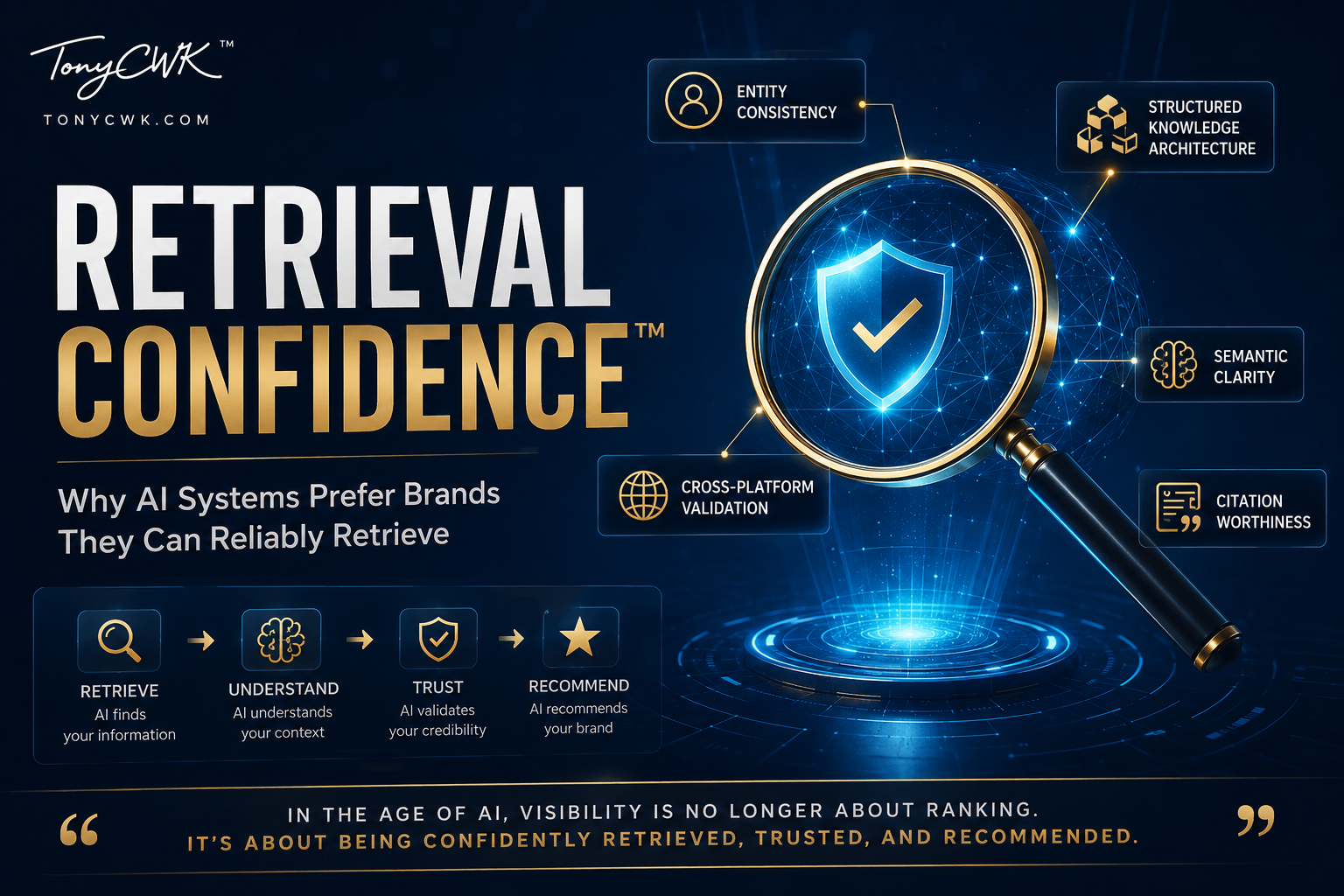
Why AI Systems Prefer Brands They Can Reliably Retrieve
In traditional SEO, visibility was largely about rankings.
In the AI era, visibility increasingly depends on whether AI systems can confidently retrieve, interpret, validate, and recommend your brand across fragmented knowledge environments.
This is where Retrieval Confidence™ becomes critical.
Retrieval Confidence™ refers to the degree of certainty an AI system has when retrieving information about a brand, entity, topic, or source during response generation.
It is no longer enough for content to exist.
AI systems must feel confident enough to surface it.
And that changes everything.
The Shift From Rankings to Retrieval Reliability
Traditional search engines focused heavily on:
- keyword relevance
- backlinks
- click signals
- page authority
- SERP positioning
Modern AI systems operate differently.
Large language models and AI retrieval systems now evaluate:
- semantic clarity
- entity consistency
- contextual trust
- structured knowledge alignment
- cross-platform validation
- information compressibility
- citation reliability
The core question is no longer:
“Does this page rank?”
The new question becomes:
“Can this information be confidently retrieved and trusted during AI synthesis?”
That difference defines the future of AI visibility.
What Is Retrieval Confidence™?
Retrieval Confidence™ is the probability that an AI system can:
- correctly identify your entity
- understand what you represent
- retrieve your information consistently
- validate your credibility
- synthesize your content accurately
- recommend your brand safely within generated answers
In other words:
Retrieval Confidence™ measures how reliably AI systems can access and trust your digital presence.
High Retrieval Confidence™ increases the likelihood of:
- AI mentions
- AI citations
- recommendation inclusion
- knowledge graph association
- semantic reinforcement
- recurring entity selection
Low Retrieval Confidence™ leads to:
- omission from AI answers
- inconsistent entity recognition
- retrieval confusion
- semantic dilution
- lower recommendation probability
Why Retrieval Confidence™ Matters in the AI Era
AI systems face a massive challenge:
The internet contains overwhelming amounts of noisy, duplicated, contradictory, and low-trust information.
As a result, AI systems increasingly prioritize:
- retrieval safety
- confidence scoring
- entity consistency
- trust reinforcement
- answer reliability
This means AI systems naturally favor brands that exhibit:
- stable thematic authority
- consistent messaging
- structured knowledge architecture
- strong semantic coherence
- repeated validation across ecosystems
The future of visibility is not merely discoverability.
It is retrievability with confidence.
The 5 Core Pillars of Retrieval Confidence™
1. Entity Consistency
AI systems must clearly understand:
- who you are
- what you do
- what topics you own
- how your entity relates to other entities
Inconsistent positioning reduces retrieval reliability.
For example:
If one platform describes your brand as:
- SEO consultant
Another says:
- AI strategist
Another says:
- digital transformation coach
AI systems experience semantic ambiguity.
Strong Retrieval Confidence™ requires:
- consistent positioning
- stable thematic associations
- aligned brand descriptors
- repeated entity reinforcement
This is why entity architecture becomes critical in AI visibility.
2. Structured Knowledge Architecture
AI systems prefer information that is:
- extractable
- organized
- structured
- machine-readable
This includes:
- schema markup
- semantic headings
- knowledge clusters
- FAQ structures
- contextual internal linking
- entity relationships
The easier information is to retrieve structurally, the higher the retrieval confidence.
AI systems favor clarity over complexity.
3. Cross-Platform Validation
AI systems do not trust isolated sources easily.
Confidence increases when information appears consistently across:
- websites
- business profiles
- interviews
- citations
- podcasts
- publications
- community discussions
- trusted third-party references
Cross-platform consistency creates:
retrieval reinforcement loops
The more ecosystems validate your entity consistently, the safer AI systems feel recommending you.
4. Semantic Clarity
AI systems retrieve compressed meaning, not just keywords.
This means your content must demonstrate:
- clear topical ownership
- thematic consistency
- semantic depth
- contextual relevance
- stable language patterns
Brands that publish scattered, trend-chasing content often weaken Retrieval Confidence™.
Meanwhile, focused thematic authority strengthens retrieval reliability dramatically.
5. Citation Worthiness
AI systems increasingly prioritize sources that are:
- quotable
- referenceable
- explanatory
- structured
- authoritative
This means AI-friendly brands often produce:
- original frameworks
- clear definitions
- visual models
- conceptual terminology
- evergreen educational assets
In many ways:
Retrieval Confidence™ grows when your content becomes reusable intelligence.
The Hidden AI Visibility Equation
In the AI era:
Visibility ≠ Traffic
Visibility ≠ Rankings
Visibility increasingly becomes:
Visibility = Retrieval Reliability × Trust Confidence × Recommendation Probability
This explains why some smaller brands now outperform larger companies inside AI-generated answers.
Because AI systems optimize for:
- clarity
- confidence
- retrievability
- semantic certainty
—not merely domain size.
Retrieval Confidence™ vs Traditional SEO
| Traditional SEO | Retrieval Confidence™ |
|---|---|
| Ranking-focused | Retrieval-focused |
| Click optimization | AI synthesis optimization |
| Keywords | Semantic entities |
| Backlinks | Trust reinforcement |
| SERP visibility | Recommendation visibility |
| Search indexing | AI retrievability |
| Traffic acquisition | Selection probability |
| Page authority | Entity confidence |
This represents one of the largest shifts in digital visibility history.
Why SMEs Can Win Through Retrieval Confidence™
Large corporations often suffer from:
- fragmented messaging
- inconsistent positioning
- siloed departments
- semantic dilution
- overly broad authority structures
Smaller brands can build:
- focused thematic authority
- highly consistent messaging
- stronger semantic clarity
- tighter knowledge architecture
This can significantly improve Retrieval Confidence™ even against larger competitors.
In the AI era:
coherence can outperform scale.
The Rise of Retrieval-Optimized Brands
The future belongs to brands that are:
- easy to understand
- easy to validate
- easy to retrieve
- easy to synthesize
- easy to recommend
This marks the rise of:
Retrieval-Optimized Brands™
These are brands intentionally designed for:
- AI readability
- semantic persistence
- entity reinforcement
- algorithmic trust
- recommendation eligibility
The future of digital authority is not simply about being visible.
It is about becoming confidently retrievable.
Final Thoughts
AI systems are changing the economics of visibility.
The old internet rewarded those who could rank.
The new AI ecosystem rewards those who can be reliably retrieved, trusted, and recommended.
This is why Retrieval Confidence™ may become one of the most important strategic concepts in future digital marketing.
Because in the age of AI:
The brands most likely to win are not merely the loudest.
They are the easiest for AI systems to confidently understand, retrieve, and trust.
FAQ for “Retrieval Confidence™”
1. What is Retrieval Confidence™?
Retrieval Confidence™ refers to how confidently an AI system can retrieve, understand, validate, and use information about a brand, entity, or topic when generating an answer.
2. Why does Retrieval Confidence™ matter?
It matters because AI systems are less likely to mention, cite, or recommend brands they cannot retrieve clearly and reliably.
3. Is Retrieval Confidence™ the same as SEO?
No. SEO focuses on search rankings and traffic. Retrieval Confidence™ focuses on whether AI systems can confidently access, interpret, and trust your information.
4. How does Retrieval Confidence™ affect AI visibility?
Higher Retrieval Confidence™ increases the chance that a brand appears in AI-generated answers, summaries, recommendations, and citations.
5. What causes low Retrieval Confidence™?
Low Retrieval Confidence™ can be caused by inconsistent messaging, weak entity signals, poor content structure, limited external validation, unclear expertise, or fragmented online presence.
6. How can brands improve Retrieval Confidence™?
Brands can improve it by strengthening entity consistency, publishing structured content, using schema markup, building topical authority, earning credible mentions, and maintaining consistent messaging across platforms.
7. Why is entity consistency important?
Entity consistency helps AI systems clearly understand who the brand is, what it represents, and which topics it should be associated with.
8. What role does structured data play?
Structured data helps search engines and AI systems interpret website content more clearly, improving machine readability and retrievability.
9. Can small businesses build strong Retrieval Confidence™?
Yes. Smaller brands can often build strong Retrieval Confidence™ by focusing on clear positioning, consistent messaging, niche expertise, and structured authority signals.
10. How is Retrieval Confidence™ related to AI Authority?
Retrieval Confidence™ is a key component of AI Authority. A brand cannot become strongly recommended by AI systems if its information cannot first be confidently retrieved and trusted.
11. Does Retrieval Confidence™ replace backlinks?
No. Backlinks may still support credibility, but Retrieval Confidence™ includes broader signals such as semantic clarity, structured knowledge, topical consistency, and ecosystem validation.
12. What is a Retrieval-Optimized Brand™?
A Retrieval-Optimized Brand™ is a brand designed to be easily understood, retrieved, validated, and recommended by AI systems.
Suggested Further Reading
“What Is AI Authority™?” 👉 https://tonycwk.com/what-is-ai-authority/
“The AI Authority Pyramid™” 👉 https://tonycwk.com/ai-authority-pyramid/
“AI Authority Framework” 👉 https://tonycwk.com/ai-authority-framework/
“AI Authority Systems™” 👉 https://tonycwk.com/ai-authority-systems/
“The AI Discovery Flywheel” 👉 https://tonycwk.com/ai-discovery-flywheel/
“The New Visibility Model: Why Being Found Is No Longer Enough” 👉 https://tonycwk.com/the-new-visibility-model
“SEO Alone Is No Longer Enough” 👉 https://tonycwk.com/seo-alone-is-no-longer-enough/
“Selection Rate vs Click-Through Rate” 👉https://tonycwk.com/selection-rate-vs-click-through-rate/
Leave a Reply