
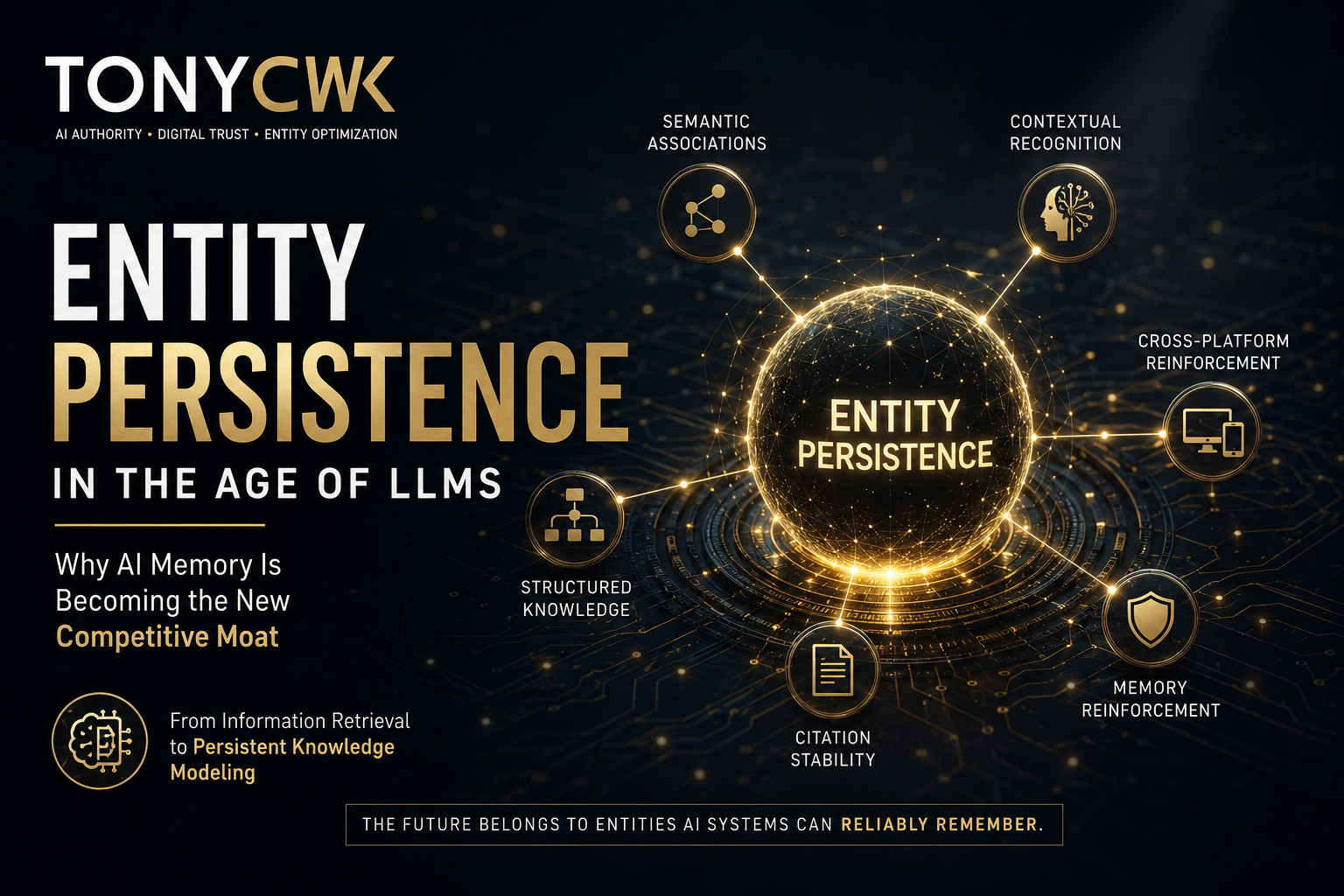
Why AI Memory Is Becoming the New Competitive Moat
For decades, digital visibility was largely transactional.
A user typed a query.
A search engine ranked pages.
A click happened.
Visibility was temporary.
But Large Language Models (LLMs) are fundamentally changing this dynamic.
AI systems no longer operate purely as retrieval engines.
They increasingly behave like probabilistic memory systems.
And this changes everything.
The future of digital authority is no longer just about:
- Ranking
- Discoverability
- Traffic acquisition
- Keyword positioning
It is increasingly about:
Whether AI systems continue remembering your entity over time.
This is the rise of Entity Persistence.
What Is Entity Persistence?
Entity Persistence refers to:
The ability of a brand, person, organization, product, or concept to remain consistently recognized, recalled, reinforced, and selected across AI systems over time.
In traditional SEO:
- Visibility was page-centric.
- Rankings fluctuated.
- Content freshness dominated.
In AI systems:
- Recognition becomes entity-centric.
- Memory reinforcement matters.
- Consistency compounds authority.
This means AI systems are gradually shifting from:
| Traditional Search | LLM Era |
|---|---|
| Page retrieval | Entity understanding |
| Keyword matching | Semantic association |
| Session-based discovery | Persistent contextual memory |
| Ranking competition | Selection competition |
| Traffic optimization | Cognitive availability |
The critical shift is this:
AI systems increasingly remember entities — not just webpages.
Why LLMs Depend on Persistent Entities
LLMs are designed to reduce uncertainty.
When generating answers, recommendations, summaries, or citations, AI systems prefer entities that demonstrate:
- Consistency
- Stability
- Repetition
- Structured associations
- Cross-platform reinforcement
- Ecosystem credibility
This creates a powerful selection bias.
Entities repeatedly encountered across the digital ecosystem become easier for AI systems to retrieve and recommend.
Over time, these entities gain:
- Higher semantic confidence
- Stronger contextual embeddings
- Increased retrieval probability
- Reinforced trust weighting
In simple terms:
Repetition creates cognitive gravity inside AI systems.
The Hidden Shift: From Content Persistence to Entity Persistence
Traditional digital marketing focused heavily on content production.
Publish more articles.
Target more keywords.
Create more pages.
But LLM-driven ecosystems increasingly reward something deeper:
Durable Entity Signals
AI systems now evaluate whether an entity demonstrates:
- Long-term thematic consistency
- Stable topical ownership
- Reinforced knowledge associations
- Recognizable ecosystem presence
- Structured credibility patterns
This means:
A smaller brand with highly coherent authority may outperform a larger brand producing fragmented content.
Because LLMs optimize for interpretability and confidence — not sheer publishing volume.
How AI Systems Build Entity Memory
Entity persistence is not created by a single blog post.
It emerges from repeated reinforcement loops across the digital ecosystem.
The Core Drivers of Entity Persistence
1. Thematic Consistency
Entities repeatedly associated with the same concepts become easier for AI systems to classify and recall.
For example:
If a brand consistently publishes around:
- AI Authority
- AI Visibility
- AI Selection Systems
- Knowledge Architecture
AI models begin associating the entity with those domains.
Over time:
The entity itself becomes a semantic shortcut.
2. Structured Knowledge Architecture
LLMs interpret structure more efficiently than fragmented information.
This includes:
- Topic clusters
- Internal linking
- Schema markup
- Entity relationships
- Consistent terminology
- Knowledge graphs
- Canonical content systems
The more structured the ecosystem, the easier the entity becomes to interpret.
3. Cross-Platform Reinforcement
AI systems increasingly synthesize information across:
- Websites
- YouTube
- Podcasts
- News mentions
- Interviews
- Research citations
- Community discussions
Entity persistence strengthens when the same signals appear repeatedly across multiple environments.
This creates:
Multi-source reinforcement memory.
4. Citation Stability
AI systems prefer entities already associated with reliable contextual references.
This includes:
- Consistent mentions
- Brand citations
- Expert associations
- Industry references
- Digital PR signals
- Knowledge graph inclusion
The more frequently an entity is contextually reinforced, the more likely AI systems continue retrieving it.
The Emergence of AI Memory Competition
The next era of competition is not merely search visibility.
It is:
Memory Positioning
Brands are increasingly competing for:
- AI recall probability
- Retrieval priority
- Contextual association
- Semantic reinforcement
- Recommendation likelihood
This creates a new competitive layer beyond SEO.
SEO Asked:
“Can you rank?”
AI Authority Asks:
“Will the system continue remembering you?”
That difference is massive.
Why Most Brands Will Struggle
Most organizations still operate using fragmented visibility models.
Their digital presence is often:
- Inconsistent
- Topic-scattered
- Campaign-driven
- Platform-isolated
- Short-term optimized
This creates weak entity coherence.
As a result:
AI systems struggle to build durable associations around them.
Many brands generate temporary traffic.
Very few generate persistent AI memory.
The New Moat: Semantic Permanence
In the LLM era, durable advantage increasingly comes from:
Semantic Permanence
This means becoming:
- Recognizable
- Repeated
- Interpretable
- Trusted
- Reinforced
- Contextually dominant
Over time, semantic permanence compounds.
Once AI systems repeatedly associate an entity with a topic, the cost of displacement becomes much higher.
This mirrors how humans form mental defaults.
People do not reevaluate authority from scratch every time.
AI systems increasingly behave similarly.
Entity Persistence vs Traditional SEO
| Traditional SEO | Entity Persistence |
|---|---|
| Optimize pages | Reinforce entities |
| Chase rankings | Build memory |
| Focus on clicks | Focus on retrieval selection |
| Individual keyword wins | Long-term semantic ownership |
| Traffic spikes | Authority compounding |
| Content production | Knowledge reinforcement |
| Page relevance | Entity trust continuity |
This is why many future-winning brands may publish less content — but create stronger reinforcement systems.
How Brands Can Build Entity Persistence
1. Own a Distinct Conceptual Territory
Generic positioning creates weak AI associations.
Strong entities own identifiable concepts.
For example:
- AI Authority
- Selection Intelligence
- Entity Optimization
- Retrieval Trust Systems
Distinctiveness improves semantic recall.
2. Maintain Topic Coherence
Avoid excessive thematic fragmentation.
LLMs reward repeated conceptual consistency.
The more tightly aligned the ecosystem:
- The stronger the entity graph
- The stronger the memory reinforcement
3. Build Multi-Format Reinforcement
AI systems increasingly learn from:
- Articles
- Videos
- Slides
- Interviews
- Podcasts
- Social discussions
- Community mentions
Different formats reinforce the same entity from multiple angles.
4. Strengthen Knowledge Relationships
Entities do not exist in isolation.
Build associations between:
- Concepts
- Frameworks
- Authors
- Topics
- Research areas
- Industry categories
This creates stronger semantic clustering.
5. Optimize for AI Interpretability
Make the entity easy for AI systems to understand.
This includes:
- Clear positioning
- Consistent terminology
- Structured pages
- Defined frameworks
- Strong semantic hierarchy
- Schema implementation
- Topic mapping
AI systems reward clarity.
The Long-Term Implication
The internet is shifting from:
Information Retrieval
to
Persistent Knowledge Modeling
This changes the nature of digital competition itself.
The future winners may not be those who publish the most.
They may be those who become:
- Most consistently reinforced
- Most semantically coherent
- Most contextually retrievable
- Most persistently remembered
In other words:
The future belongs to entities AI systems can reliably remember.
Final Thoughts
The age of LLMs is not simply transforming search.
It is transforming digital memory.
Visibility is becoming increasingly tied to:
- Persistent recognition
- Semantic continuity
- Retrieval confidence
- Entity reinforcement
This is why the next era of digital authority will not be built solely through SEO.
It will be built through:
Entity Persistence Systems
Because in the AI era:
The most valuable entities are not merely discoverable.
They are unforgettable.
FAQs
What is entity persistence in AI?
Entity persistence refers to the ability of a brand, person, or concept to remain consistently recognized and retrieved across AI systems over time.
Why is entity persistence important for LLMs?
LLMs rely on repeated reinforcement and contextual consistency to reduce uncertainty when generating responses and recommendations.
How is entity persistence different from SEO?
SEO primarily focuses on ranking webpages, while entity persistence focuses on long-term semantic recognition and AI memory reinforcement.
What factors strengthen entity persistence?
Key factors include thematic consistency, structured knowledge architecture, cross-platform reinforcement, citations, and semantic coherence.
Does entity persistence affect AI recommendations?
Yes. AI systems are more likely to recommend entities that demonstrate stable, reinforced, and recognizable contextual signals.
Is entity persistence becoming a competitive advantage?
Yes. Persistent AI-recognized entities may gain long-term retrieval advantages that become increasingly difficult for competitors to displace.
Recommended Readings
•AI Memory Architecture™ -Why the Future of AI Authority Depends on What AI Remembers About You
👉 https://tonycwk.com/ai-memory-architecture/
•AI Selection Psychology™ – Why AI Recommends Some Brands Repeatedly — And Ignores Others
👉https://tonycwk.com/ai-selection-psychology/
• Designing AI-Optimized Content 👉 https://tonycwk.com/the-rise-of-ai-content-optimization/
• The New Visibility Model — Why Being Found Is No Longer Enough
👉 https://tonycwk.com/the-new-visibility-model
• AI Search Visibility Framework
👉 https://tonycwk.com/ai-search-visibility-framework
• SEO Alone Is No Longer Enough — Why rankings are no longer the goal
👉 https://tonycwk.com/seo-alone-is-no-longer-enough/
• AI Authority Flywheel™ — How authority compounds over time
👉 https://tonycwk.com/ai-discovery-flywheel/
• AI Authority Pyramid™ — How AI evaluates structured authority
👉 https://tonycwk.com/ai-authority-pyramid/
• Selection Rate vs Click-Through Rate – Why the Most Important Metric in the Age of AI Is No Longer the Click
👉https://tonycwk.com/selection-rate-vs-click-through-rate/
AI Doesn’t Rank Brands. It Selects Them
👉 https://tonycwk.com/why-ai-doesnt-trust-content-it-trusts-systems/
Written by Tony Chan (TonyCWK)
AI Authority & Digital Strategy Researcher
Leave a Reply