
For more than two decades, digital marketing was built around a relatively simple objective:
Get discovered by humans.
Search engines ranked pages. Social platforms distributed content. Advertising bought attention. Websites converted visitors.
The underlying assumption remained largely unchanged: a human would eventually evaluate the options and make the decision.
That assumption is beginning to break.
AI systems are moving beyond helping people find information. They increasingly retrieve information, compare alternatives, recommend products, evaluate constraints, and—in emerging agentic commerce environments—execute actions on behalf of users.
That changes the competitive question.
It is no longer simply:
Can customers find your brand?
It becomes:
Can a machine identify your brand, understand it, develop sufficient confidence in it, select it, and safely act on that selection?
This is the emerging Machine Decision Economy.
And it requires a different way of thinking about digital visibility.
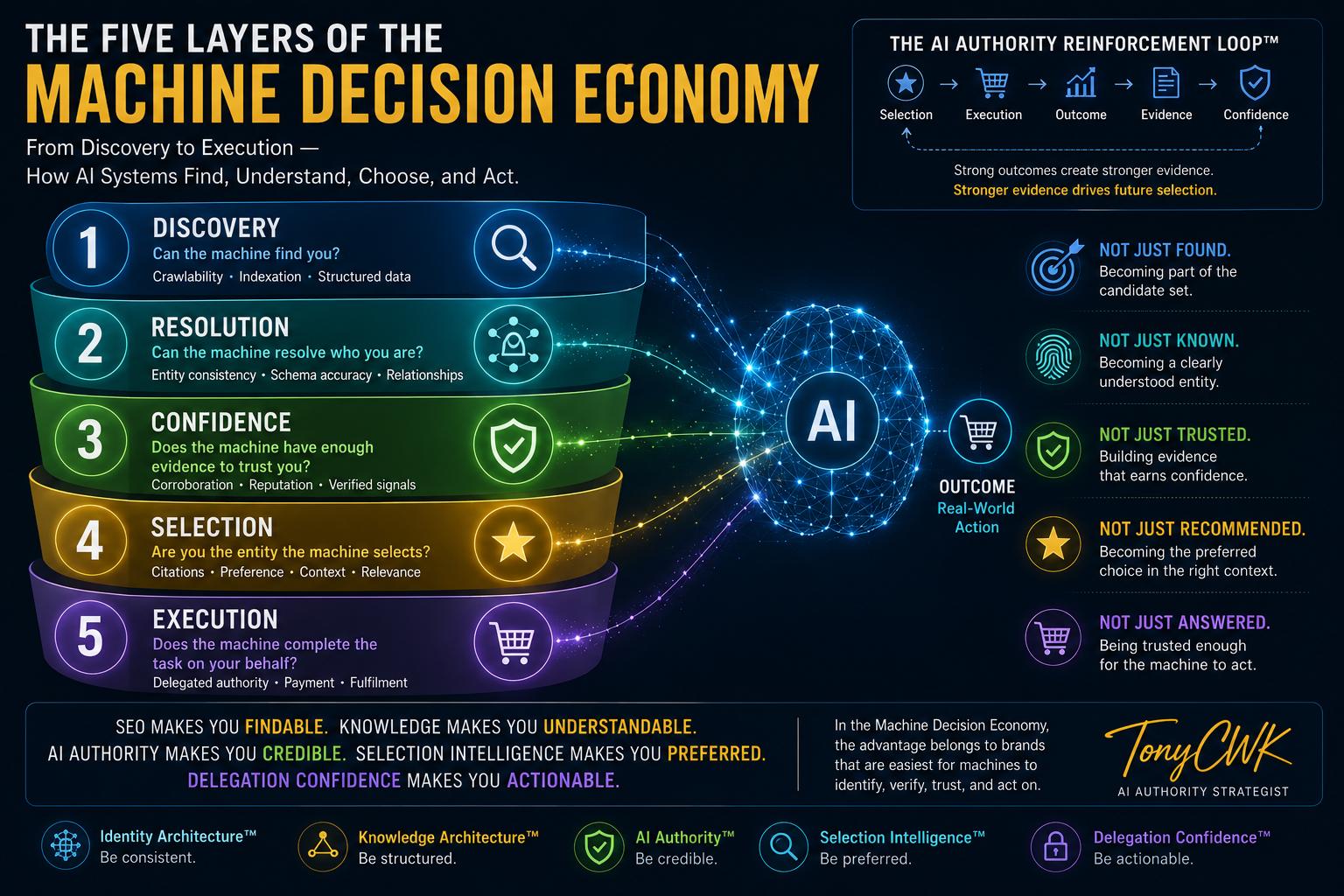
The Five Layers of the Machine Decision Economy
Machine-mediated decisions can be understood through five progressively demanding layers:
Discovery → Resolution → Confidence → Selection → Execution
These aren’t five isolated marketing tactics.
They represent a progression from machine visibility to machine action.
Each layer increases the burden of proof placed on the brand.
Layer 1 — Discovery
Can the machine find you?
Discovery is the foundation.
It includes familiar digital disciplines such as:
- crawlability
- indexability
- accessible content
- structured information
- product feeds
- machine-readable data
Traditional SEO remains important here.
If systems cannot access or retrieve your information, the rest of the stack becomes irrelevant.
But discovery creates eligibility—not preference.
Being retrievable merely puts the brand into the potential candidate set.
Discovery answers: “Are you available?”
It does not answer:
“Should I choose you?”
That distinction becomes increasingly important as AI systems mediate more decisions.
Layer 2 — Resolution
Once a brand has been discovered, another problem appears:
Does the machine know exactly who or what it has discovered?
A company may have a website, social profiles, product listings, marketplace pages, reviews, press mentions, executives, subsidiaries, locations and third-party references scattered across the internet.
Humans can often tolerate inconsistencies between these sources.
Machines have to reconcile them.
That makes entity resolution increasingly important.
Signals may include:
- consistent organization and product identities
- accurate structured data
- clear relationships between entities
- consistent names and attributes
- authoritative external references
sameAsrelationships where appropriate- coherent knowledge-graph connections
This is where Identity Architecture™ and Knowledge Architecture™ become more important.
The objective isn’t merely to publish information.
It is to make the brand machine-resolvable.
A brand can therefore be highly visible yet structurally ambiguous.
And ambiguity introduces uncertainty.
Discovery makes you retrievable.
Resolution makes you understandable.
Layer 3 — Confidence
Understanding an entity still doesn’t mean an AI system should recommend it.
The next question is harder:
Is there enough reliable evidence to support choosing this entity?
This is where the concept of AI Authority becomes central.
AI Authority should not be understood as a single ranking factor or universal score.
It is better understood as the accumulated evidence that makes an entity easier for AI systems to recognize as credible, relevant and supportable within a particular context.
That evidence can come from multiple directions:
First-party evidence
Clear specifications, policies, expertise, documentation and factual consistency.
Third-party evidence
Independent citations, reviews, authoritative mentions, industry recognition and corroboration.
Entity evidence
Consistent identity and relationships across trusted information environments.
Experience evidence
Reviews, customer outcomes, service quality and reputation.
Operational evidence
Availability, pricing accuracy, policies, fulfilment capabilities and transaction reliability.
The important principle is:
AI Authority is not what a brand says about itself. It is what the broader information ecosystem makes defensible for a machine to believe about the brand.
This distinction matters.
Marketing traditionally focused heavily on persuasion.
Machine-mediated selection places greater emphasis on verification.
A claim that exists only on your website is a claim.
A claim consistently supported by independent, authoritative evidence becomes much easier to rely upon.
That is the transition from presence to confidence.
Layer 4 — Selection
Selection is where the economics become interesting.
An AI system may retrieve ten brands.
It may understand eight.
It may have adequate evidence for five.
But perhaps only one or two satisfy the user’s actual constraints.
This means AI visibility and AI selection are fundamentally different outcomes.
Visibility asks whether you appear.
Selection asks whether you win.
Selection can depend on context:
- price
- location
- availability
- specifications
- reputation
- risk
- compatibility
- delivery
- user preferences
- historical outcomes
- policy constraints
- confidence in the underlying information
There may therefore never be one universally “preferred brand” for AI.
The more realistic objective is becoming the preferred eligible entity for the right decision context.
That is a much more defensible way to think about AI selection.
A premium hotel might be selected for one traveller and rejected for another.
A cybersecurity vendor might be preferred for a regulated enterprise but inappropriate for a five-person company.
A product may have tremendous authority yet lose because it cannot satisfy a delivery constraint.
AI selection therefore sits at the intersection of:
Authority × Relevance × Confidence × Context × Utility
This is why optimizing solely for AI mentions can become misleading.
Mentions measure presence.
Selection measures preference.
Layer 5 — Execution
Selection used to be where marketing handed the customer to commerce.
Agentic systems potentially extend the decision chain further.
The machine may:
- make a reservation
- reorder a product
- negotiate within predefined constraints
- schedule an appointment
- initiate payment
- manage a subscription
- purchase inventory
- execute a transaction
At this point, marketing collides with identity, payments, security, permissions and operations.
Execution requires a higher standard than recommendation.
A system may have enough confidence to say:
“I recommend Brand X.”
But not enough confidence—or authority—to say:
“I purchased Brand X for you.”
That difference is what I call Delegation Confidence™.
Recommendation confidence asks:
Is this a sufficiently good answer to suggest?
Delegation confidence asks:
Is this sufficiently trustworthy and appropriate for me to act upon?
The second threshold should naturally be higher because the consequences are greater.
But There Is a Sixth Problem: Staying Selected
This is where the Five Layers become more interesting.
The framework describes how a brand moves toward execution.
But competition doesn’t stop after Layer 5.
The outcome feeds back into future decisions.
A successful transaction can generate:
- positive reviews
- repeat purchases
- fulfilment evidence
- stronger reputation
- better customer outcomes
- updated availability signals
- additional citations
- stronger behavioural evidence
A failed transaction can produce the opposite.
This creates what I describe as the AI Authority Reinforcement Loop™:
Selection → Execution → Outcome → Evidence → Confidence → Future Selection
AI Authority therefore should not be treated as something a company “achieves.”
It has to be maintained.
And that changes brand strategy.
From Brand Loyalty to Machine Preference
Human loyalty has traditionally been relatively sticky.
People develop habits.
They remember brands.
They tolerate friction.
They may continue purchasing because of emotional affinity, familiarity or convenience.
AI agents potentially behave differently.
An agent can reevaluate the market repeatedly.
It can compare hundreds of attributes at negligible cognitive cost.
It can detect that yesterday’s best option is no longer today’s best option.
That potentially makes machine preference less permanent than human loyalty.
A brand might be selected today and displaced tomorrow because:
- its price changed
- inventory disappeared
- information became outdated
- another entity accumulated stronger evidence
- reviews deteriorated
- policies changed
- fulfilment performance weakened
- a competitor became more appropriate for the user’s constraints
This creates a new competitive discipline:
Selection Maintenance
The objective isn’t simply:
How do we get AI to recommend us?
It becomes:
How do we remain one of the most defensible choices every time the decision is recomputed?
That is a much more difficult problem.
How Brands Maintain AI Preference
I believe maintaining machine preference will require at least six disciplines.
1. Maintain Entity Integrity
Names, products, executives, locations, relationships and attributes need to remain consistent across the information ecosystem.
Identity drift creates resolution friction.
2. Maintain Evidence Freshness
Authority isn’t only about accumulating historical evidence.
Information has to remain current.
Prices, specifications, policies, availability, credentials and product data should accurately represent present reality.
3. Expand Independent Corroboration
Brands cannot manufacture durable authority solely through first-party publishing.
Independent evidence strengthens confidence.
The objective becomes an ecosystem of corroboration rather than a library of self-assertion.
4. Build Contextual Authority
Brands shouldn’t attempt to be “the best” universally.
They should make it exceptionally clear where they are the appropriate choice and why.
Specific authority may ultimately be more useful to decision systems than vague category dominance.
5. Reduce Execution Risk
As systems move toward action, operational reliability becomes part of discoverability strategy.
Clear returns.
Reliable inventory.
Accurate pricing.
Verified identity.
Secure payments.
Predictable fulfilment.
Machine-readable policies.
These aren’t merely ecommerce concerns anymore.
They can become selection signals.
6. Measure Selection, Not Just Visibility
The emerging KPI hierarchy should move beyond rankings and mentions.
Brands should increasingly ask:
Are we retrieved?
Are we correctly understood?
Are we cited?
Are we recommended?
Under which contexts are we selected?
When are competitors selected instead?
Does recommendation convert into delegated action?
What outcomes reinforce or weaken future selection?
That is the beginning of what I call AI Selection Intelligence™.
AI Authority Becomes a Compounding Asset
This leads to an important conclusion.
AI Authority isn’t another optimization tactic sitting beside SEO.
It is the connective tissue between Resolution, Confidence and Selection.
Technical SEO helps systems discover information.
Knowledge Architecture helps systems understand it.
Identity Architecture helps systems resolve it.
External corroboration helps systems verify it.
AI Authority emerges from the strength and consistency of those signals.
Selection Intelligence tells us whether that accumulated authority actually results in preference.
Delegation Confidence determines whether preference can progress into action.
And successful outcomes reinforce the system.
The complete progression becomes:
Discovery
↓
Resolution
↓
Confidence
↓
Selection
↓
Execution
↓
Outcome
↺
Authority Reinforcement
That final feedback loop may eventually prove as important as the original five layers.
The Human Still Matters
There is one important qualification.
The Machine Decision Economy doesn’t mean humans disappear.
People determine goals.
People establish preferences.
People grant permissions.
People define spending limits.
People decide how much authority they are prepared to delegate.
And for many high-risk or emotionally important decisions, humans may remain deeply involved.
The more useful way to think about the future isn’t:
Human decisions → Machine decisions
It is:
Human intent → Machine evaluation → Machine recommendation → Human or delegated approval → Machine execution
The balance will differ by transaction.
Buying printer paper isn’t the same as choosing a university.
Renewing a software subscription isn’t the same as selecting a financial adviser.
Autonomy will expand unevenly.
But even where humans retain final approval, AI may increasingly determine the shortlist placed in front of them.
That alone makes machine selection strategically important.
The New Competitive Question
The Traffic Era asked:
Can people find us?
The Recommendation Era asks:
Will AI recommend us?
The Machine Decision Economy adds a harder question:
Will AI have enough evidence and confidence to choose us—and enough trust to act on that choice?
That is why visibility alone will not define the next era of digital competition.
Neither will content volume.
Nor schema alone.
Nor citations alone.
The durable advantage will come from building a coherent system in which identity, knowledge, authority, evidence, operational reliability and outcomes reinforce one another.
Because the future may not belong to the brand that appears most often.
It may belong to the brand that repeatedly becomes the most defensible decision.
SEO makes you findable.
Knowledge makes you understandable.
AI Authority makes you credible.
Selection Intelligence makes you preferred.
Delegation Confidence makes you actionable.
And when successful execution generates new evidence that strengthens future confidence, the system begins to compound.
That is the deeper opportunity inside the Machine Decision Economy.
The goal is no longer simply to win the search.
It is to remain worthy of the next decision.
— TonyCWK
Frequently Asked Questions
What is the Machine Decision Economy?
The Machine Decision Economy describes an emerging environment in which AI systems increasingly participate in discovering, evaluating, recommending, selecting, and eventually acting on products, services, brands, and information.
Instead of digital competition ending when a brand becomes visible to a human, brands increasingly need to become understandable, verifiable, selectable, and actionable by machines as well.
What are the Five Layers of the Machine Decision Economy?
The five layers are:
Discovery → Resolution → Confidence → Selection → Execution
Discovery determines whether an AI system can find the brand.
Resolution determines whether the system can correctly identify and understand the entity.
Confidence determines whether enough reliable evidence exists to support recommending or acting on it.
Selection determines whether the brand becomes the preferred answer for a particular decision context.
Execution occurs when an AI system goes beyond recommendation and performs an action such as purchasing, booking, scheduling, or paying.
Why is Discovery alone no longer enough?
Discovery only makes a brand eligible for consideration.
An AI system may retrieve many possible sources or products, but retrieval does not guarantee understanding, trust, recommendation, or selection.
A brand can therefore be highly visible while still failing to become the entity an AI system prefers.
The strategic objective is shifting from being found to being confidently chosen.
What is Entity Resolution and why does it matter?
Entity Resolution is the process through which an AI or information system determines exactly which person, company, product, location, or other entity a piece of information refers to.
Consistent names, structured data, authoritative references, entity relationships, product attributes, and sameAs connections can help reduce ambiguity.
If a system cannot confidently resolve a brand or product, uncertainty introduced at this stage can weaken later confidence and selection.
How does AI Authority fit into the Five Layers?
AI Authority is not necessarily a separate sixth layer.
It acts more like a reinforcing condition across Resolution, Confidence, and Selection.
AI Authority develops when an entity is consistently represented, independently corroborated, contextually relevant, and supported by credible evidence across the broader information ecosystem.
In practical terms:
Resolution establishes who you are.
AI Authority strengthens why you should be trusted.
Confidence determines whether that evidence is sufficient.
Selection determines whether you are ultimately chosen.
Is AI Authority the same as traditional SEO authority?
No.
Traditional SEO authority has historically been associated with factors that help pages and domains perform in search, including links, relevance, content quality, and other search signals.
AI Authority is a broader concept.
It concerns whether machine systems can consistently understand, verify, and rely on an entity when constructing recommendations or decisions.
SEO remains an important foundation, but AI-mediated selection can also depend on entity clarity, external corroboration, factual consistency, reputation, current product information, operational reliability, and contextual relevance.
What is the difference between AI Visibility and AI Selection?
AI Visibility measures whether a brand appears.
AI Selection measures whether the brand is actually preferred.
A company might appear in multiple AI answers without becoming the recommended provider or product.
That means citations and mentions are useful indicators, but they do not necessarily prove decision preference.
The more advanced question is not:
“Did the AI mention us?”
It is:
“Under what conditions does the AI choose us instead of a competitor?”
What is AI Selection Intelligence?
AI Selection Intelligence™ is the discipline of understanding why AI systems select one entity over another across different decision contexts.
It can include studying:
- whether the brand is retrieved
- whether its entity is correctly resolved
- what evidence supports it
- where competitors are selected instead
- which queries or contexts produce recommendations
- which constraints change the outcome
- whether recommendations progress into action
Traditional analytics often measures traffic after discovery.
Selection Intelligence attempts to understand what happens before the decision.
What is the difference between Recommendation Confidence and Delegation Confidence?
Recommendation Confidence is the level of confidence required for an AI system to suggest an option.
Delegation Confidence is the higher level of confidence required before a system—or the human using it—is willing to let the AI perform an action.
For example, recommending a hotel presents relatively limited risk.
Booking the hotel, entering payment details, and accepting cancellation terms carries greater consequences.
As AI systems move from answering questions toward executing tasks, this distinction becomes increasingly important.
What does Execution mean in agentic commerce?
Execution occurs when an AI system moves beyond information and performs an authorized action.
Examples might include:
- purchasing a product
- making a reservation
- booking travel
- renewing a subscription
- scheduling an appointment
- initiating a payment
- placing an approved business order
At this stage, digital marketing intersects with commerce infrastructure, identity, permissions, security, payments, inventory, fulfilment, and policy.
Can a brand permanently become the preferred AI recommendation?
Probably not.
Machine preference can be continuously recalculated as circumstances change.
A brand that is appropriate today may become less suitable tomorrow because of changes in price, availability, customer reviews, specifications, reputation, policies, delivery performance, competitive offerings, or the user’s own constraints.
Brands therefore need to think beyond winning selection toward maintaining selection readiness.
How can brands remain preferred or selected by AI systems?
Brands should focus on maintaining several reinforcing conditions:
Entity integrity — keep identity and factual information consistent.
Evidence freshness — maintain accurate specifications, prices, policies, availability, and credentials.
Independent corroboration — build credible third-party evidence rather than relying entirely on self-published claims.
Contextual authority — clearly establish the situations in which the brand is especially relevant or appropriate.
Operational reliability — reduce purchasing and fulfilment risk.
Outcome quality — create experiences that generate positive reviews, repeat behaviour, reputation, and further evidence.
The objective is not to manipulate AI systems into choosing the brand.
It is to make the brand an increasingly defensible choice.
What is the AI Authority Reinforcement Loop?
The AI Authority Reinforcement Loop™ describes how successful selection and execution can create new evidence that strengthens future selection.
A simplified version is:
Selection → Execution → Outcome → Evidence → Confidence → Future Selection
For example, a successful purchase may lead to positive reviews, stronger reputation, repeat demand, reliable fulfilment records, and additional independent references.
Those signals may strengthen future confidence.
Poor outcomes can create the opposite effect.
Does the Machine Decision Economy mean humans will stop making purchasing decisions?
No.
Human involvement will vary according to risk, complexity, personal preference, regulation, and the amount of authority people are comfortable delegating.
A more realistic progression is:
Human intent → Machine evaluation → Machine recommendation → Human or delegated approval → Machine execution
For low-risk repetitive transactions, greater autonomy may be acceptable.
For high-value, emotional, regulated, or irreversible decisions, human involvement is likely to remain much greater.
What should brands measure in the Machine Decision Economy?
Traditional rankings, traffic, conversions, and revenue remain important.
But brands may increasingly need to add new questions:
Are we being retrieved?
Are we being correctly understood?
Are our claims independently corroborated?
Are we being cited?
Are we being recommended?
When are competitors selected instead?
Which user constraints change selection?
Does recommendation progress into transaction?
Do transaction outcomes strengthen or weaken future confidence?
This expands measurement from visibility toward selection and decision intelligence.
Will SEO still matter in the Machine Decision Economy?
Yes.
SEO continues to support discoverability, crawlability, indexation, technical accessibility, content quality, and structured information.
But SEO increasingly becomes the foundation rather than the full strategy.
The broader progression can be summarized as:
SEO makes you findable.
Knowledge Architecture makes you understandable.
AI Authority makes you credible.
Selection Intelligence helps you understand preference.
Delegation Confidence makes machine action possible.
The future is therefore less about replacing SEO and more about extending optimization further along the machine decision chain.
Leave a Reply