
By TonyCWK
For more than two decades, digital marketing has been built on one fundamental question:
Can customers find us?
Search engines rewarded visibility.
Marketers measured rankings.
Analytics platforms measured traffic.
Campaigns were optimized for clicks and conversions.
Today, artificial intelligence is changing that question.
Customers are no longer just searching.
They are asking AI assistants for recommendations.
Increasingly, AI is not simply retrieving information—it is synthesizing evidence, comparing options and, in many cases, making recommendations on behalf of users. As AI agents mature, they may even make purchasing decisions within the boundaries users set.
That changes what businesses need to measure.
The future is no longer about whether AI can find your brand.
It is about whether AI will choose your brand.
This is where a new discipline begins.
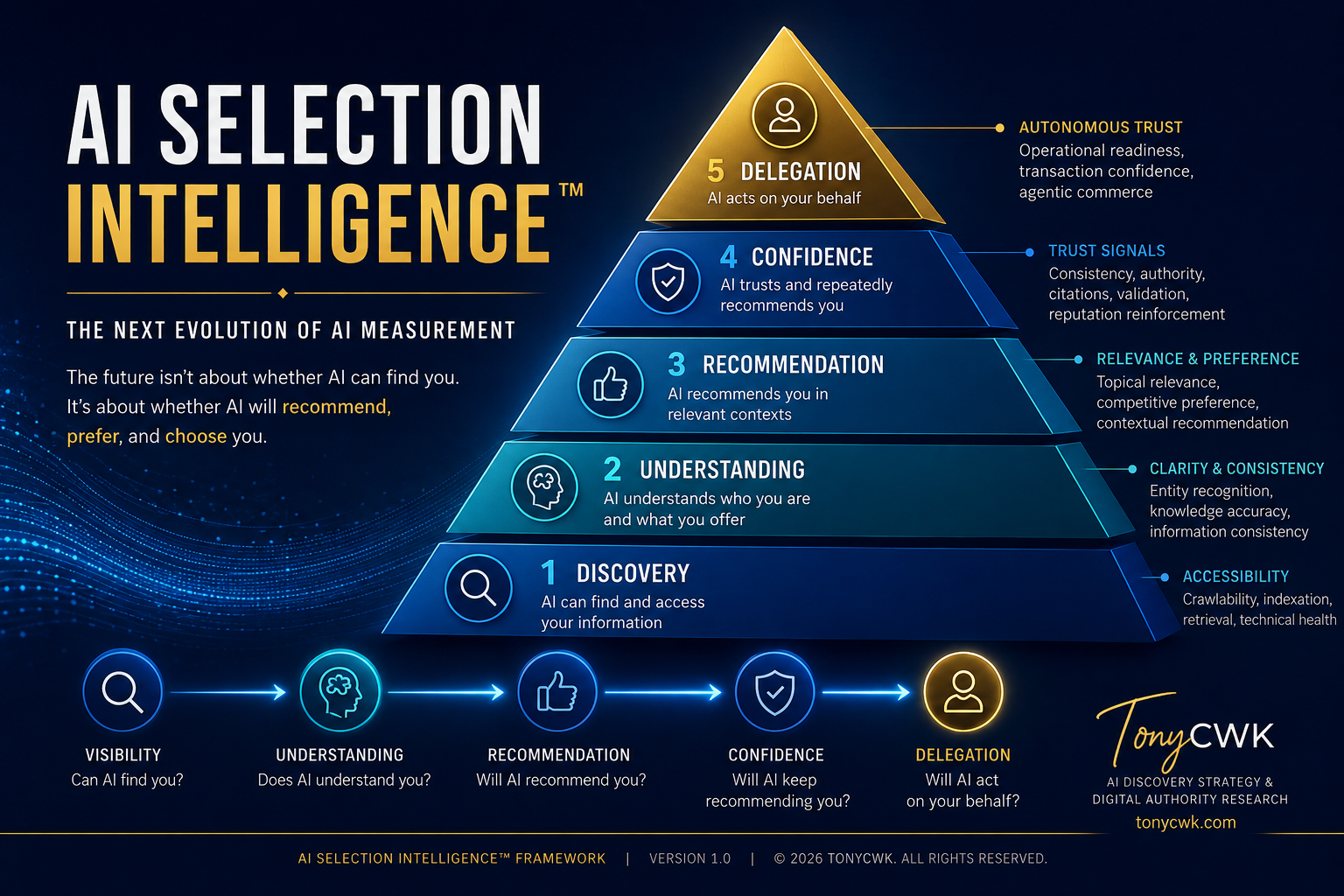
I call it AI Selection Intelligence™.
The Problem With Today’s AI Visibility Metrics
A growing number of platforms now promise to measure AI visibility.
Most track metrics such as:
- Brand mentions
- AI citations
- Share of voice
- Prompt coverage
- Competitor comparisons
These are valuable indicators.
But they answer only one question:
Did AI mention my business?
That is an important starting point.
It is not the finish line.
Imagine two competing brands.
Both are mentioned by AI.
One is recommended first.
The other appears as an alternative.
Both have identical visibility.
Neither has identical business value.
Visibility alone cannot explain why one brand becomes the preferred recommendation.
That is why the next generation of AI measurement must evolve beyond visibility.
From Search Metrics To Decision Metrics
Every major shift in digital marketing has introduced new metrics.
Search introduced rankings.
Social introduced engagement.
Content introduced authority.
AI introduces something different.
It introduces decision support.
When AI becomes part of the decision-making process, businesses must understand not only whether they are present, but why they are preferred.
This requires an entirely new measurement philosophy.
I refer to these as AI Decision Metrics™.
Rather than measuring exposure alone, they measure the signals that influence AI recommendations.
The AI Decision Measurement Framework™
Level 1 – Discovery
Can AI find your business?
This is the foundation.
Typical indicators include:
- Crawlability
- Indexation
- Retrieval frequency
- Content accessibility
- Technical health
Without discovery, nothing else matters.
Level 2 – Understanding
Does AI understand who you are?
Being found does not guarantee being understood.
AI increasingly relies on entities, relationships and structured information.
Important indicators include:
- Entity recognition
- Brand identity consistency
- Product relationships
- Semantic clarity
- Knowledge architecture
- Structured data quality
Businesses with fragmented identities often experience inconsistent AI answers because the underlying information is inconsistent.
Level 3 – Recommendation
Will AI recommend your brand?
This is where current AI visibility tools are beginning to focus.
Useful indicators include:
- Recommendation frequency
- Citation frequency
- Position within recommendations
- Competitive replacement rate
- Contextual recommendation rate
These metrics reveal whether AI considers your brand relevant.
They do not yet explain why.
Level 4 – Confidence
How confident is the AI in recommending you?
This is the missing layer in most current measurement frameworks.
Rather than assuming AI calculates a single confidence score, organizations should evaluate the observable signals that consistently strengthen recommendations.
These include:
- Cross-source consistency
- Expertise signals
- Citation diversity
- Freshness of information
- Reputation reinforcement
- Third-party validation
- Identity certainty
- Ecosystem consistency
Repeated recommendations rarely happen because of one excellent webpage.
They emerge because multiple trustworthy signals reinforce one another across the digital ecosystem.
This is where AI Authority™ evolves into measurable business outcomes.
Level 5 – Delegation
Would an AI agent choose your business autonomously?
This is the next frontier.
Future AI assistants will increasingly compare suppliers, evaluate policies, verify availability and recommend options with minimal user intervention.
Success will depend on signals such as:
- Accurate pricing
- Product completeness
- Availability
- Return policies
- Customer support
- Security assurances
- Verified reviews
- Transaction readiness
The future competitive advantage will belong to organizations that are not merely visible but operationally ready for AI-mediated decisions.
Introducing AI Selection Intelligence™
Traditional analytics explains what happened.
Selection Intelligence explains why AI chose one brand over another.
It seeks to answer questions such as:
- Why was our competitor recommended instead of us?
- Which trust signals influenced the recommendation?
- Which missing signals weakened our position?
- Which information inconsistencies reduced confidence?
- Which ecosystem improvements increase future recommendation likelihood?
These are strategic questions rather than reporting metrics.
As AI becomes the intermediary between businesses and customers, answering them will become a board-level capability.
Visibility Is Becoming A Commodity
Every organization can improve visibility.
Fewer organizations can build authority.
Even fewer can earn consistent recommendations.
The companies that dominate the AI era will not necessarily create the most content.
They will create the most coherent, trustworthy and consistently reinforced knowledge ecosystems.
Visibility becomes increasingly common.
Preference becomes increasingly scarce.
The Evolution Of Measurement
For years, marketing measured attention.
AI now requires us to measure preference.
The progression is becoming increasingly clear.
Visibility answers:
“Can AI find me?”
Understanding answers:
“Does AI know who I am?”
Recommendation answers:
“Will AI mention me?”
Confidence answers:
“Will AI recommend me consistently?”
Delegation answers:
“Will AI act on my behalf?”
That progression represents the next evolution of digital measurement.
The Next Competitive Advantage
Organizations should not stop measuring AI visibility.
They should recognise that it is only the beginning.
The next competitive advantage will belong to businesses that understand why AI recommends, reinforces and repeatedly prefers one brand over another.
That requires measuring far more than mentions.
It requires measuring confidence.
It requires measuring consistency.
It requires measuring trust.
Most importantly, it requires measuring selection.
Because in the AI economy, visibility may get you noticed.
Selection determines whether you are chosen.
And the future of digital marketing will not be defined by who is seen first.
It will be defined by who AI chooses first.
That is the purpose of AI Selection Intelligence™.
Frequently Asked Questions
What is AI Selection Intelligence™?
AI Selection Intelligence™ is the practice of understanding why AI systems recommend, prefer, overlook, or repeatedly select one brand over another. It moves beyond measuring mentions and citations to examine the factors that influence AI-supported decisions, including relevance, authority, consistency, credibility, context, and operational readiness.
How is AI Selection Intelligence™ different from AI visibility?
AI visibility measures whether a brand appears in AI-generated answers. AI Selection Intelligence™ examines whether the brand is recommended, how prominently it is positioned, why it was selected, and whether that preference remains consistent across prompts, platforms, and customer contexts.
Visibility measures presence. Selection Intelligence measures preference.
Why are brand mentions not enough to measure AI performance?
A brand mention does not necessarily mean endorsement. A company may be mentioned as an alternative, an example, a comparison point, or even in a negative context. Businesses therefore need to distinguish between simple mentions, citations, positive recommendations, preferred positioning, and repeated selection.
What are AI Decision Metrics™?
AI Decision Metrics™ are measurements designed to evaluate how a brand performs within AI-supported discovery and decision-making. They may include retrieval frequency, entity accuracy, recommendation frequency, contextual relevance, citation quality, competitive preference, consistency, confidence signals, and delegation readiness.
What are the five levels of the AI Decision Measurement Framework™?
The five levels are:
- Discovery — Can AI find the business?
- Understanding — Does AI accurately understand the business?
- Recommendation — Does AI recommend the business?
- Confidence — Are the signals strong and consistent enough to support repeated recommendations?
- Delegation — Is the business ready for AI agents to act, compare, purchase, book, or transact on a user’s behalf?
How can a business measure whether AI understands its brand correctly?
A business can test brand understanding by asking AI systems consistent questions about its identity, products, locations, expertise, target audience, policies, and differentiators. The answers should then be compared with the company’s verified information and reviewed for inaccuracies, omissions, contradictions, and outdated details.
What influences AI recommendation confidence?
AI recommendation confidence can be influenced by observable signals such as consistent brand information, strong entity relationships, authoritative citations, current content, third-party validation, customer reviews, reputation, topical expertise, structured data, and corroboration across trusted sources.
Businesses should not assume that every AI system exposes a formal confidence score. Instead, they should evaluate the signals that appear to support stable and repeated recommendations.
Why is entity consistency important for AI visibility and selection?
AI systems may encounter information about a business across websites, directories, reviews, social profiles, databases, and media coverage. When names, descriptions, addresses, products, or relationships conflict, AI systems may struggle to identify which information is correct.
Entity consistency improves the likelihood that AI systems understand and represent the business accurately.
What is contextual recommendation rate?
Contextual recommendation rate measures how often a brand is recommended within the customer situations where it is genuinely relevant. For example, a cybersecurity company may be recommended frequently for general security queries but rarely for small-business compliance needs.
The second result may reveal an important positioning or content gap that overall mention counts would miss.
How is competitive preference measured in AI search?
Competitive preference can be measured by comparing which brands are recommended first, which are described most positively, which receive supporting citations, and which appear across a broader range of relevant prompts.
Businesses should also examine why competitors are selected, including their stronger content, clearer positioning, better reviews, more authoritative references, or more complete product information.
What is delegation readiness?
Delegation readiness describes whether a business provides enough accurate, structured, trustworthy, and actionable information for an AI agent to confidently complete or support a task.
This may include clear pricing, current availability, product specifications, delivery information, booking options, return policies, security details, verified identity, and reliable transaction processes.
Will AI visibility replace traditional SEO metrics?
No. Traditional SEO remains essential because crawlability, indexation, technical performance, content quality, and authority still affect whether information can be discovered and retrieved.
AI measurement adds new layers rather than replacing SEO. Businesses must still be findable before they can become understandable, recommendable, trusted, or selected.
Can companies directly control whether AI recommends them?
Companies cannot directly control AI recommendations. However, they can improve the quality, clarity, consistency, authority, and accessibility of the signals that AI systems may use.
The goal is not to manipulate AI answers. It is to create a stronger evidence environment that supports accurate understanding and justified recommendations.
How often should AI visibility and selection performance be measured?
Measurement should be performed regularly because AI answers can change as search indexes, sources, model behaviour, competitor activity, and business information evolve.
A practical approach is to monitor priority prompts monthly, conduct broader competitive reviews quarterly, and retest important queries after major website, product, branding, or location changes.
What is the biggest limitation of current AI visibility tools?
Many tools are effective at measuring mentions, citations, prompt coverage, and share of voice. However, fewer tools can explain why a brand was recommended, why a competitor was preferred, or which underlying signals caused the result.
This is why AI visibility reporting should be combined with human analysis, entity auditing, source evaluation, competitive research, and strategic interpretation.
What should businesses measure first?
Businesses should begin with five fundamental questions:
- Can AI find the brand?
- Does AI understand the brand correctly?
- Is the brand recommended for relevant situations?
- Are the recommendations consistent across sources and platforms?
- Is the business ready for AI-supported transactions or actions?
These questions provide a more complete starting point than brand mentions alone.
Leave a Reply