
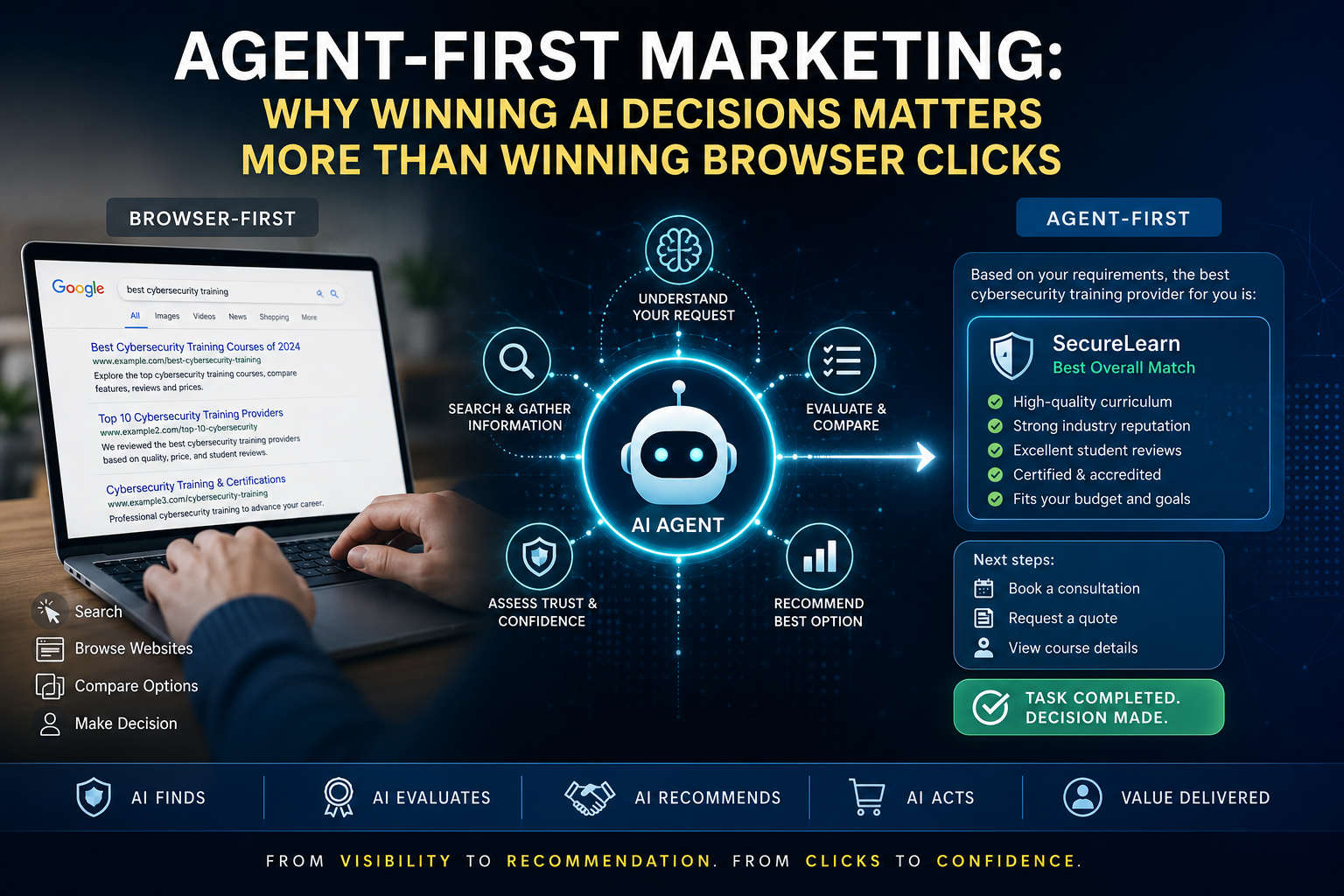
The next evolution of digital marketing isn’t about replacing browsers. It’s about recognising that AI agents are becoming the new decision-makers.
For more than two decades, digital marketing has revolved around one assumption:
A human sits behind a browser.
Every optimisation strategy—SEO, PPC, CRO, UX, landing pages and content marketing—was built around helping a person discover information, compare options and ultimately make a decision.
Success was measured by familiar metrics:
- Rankings
- Impressions
- Click-through rates
- Website visits
- Conversion rates
The browser was the centre of the customer journey.
But that assumption is beginning to change.
Not because browsers are disappearing.
Because decision-making is being delegated.
The Browser Is No Longer The Centre Of The Journey
When someone asks an AI assistant:
“Find me the best cybersecurity training provider.”
or
“Recommend a warehouse IP camera under S$100.”
they are no longer asking for a list of websites.
They are asking for a recommendation.
The AI searches, evaluates, compares, filters and synthesises information before presenting an answer.
Increasingly, users accept that recommendation without opening ten browser tabs.
Tomorrow’s AI agents will go even further.
Instead of helping users browse, they will increasingly perform tasks such as:
- comparing products
- scheduling appointments
- requesting quotations
- booking services
- placing orders
- managing subscriptions
- monitoring renewals
The browser becomes an interface.
The AI agent becomes the decision engine.
From Browser-First To Agent-First Marketing
Traditional digital marketing assumes this journey:
Customer
      ↓
Browser
      ↓
Search Engine
      ↓
Website
      ↓
Decision
The emerging model looks different:
Customer
      ↓
AI Agent
      ↓
Search + Knowledge Sources + APIs
      ↓
Evaluation
      ↓
Recommendation
      ↓
Decision
Notice what changed.
The website hasn’t disappeared.
It simply isn’t the primary destination anymore.
Instead, it becomes one of many knowledge sources the AI uses when making recommendations.
That changes what marketers need to optimise for.
Traffic Is No Longer The First Goal
For years, marketers celebrated website traffic.
More visitors usually meant more opportunities.
In an AI-assisted world, that relationship becomes weaker.
An AI agent may answer a customer’s question directly.
It may recommend your business without generating a website visit.
It may complete a booking through an API.
It may compare specifications without the customer ever seeing your product page.
This doesn’t mean websites become unimportant.
It means the website’s role evolves.
Instead of existing primarily for human visitors, it must increasingly serve both humans and machines.
The New Question Isn’t “Can AI Find Me?”
The more important question is:
Will AI choose me?
Discovery is only the first step.
Selection is where value is created.
An AI agent doesn’t simply retrieve information.
It evaluates competing sources.
It assesses consistency.
It looks for corroborating evidence.
It compares reputation signals.
It weighs confidence before making a recommendation.
Being visible is necessary.
Being selected is what matters.
Why Authority Alone Is No Longer Enough
Many organisations are now investing in AI visibility.
They publish more content.
They implement schema.
They optimise technical SEO.
They strengthen their entity footprint.
All of these remain important.
But visibility and authority alone do not explain repeated recommendations.
An AI agent must also develop confidence that your business is the safest and most reliable choice for the user’s specific context.
Authority answers:
“Should this source be considered?”
Confidence answers:
“Should this source be recommended?”
Delegation answers:
“Should I complete the task using this business?”
These are three different decisions.
Agent-First Marketing Optimises For Machine Confidence
Marketing has traditionally focused on influencing human perception.
Agent-first marketing expands that objective.
It asks:
- Can an AI verify our identity?
- Can it understand our expertise?
- Can it extract accurate information?
- Can it compare us fairly?
- Can it explain why we were recommended?
- Can it complete a task confidently?
These questions increasingly determine whether an AI agent recommends your business—or quietly passes it over.
The Five Foundations Of Agent-First Marketing
1. Verifiable Identity
AI needs confidence that your organisation is who it claims to be.
Consistent entities, ownership, business information and authoritative profiles reduce ambiguity.
Without identity, confidence cannot form.
2. Structured Knowledge
AI cannot recommend what it cannot understand.
Well-organised knowledge architecture, structured data, semantic relationships and comprehensive documentation improve machine comprehension.
Your content should explain your expertise, not merely contain keywords.
3. Confidence Signals
Recommendations are strengthened by corroboration.
Independent citations, customer reviews, recognised expertise, trusted references and consistent information across the web reinforce confidence.
Confidence compounds over time.
4. Actionable Information
AI agents increasingly need operational information.
That includes:
- pricing
- availability
- locations
- service areas
- return policies
- contact channels
- product specifications
- transactional readiness
The easier it is for an agent to act, the more useful your business becomes.
5. Recommendation Readiness
Ultimately, AI agents optimise for successful outcomes.
The organisations most likely to be recommended are those whose information is accurate, current, verifiable and consistently reinforced across multiple trusted sources.
Recommendation is earned—not assumed.
Browser Clicks Still Matter—But They Are No Longer The Whole Story
Some will interpret agent-first marketing as the end of SEO.
That would be a mistake.
Technical SEO remains essential.
Indexing still matters.
Fast websites still matter.
Structured data still matters.
Human user experience still matters.
These foundations enable AI systems to discover and understand your business.
But discovery alone is no longer enough.
The competitive advantage increasingly shifts towards becoming the organisation that AI confidently recommends.
This is not the replacement of SEO.
It is the evolution of digital marketing.
The Next Competitive Battleground
For years, brands competed for rankings.
Increasingly, they will compete for recommendations.
Eventually, they will compete for delegated decisions.
The businesses that succeed will not necessarily publish the most content.
They will build the strongest systems of identity, knowledge, confidence and trust.
In an agent-first world, visibility starts the conversation.
Authority earns consideration.
Confidence earns recommendation.
That is why the future of digital marketing is no longer simply about winning browser clicks.
It is about winning AI decisions.
Key Takeaways
- Browser-first marketing optimises for human navigation.
- Agent-first marketing optimises for AI decision-making.
- Visibility gets you discovered; recommendation gets you chosen.
- AI agents increasingly evaluate confidence, not just relevance.
- Businesses should build verifiable identity, structured knowledge, confidence signals and actionable information.
- SEO remains the foundation, but recommendation readiness becomes the competitive differentiator.
- The future of digital marketing belongs to organisations that are selected—not merely found.
Suggested FAQ
1. What is agent-first marketing?
Agent-first marketing is the practice of optimising your digital presence so AI agents can accurately understand, evaluate and confidently recommend your business—not just help humans find it.
2. Does agent-first marketing replace SEO?
No. SEO remains the foundation for discovery and crawlability. Agent-first marketing builds on SEO by focusing on recommendation confidence, trust and task completion.
3. Why are browser clicks becoming less important?
AI assistants increasingly answer questions, compare products and make recommendations directly, reducing the need for users to visit multiple websites before making a decision.
4. What makes an AI agent recommend one business over another?
While implementations differ, common factors include clear identity, high-quality structured information, consistent facts across sources, credible third-party validation, demonstrated expertise and up-to-date, actionable information.
5. How can businesses prepare for an agent-first future?
Strengthen your technical SEO, improve your knowledge architecture, maintain consistent business information, publish authoritative first-party content, reinforce external credibility and ensure operational information is accurate and machine-readable.
Leave a Reply