
Why The Future Of AI May Require More Than Recommendations
Artificial intelligence is becoming increasingly capable of recommending products, services, experts, and brands.
Ask an AI assistant for the best CRM.
It can provide recommendations.
Ask for marketing agencies.
It can provide options.
Ask for software platforms.
It can compare alternatives.
These recommendations are becoming increasingly useful.
But a much bigger question is beginning to emerge:
What happens when AI moves beyond recommendation and begins acting on behalf of users?
This is where an important distinction appears.
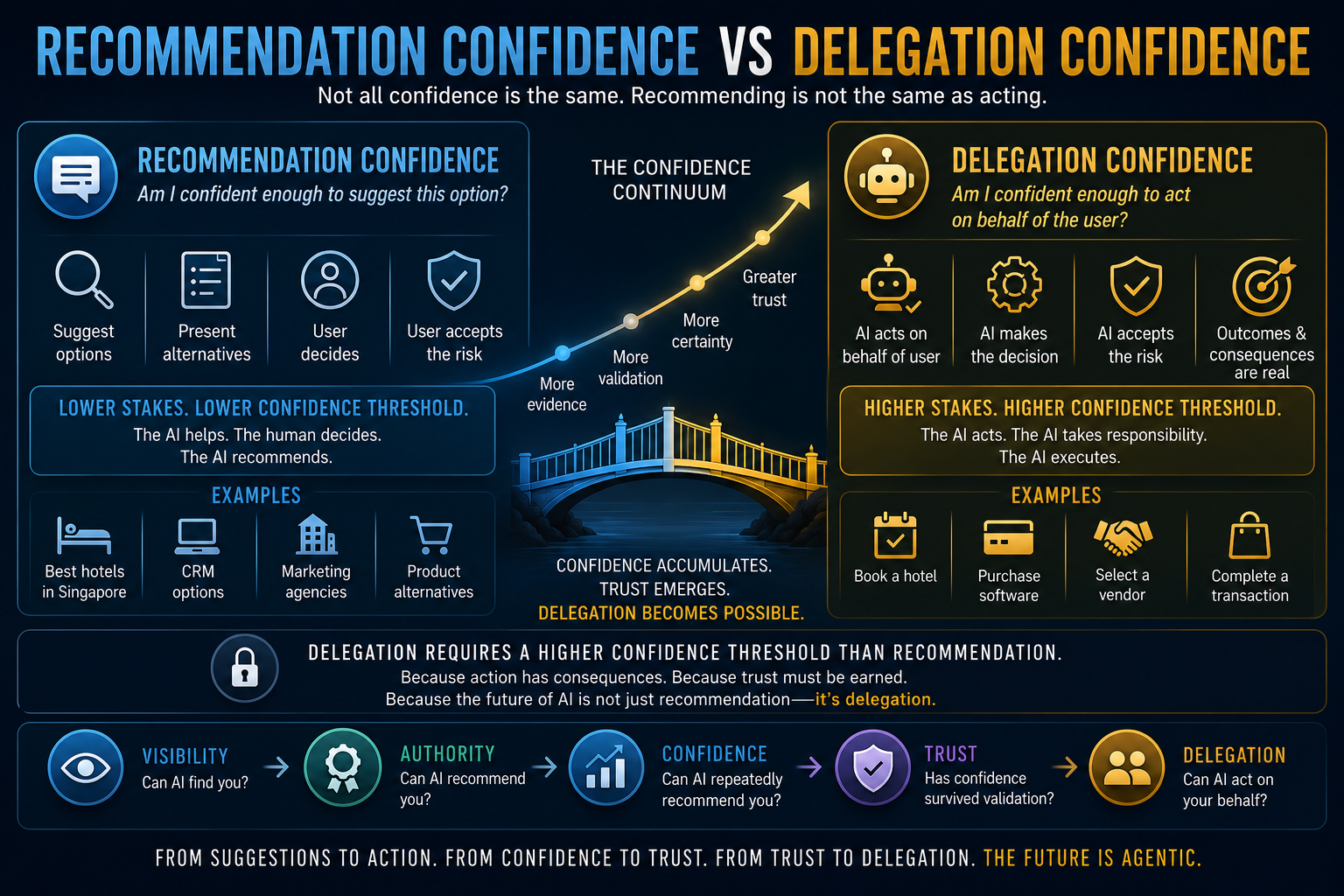
Recommendation confidence is not the same as delegation confidence.
And understanding the difference may become critical as AI systems evolve toward agentic commerce.
The Confidence Gap
Today, most AI interactions stop at recommendations.
The AI provides options.
The human decides.
The human accepts the risk.
The human remains accountable for the outcome.
This means AI only needs enough confidence to make a recommendation.
But delegation changes the equation.
When AI books an appointment, purchases a product, selects a supplier, or executes a transaction, the consequences become different.
The AI is no longer helping a decision.
It is participating in one.
This introduces a confidence gap.
The confidence required to recommend may be lower than the confidence required to act.
What Is Recommendation Confidence?
Recommendation confidence answers a relatively simple question:
“Am I confident enough to suggest this option?”
Examples include:
- Recommending a restaurant
- Suggesting a software platform
- Proposing a service provider
- Presenting product alternatives
The user remains responsible for the final decision.
The AI is helping.
Not acting.
Recommendation confidence is primarily about reducing uncertainty enough to surface an option.
It does not require certainty.
It requires sufficient confidence to participate in the evaluation process.
What Is Delegation Confidence?
Delegation confidence answers a different question:
“Am I confident enough to act on behalf of the user?”
Examples may include:
- Booking a hotel
- Purchasing software
- Scheduling appointments
- Selecting vendors
- Completing transactions
The stakes become higher.
The risks become greater.
The consequences become more direct.
This means the confidence threshold rises significantly.
Delegation requires more than recommendation.
It requires confidence strong enough to support action.
Why Delegation Requires More Confidence
Imagine asking AI:
“What are the best hotels in Singapore?”
A recommendation is relatively low risk.
The AI can provide several options.
You decide.
Now imagine asking:
“Book the best hotel for my business trip.”
The situation changes.
The AI is no longer suggesting.
It is choosing.
Mistakes now have consequences.
The confidence threshold becomes much higher.
The same principle applies across:
- Finance
- Healthcare
- Travel
- Procurement
- Professional services
The greater the consequence, the greater the confidence required.
The Role Of Trust
This is where trust becomes important.
Recommendation confidence may allow AI to suggest.
Delegation confidence may require AI to trust.
Trust reduces uncertainty enough to support action.
In other words:
Recommendation confidence helps AI recommend.
Trust enables AI to act.
The bridge between the two may be confidence accumulation.
Repeated evidence.
Repeated validation.
Repeated successful outcomes.
Over time, confidence grows.
Trust begins to emerge.
Delegation becomes possible.
A New Confidence Threshold
One way to think about this is through confidence thresholds.
Recommendation Threshold
Confidence is sufficient to suggest an option.
Human review remains central.
Human approval remains required.
Delegation Threshold
Confidence becomes strong enough to support action.
The AI can execute with reduced human involvement.
Trust becomes increasingly important.
The threshold is different.
The requirement is different.
The risk is different.
This distinction may become one of the defining characteristics of future AI systems.
What This Means For Brands
Many organizations are currently focused on visibility and recommendation.
Can AI find us?
Can AI recommend us?
These remain important questions.
But future brands may face another challenge:
Can AI trust our brands enough to act?
This requires more than authority.
More than awareness.
More than visibility.
It may require accumulated confidence that survives repeated validation.
Brands that consistently demonstrate:
- Competence
- Consistency
- Credibility
- Transparency
- Accountability
may become better positioned for this future.
Not because these factors guarantee trust.
But because they may contribute to confidence accumulation over time.
The Evolution Of AI Visibility
The evolution may look something like this:
Visibility
Can AI find you?
↓
Authority
Can AI recommend you?
↓
Confidence
Can AI repeatedly recommend you?
↓
Trust
Has confidence survived validation?
↓
Delegation
Can AI act on behalf of the user?
Each stage introduces a higher threshold.
Each stage requires greater certainty.
Each stage reduces tolerance for uncertainty.
The Future Of Agentic Commerce
The future of AI may not be defined by recommendations alone.
It may be defined by decisions.
And eventually, delegated actions.
Recommendation confidence and delegation confidence are not the same thing.
One supports suggestions.
The other supports action.
Understanding the difference may become increasingly important as AI systems move from information retrieval toward autonomous execution.
Because the future question may not be:
Can AI recommend my brand?
It may be:
Can AI become confident enough to act on my brand?
And the answer may depend on how confidence accumulates, how trust is formed, and how uncertainty is reduced over time.
In the Recommendation Era, being selected may be enough.
In the Delegation Era, being trusted may become essential.
FAQ
1. What is recommendation confidence?
Recommendation confidence is the level of certainty AI needs to suggest an option to a user. The AI recommends, but the human still reviews, decides, and accepts the risk.
2. What is delegation confidence?
Delegation confidence is the higher level of certainty AI may need before acting on behalf of a user, such as booking, buying, selecting, scheduling, or completing a transaction.
3. Why is delegation confidence higher than recommendation confidence?
Delegation confidence is higher because action creates greater consequences. Recommending a hotel is lower risk than booking one. Suggesting a vendor is lower risk than selecting and paying that vendor.
4. How does trust relate to delegation confidence?
Trust emerges when confidence survives repeated validation over time. Delegation becomes possible when trust reaches a sufficient threshold for action.
5. Why does this matter for agentic commerce?
Agentic commerce depends on AI systems acting for users, not just advising them. This means brands may need to build enough confidence and trust for AI systems to move from recommendation to delegated action.
6. What should brands do to prepare for delegation confidence?
Brands should focus on competence, consistency, credibility, transparency, accountability, verifiable evidence, reliable outcomes, and clear recovery paths when things go wrong.
Leave a Reply