
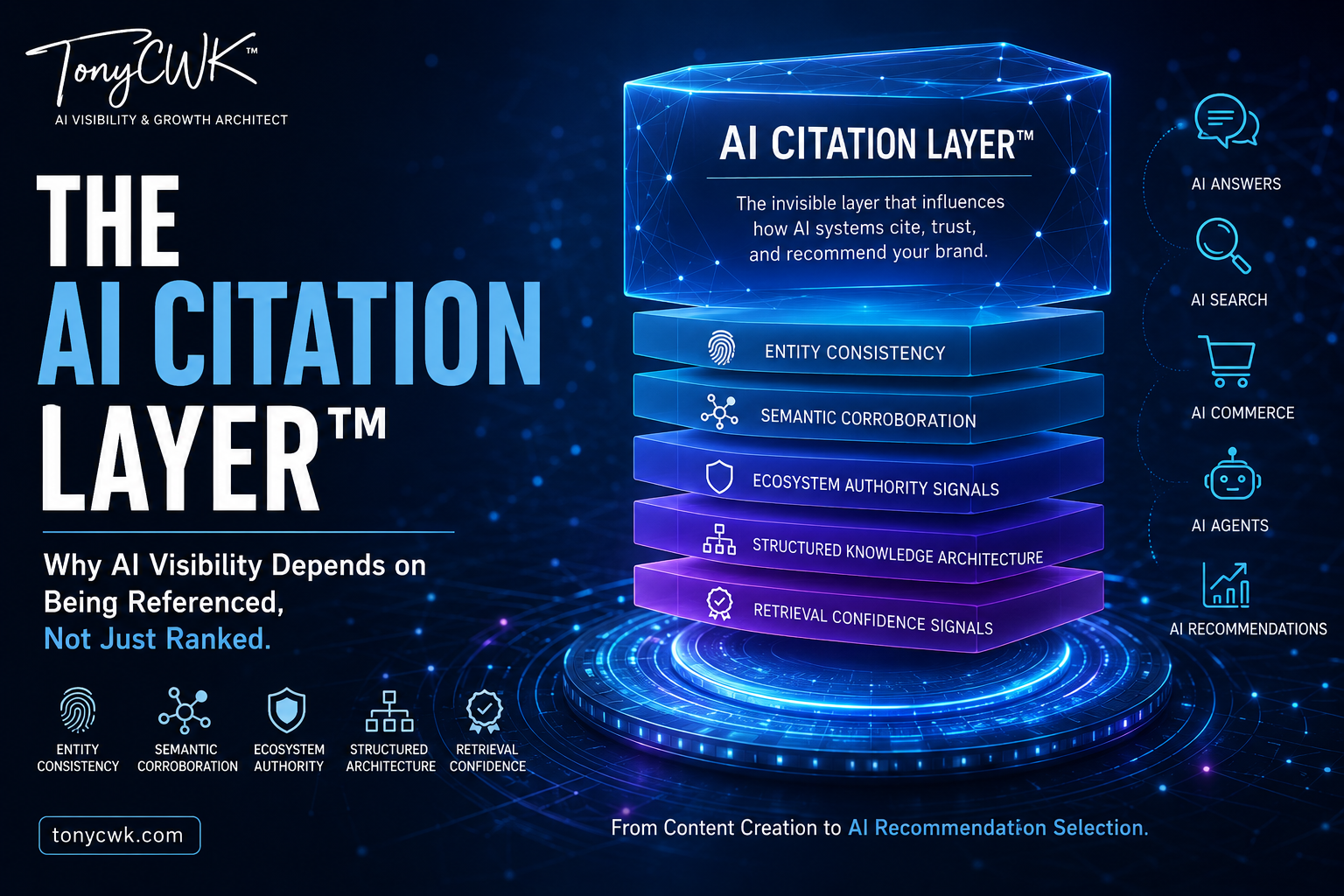
Why AI Visibility Depends on Being Referenced, Not Just Ranked
For more than two decades, digital visibility was largely built on one principle:
Rank higher. Get clicked.
But in the age of AI-generated answers, recommendation engines, and delegated search experiences, visibility is increasingly determined by something else entirely:
Whether AI systems choose to reference you.
This shift introduces a new strategic infrastructure layer that most businesses have not yet fully understood:
The AI Citation Layer™
The AI Citation Layer™ represents the ecosystem of signals, references, corroborations, structured entities, semantic consistency, and retrieval confidence mechanisms that influence whether AI systems cite, recommend, mention, or rely on a brand during generated responses.
In traditional SEO, rankings determined discoverability.
In AI systems, citations increasingly determine legitimacy.
And legitimacy determines selection.
The Shift From Rankings to Citations
Traditional search engines primarily operated through:
- indexing
- crawling
- keyword relevance
- backlinks
- SERP rankings
But modern AI systems operate differently.
Large language models and AI discovery systems synthesize information from:
- multiple web sources
- structured entities
- semantic relationships
- corroborated mentions
- authoritative ecosystems
- knowledge graph consistency
- contextual reinforcement
This means AI systems do not simply ask:
“Who ranks first?”
They increasingly ask:
“Which source appears most trustworthy, repeatedly referenced, semantically reinforced, and contextually reliable?”
That is the foundation of the AI Citation Layer™.
What Is The AI Citation Layer™?
The AI Citation Layer™ is the invisible recommendation infrastructure that influences how AI systems determine:
- which brands to mention
- which companies to trust
- which websites to summarize
- which entities to recommend
- which sources to synthesize into answers
- which businesses to ignore
It is the layer between:
Content Creation
and
AI Recommendation Selection
Most brands today focus heavily on content production.
Very few focus on citation architecture.
That gap will become one of the defining competitive advantages of the AI era.
Why Citations Matter More in AI Systems
In traditional search, a user evaluated links manually.
In AI interfaces, the AI increasingly performs the evaluation on behalf of the user.
This changes the economics of trust.
When an AI system cites or references a source, it is effectively performing:
- trust delegation
- authority transfer
- recommendation signaling
- probabilistic confidence scoring
In other words:
AI citations are not merely references.
They are machine-level trust indicators.
The 5 Components of The AI Citation Layer™
1. Entity Consistency
AI systems rely heavily on entity clarity.
Brands with fragmented naming structures create ambiguity.
Consistent reinforcement across:
- websites
- directories
- media mentions
- structured schema
- podcasts
- social platforms
helps AI systems build stronger entity confidence.
This improves retrieval certainty.
2. Semantic Corroboration
AI systems look for repeated conceptual alignment across multiple independent sources.
For example, if multiple sources consistently associate a brand with:
- AI Authority
- AI Discovery
- Generative Search Optimization
- Recommendation Systems
the AI develops stronger thematic confidence.
This creates semantic reinforcement loops.
3. Ecosystem Authority Signals
AI systems increasingly evaluate not just the website itself, but the surrounding ecosystem.
This includes:
- third-party mentions
- interviews
- podcast appearances
- citations by industry sites
- academic references
- professional commentary
- social validation
Authority is becoming ecosystem-based rather than domain-based.
4. Structured Knowledge Architecture
AI systems prefer extractable knowledge.
Brands with:
- clear topical clustering
- structured headings
- schema markup
- FAQ architecture
- semantic organization
- contextual internal linking
are easier for AI systems to retrieve, interpret, and synthesize.
Structure improves citation probability.
5. Retrieval Confidence Signals
AI systems prioritize information that appears:
- stable
- coherent
- repeatedly reinforced
- low-risk
- contextually aligned
This is why fragmented messaging weakens AI recommendation confidence.
The stronger the retrieval confidence, the higher the likelihood of citation.
The AI Citation Economy™
We are entering a new digital economy where:
Visibility is no longer purely earned through ranking.
It is increasingly earned through citation eligibility.
This creates a fundamental transition:
| Traditional SEO Era | AI Citation Era |
|---|---|
| Rankability | Citation Probability |
| Keywords | Semantic Reinforcement |
| Backlinks | Retrieval Confidence |
| Search Impressions | Recommendation Presence |
| SERP Position | AI Mention Frequency |
| Click Optimization | Selection Optimization |
The future competitive advantage may not belong to the loudest brand.
It may belong to the most consistently corroborated one.
Why Most Brands Are Unprepared
Most organizations still optimize primarily for:
- clicks
- rankings
- traffic
- impressions
- ads
- page-level SEO
But AI systems increasingly evaluate:
- entity reliability
- contextual consistency
- semantic trust
- ecosystem reinforcement
- citation legitimacy
This means many companies may still rank well in Google while simultaneously becoming weak AI recommendation candidates.
That gap will widen over time.
The Rise of Citation Engineering™
As AI systems become recommendation intermediaries, businesses will increasingly need to engineer:
- citation consistency
- semantic clarity
- authority reinforcement
- ecosystem visibility
- retrieval confidence
- cross-platform coherence
This introduces a new strategic discipline:
Citation Engineering™
Citation Engineering™ is the deliberate process of designing digital ecosystems that improve AI citation probability and recommendation trustworthiness.
This is likely to become a major competitive discipline in the AI era.
The Future of AI Visibility
The future of digital visibility is evolving from:
Being Found
to
Being Referenced
And eventually:
Being Selected Automatically
As AI systems move toward:
- delegated search
- autonomous recommendations
- conversational commerce
- agentic discovery
- AI-assisted decisions
the AI Citation Layer™ becomes increasingly critical.
Because AI systems cannot recommend what they cannot confidently trust.
The Strategic Implication for Businesses
Businesses that succeed in the next era will likely focus less on isolated content tactics and more on:
- ecosystem-wide semantic authority
- entity reinforcement
- structured knowledge systems
- citation consistency
- AI-readable credibility
- retrieval trust architecture
This is not merely an SEO evolution.
It is a visibility infrastructure transformation.
Final Thought
In the traditional web:
Pages competed for rankings.
In the AI era:
Entities compete for citations.
And in the future of delegated discovery:
Citations may become the foundation of algorithmic trust itself.
The brands that understand this early will not merely become more searchable.
They may become more recommendable, retrievable, and selectable across the emerging AI ecosystem.
That is the strategic importance of:
The AI Citation Layer™
FAQ Section — The AI Citation Layer™
1. What is The AI Citation Layer™?
The AI Citation Layer™ refers to the ecosystem of references, semantic signals, entity consistency, corroborated mentions, and retrieval confidence indicators that influence whether AI systems cite, mention, recommend, or trust a brand during generated responses.
2. Why is citation becoming important in AI systems?
AI systems increasingly synthesize information instead of simply ranking pages. This means visibility depends more on whether a source is considered trustworthy, corroborated, and contextually reliable enough to be referenced in AI-generated outputs.
3. How is the AI Citation Layer™ different from traditional SEO?
Traditional SEO primarily focused on rankings, backlinks, and keywords. The AI Citation Layer™ focuses on semantic reinforcement, entity clarity, ecosystem authority, structured knowledge, and retrieval confidence that influence AI recommendation behavior.
4. Do AI systems use citations the same way humans do?
Not exactly. Human citations often serve academic or attribution purposes. AI citations function more as machine-level trust validation signals that help systems determine which sources appear most reliable and recommendation-worthy.
5. What is citation probability in AI systems?
Citation probability refers to the likelihood that an AI system will reference, mention, synthesize, or recommend a brand or source during generated responses based on its confidence in that entity.
6. What affects AI citation probability?
Factors include:
- entity consistency
- semantic reinforcement
- structured schema
- ecosystem authority signals
- third-party corroboration
- retrieval confidence
- contextual coherence
- AI-readable content architecture
7. Why does entity consistency matter for AI citations?
AI systems rely heavily on entity resolution. Consistent naming, positioning, and thematic reinforcement across platforms help AI systems confidently identify and trust a brand.
8. What are ecosystem authority signals?
Ecosystem authority signals include:
- media mentions
- interviews
- podcasts
- directory listings
- professional commentary
- social references
- third-party citations
- cross-platform validation
These reinforce credibility beyond a company’s own website.
9. How does structured content improve AI citation potential?
Structured content improves extractability. AI systems prefer content that is easy to interpret, segment, summarize, and retrieve through clear headings, schema markup, FAQs, semantic clustering, and contextual linking.
10. What is retrieval confidence?
Retrieval confidence refers to the level of certainty an AI system has that retrieved information is coherent, trustworthy, stable, and contextually aligned.
11. Can brands rank well on Google but still perform poorly in AI recommendations?
Yes. A website may still rank strongly in traditional search while lacking the semantic consistency, corroboration, and ecosystem reinforcement required for strong AI recommendation visibility.
12. What is Citation Engineering™?
Citation Engineering™ is the strategic process of designing digital ecosystems that improve AI citation probability through semantic consistency, authority reinforcement, entity clarity, and retrieval trust architecture.
13. How does semantic reinforcement influence AI citations?
When multiple independent sources repeatedly associate a brand with certain topics or expertise areas, AI systems gain stronger confidence in that thematic relationship.
14. Will backlinks become less important in the AI era?
Backlinks may still matter, but their role is evolving. AI systems increasingly evaluate broader contextual credibility and semantic corroboration rather than relying solely on hyperlink authority.
15. How does the AI Citation Layer™ relate to AI Authority™?
The AI Citation Layer™ can be viewed as part of AI Authority™ infrastructure because citations reinforce trust, retrieval confidence, recommendation legitimacy, and algorithmic recognition.
16. Why are AI systems shifting from retrieval to recommendation?
Modern AI systems aim to reduce decision friction for users by synthesizing trusted answers directly rather than simply presenting lists of links for manual evaluation.
17. What role do FAQs and schema play in AI citations?
FAQs and schema improve machine readability and structured extraction, helping AI systems better interpret and retrieve information confidently.
18. How can SMEs compete in the AI Citation Era?
SMEs can compete effectively by building:
- strong thematic authority
- consistent entity positioning
- structured knowledge ecosystems
- niche expertise reinforcement
- high semantic coherence
Smaller brands often move faster and maintain clearer positioning than large fragmented organizations.
19. What industries will be most affected by the AI Citation Layer™?
Industries heavily influenced by trust, expertise, comparison, and recommendation systems may see the greatest impact, including:
- digital marketing
- consulting
- healthcare
- finance
- SaaS
- education
- e-commerce
- professional services
20. What is the future significance of the AI Citation Layer™?
As AI interfaces become more agentic and recommendation-driven, the AI Citation Layer™ may become a foundational infrastructure for algorithmic trust, automated selection, and delegated discovery.
Suggested Further Reading
- “AI Authority Systems” 👉 https://tonycwk.com/ai-authority-systems/
- “Retrieval Confidence™” 👉 https://tonycwk.com/retrieval-confidence/
- “Selection Intelligence™” 👉 https://tonycwk.com/selection-intelligence/
- “AI Selection Systems™” 👉 https://tonycwk.com/ai-selection-systems/
- “The Future of Search Is Recommendation, Not Retrieval” 👉 https://tonycwk.com/the-future-of-search-is-recommendation-not-retrieval/
- “Algorithmic Authority Recognition” 👉 https://tonycwk.com/algorithmic-authority-recognition/
- “Entity Persistence in the Age of LLMs” 👉 https://tonycwk.com/entity-persistence-in-the-age-of-llms/
- “The AI Discovery Flywheel” 👉 https://tonycwk.com/ai-discovery-flywheel/
- “The AI Authority Pyramid™” 👉 https://tonycwk.com/ai-authority-pyramid/
- “Why AI Doesn’t Trust Content — It Trusts Systems” 👉 https://tonycwk.com/why-ai-doesnt-trust-content-it-trusts-systems/
Written by Tony Chan (TonyCWK)
AI Authority & Digital Strategy Researcher
Leave a Reply