
Why the Future of Digital Visibility Is No Longer About Rankings Alone
For over two decades, digital marketing operated on a relatively stable premise:
Visibility created opportunity.
Brands competed for:
- search rankings
- impressions
- clicks
- traffic
- conversions
The dominant assumption was simple:
If users could find your business, they could evaluate your business.
But AI is fundamentally changing this relationship.
We are now entering an era where users increasingly delegate discovery, evaluation, comparison, and even transaction decisions to AI systems.
This shift represents one of the most significant transformations in the history of digital commerce.
And it introduces a new competitive reality:
Brands are no longer competing only for visibility.
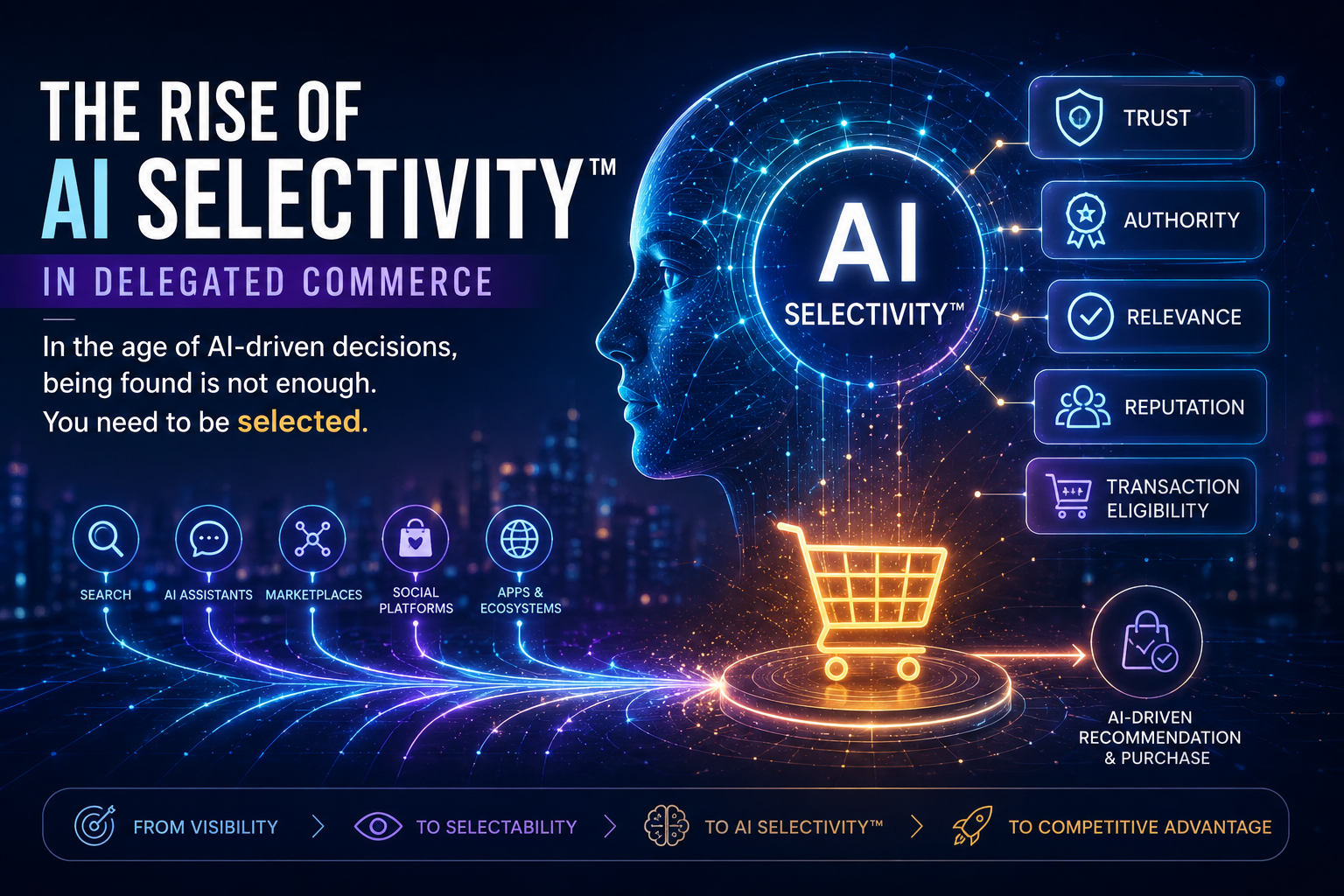
They are competing for AI selectivity.
What Is AI Selectivity™?
AI Selectivity™ refers to:
The process by which AI systems determine which brands, products, services, entities, or sources are most eligible for recommendation, inclusion, prioritization, or transactional delegation.
In traditional search:
users selected.
In delegated commerce:
AI increasingly selects on behalf of users.
This changes everything.
Because the future competitive advantage may no longer belong to the brands that are merely discoverable.
It may belong to the brands that AI systems consistently trust enough to recommend.
From Search Engines to Decision Engines
Traditional search engines primarily functioned as retrieval systems.
Users searched.
Search engines returned links.
Humans performed evaluation manually.
But modern AI systems increasingly operate as:
- recommendation engines
- synthesis engines
- decision-support systems
- intent interpreters
- transactional assistants
This evolution shifts the role of digital platforms from:
“helping users find information”
to
“helping users make decisions.”
That transition fundamentally changes how digital authority is formed.
The Rise of Delegated Commerce
Delegated commerce describes an emerging environment where consumers increasingly outsource parts of the purchasing journey to AI systems.
Instead of:
- manually comparing dozens of websites
- researching multiple brands
- reading endless reviews
- evaluating product specifications individually
users may increasingly rely on AI to:
- shortlist products
- compare features
- evaluate trustworthiness
- interpret value
- optimize purchases
- execute transactions
This means AI systems are becoming:
the new gatekeepers of digital commerce.
And gatekeepers require selection logic.
That logic is where AI Selectivity™ emerges.
Why Rankings Alone Are Becoming Insufficient
Traditional SEO was largely optimized around:
- keyword visibility
- ranking positions
- click-through rates
- backlink acquisition
- search traffic
But AI systems evaluate information differently.
Modern AI recommendation systems increasingly assess:
- semantic consistency
- entity clarity
- contextual authority
- retrieval confidence
- ecosystem credibility
- structured knowledge architecture
- cross-platform reinforcement
- recommendation reliability
This means a highly ranked page does not automatically become:
a highly recommended entity.
Visibility does not necessarily equal selection.
The New Visibility Model
The digital visibility model is evolving across three major eras:
1. Search Era
Competitive advantage centered around:
- rankings
- traffic
- discoverability
Primary objective:
Being found.
2. AI Discovery Era
Competitive advantage increasingly centers around:
- AI recommendation eligibility
- semantic authority
- retrieval confidence
- ecosystem trust
Primary objective:
Being selected.
3. Delegated Commerce Era
Competitive advantage may increasingly center around:
- transactional inclusion
- AI purchasing preference
- autonomous recommendation trust
- ecosystem recommendation persistence
Primary objective:
Being delegated.
AI Systems Are Building Preference Models
One of the most underestimated developments in AI commerce is this:
AI systems do not merely retrieve information.
They increasingly form preference models.
These systems may learn to prioritize entities that demonstrate:
- higher confidence signals
- stronger ecosystem consistency
- reliable structured data
- repeated authority reinforcement
- trustworthy external validation
- stronger recommendation coherence
Over time, AI systems may become increasingly selective regarding:
- which brands to surface
- which products to recommend
- which businesses to prioritize
- which sources to trust
This is the foundation of AI Selectivity™.
The Shift From Click Optimization to Selection Eligibility
Historically, marketers optimized for:
- clicks
- reach
- impressions
- engagement
But in delegated commerce systems, brands may increasingly need to optimize for:
- recommendation eligibility
- retrieval consistency
- semantic trust
- ecosystem authority
- AI interpretability
- decision confidence
This creates a major strategic transition:
From:
“How do we attract traffic?”
To:
“How do we become recommendation-worthy?”
AI Selectivity™ and the Future of Ecommerce
As AI systems become increasingly integrated into commerce ecosystems, future transactional models may include:
- AI-assisted purchasing
- autonomous shopping agents
- universal cart systems
- multi-platform transaction orchestration
- predictive purchasing
- delegated procurement systems
In these environments, users may not manually browse every option.
Instead:
AI systems may increasingly filter the market before humans even see the choices.
That means:
many brands may become invisible before traditional competition even begins.
This is why AI Selectivity™ may become one of the defining competitive forces of the next digital era.
The Emerging AI Commerce Advantage
In delegated commerce systems, the strongest brands may not necessarily be:
- the loudest
- the largest
- the most visible
Instead, they may increasingly be the brands that:
- AI systems understand clearly
- recommendation systems trust consistently
- retrieval systems validate confidently
- ecosystems reinforce repeatedly
This represents a shift from:
attention competition
to
recommendation competition.
The Future Competitive Question
The future question for businesses may no longer be:
“Can customers find us?”
Instead, it may increasingly become:
“Will AI systems choose us?”
That is the strategic importance of AI Selectivity™.
Conclusion
The rise of delegated commerce signals a major transformation in digital visibility.
As AI systems increasingly participate in:
- discovery
- evaluation
- comparison
- recommendation
- transaction orchestration
the nature of competitive advantage changes fundamentally.
The future of digital success may no longer depend solely on being searchable.
It may depend on being selectable.
And in the age of AI-driven recommendation systems, AI Selectivity™ may become one of the most important strategic capabilities businesses need to build.
FAQ for “The Rise of AI Selectivity™ in Delegated Commerce”
1. What is AI Selectivity™?
AI Selectivity™ refers to the process by which AI systems decide which brands, products, services, or sources are most suitable to recommend, prioritize, include, or delegate decisions toward.
2. Why is AI Selectivity™ important?
AI Selectivity™ is important because AI systems are increasingly influencing what users discover, compare, trust, and buy. Brands may no longer compete only for visibility, but for recommendation eligibility.
3. What is delegated commerce?
Delegated commerce is the shift where users rely on AI systems to assist with or manage parts of the buying journey, including discovery, comparison, evaluation, recommendation, and transaction.
4. How is AI Selectivity™ different from SEO?
SEO focuses mainly on helping content rank and become discoverable. AI Selectivity™ focuses on whether AI systems trust, understand, and prefer a brand enough to recommend it.
5. Does AI Selectivity™ replace SEO?
No. SEO remains important, but AI Selectivity™ extends beyond rankings. It adds authority, trust, structured knowledge, semantic clarity, and recommendation confidence.
6. How does universal cart relate to AI Selectivity™?
Universal cart systems signal a future where AI may help users move from discovery to transaction across platforms. This increases the importance of being selected by AI before the purchase decision happens.
7. Why are clicks becoming less important in delegated commerce?
Clicks may become less central because AI systems can summarize, compare, recommend, and potentially transact without requiring users to visit multiple websites manually.
8. What makes a brand AI-selectable?
A brand becomes AI-selectable when it has clear entity signals, consistent information, strong authority content, structured data, external credibility, and trustworthy ecosystem reinforcement.
9. How does AI Selectivity™ affect ecommerce?
In ecommerce, AI Selectivity™ may influence which products are shortlisted, recommended, compared, or placed into AI-assisted transaction flows.
10. Can small businesses benefit from AI Selectivity™?
Yes. Small businesses can benefit if they build strong topical authority, clear positioning, structured content, reviews, credibility signals, and consistent brand information across platforms.
11. Is AI Selectivity™ only relevant to ecommerce brands?
No. While ecommerce is highly affected, AI Selectivity™ also matters for consultants, service providers, local businesses, B2B companies, educators, and professional experts.
12. What is the difference between Selectability™ and AI Selectivity™?
Selectability™ is the brand’s ability to qualify for AI recommendation. AI Selectivity™ is the AI system’s process of choosing, filtering, or preferring one option over another.
13. How does Retrieval Confidence™ support AI Selectivity™?
Retrieval Confidence™ supports AI Selectivity™ by helping AI systems retrieve, validate, and trust information about a brand consistently across contexts.
14. What role does structured data play in AI Selectivity™?
Structured data helps AI systems understand entities, relationships, products, services, authorship, organization details, and content context more clearly.
15. How can brands improve AI Selectivity™?
Brands can improve AI Selectivity™ by building authority content, using structured data, strengthening reviews and citations, maintaining cross-platform consistency, and creating AI-readable knowledge architecture.
16. Why is AI Selectivity™ a competitive advantage?
It is a competitive advantage because the brands AI systems choose may gain disproportionate visibility, trust, and transactional opportunity in AI-mediated journeys.
17. How does delegated commerce affect digital marketing?
Delegated commerce shifts digital marketing from traffic acquisition toward trust-building, recommendation eligibility, structured authority, and AI-assisted decision influence.
18. Will paid ads still matter in the age of AI Selectivity™?
Yes, paid ads may still matter, but they may become less sufficient on their own. Brands will also need organic authority, trust signals, and AI-readable credibility.
19. What is the future of digital visibility?
The future of digital visibility is moving from being found in search results to being selected by AI systems and potentially included in AI-assisted transaction pathways.
20. Why should businesses act on AI Selectivity™ now?
Businesses should act now because AI systems are already reshaping discovery and decision-making. Early authority-building may create long-term advantages before the category becomes crowded.
Suggested Further Reading
- AI Authority™ 👉 https://tonycwk.com/what-is-ai-authority/
- AI Selection Systems™ 👉 https://tonycwk.com/ai-selection-systems/
- Selection Intelligence™ 👉 https://tonycwk.com/selection-intelligence/
- Retrieval Confidence™ 👉 https://tonycwk.com/retrieval-confidence/
- Algorithmic Authority Recognition 👉 https://tonycwk.com/algorithmic-authority-recognition/
- Why AI Doesn’t Trust Content — It Trusts Systems 👉 https://tonycwk.com/why-ai-doesnt-trust-content-it-trusts-systems/
- The AI Discovery Flywheel 👉 https://tonycwk.com/ai-discovery-flywheel/
- AI Authority Framework 👉 https://tonycwk.com/ai-authority-framework/
Written by Tony Chan (TonyCWK)
AI Authority & Digital Strategy Researcher
Leave a Reply