
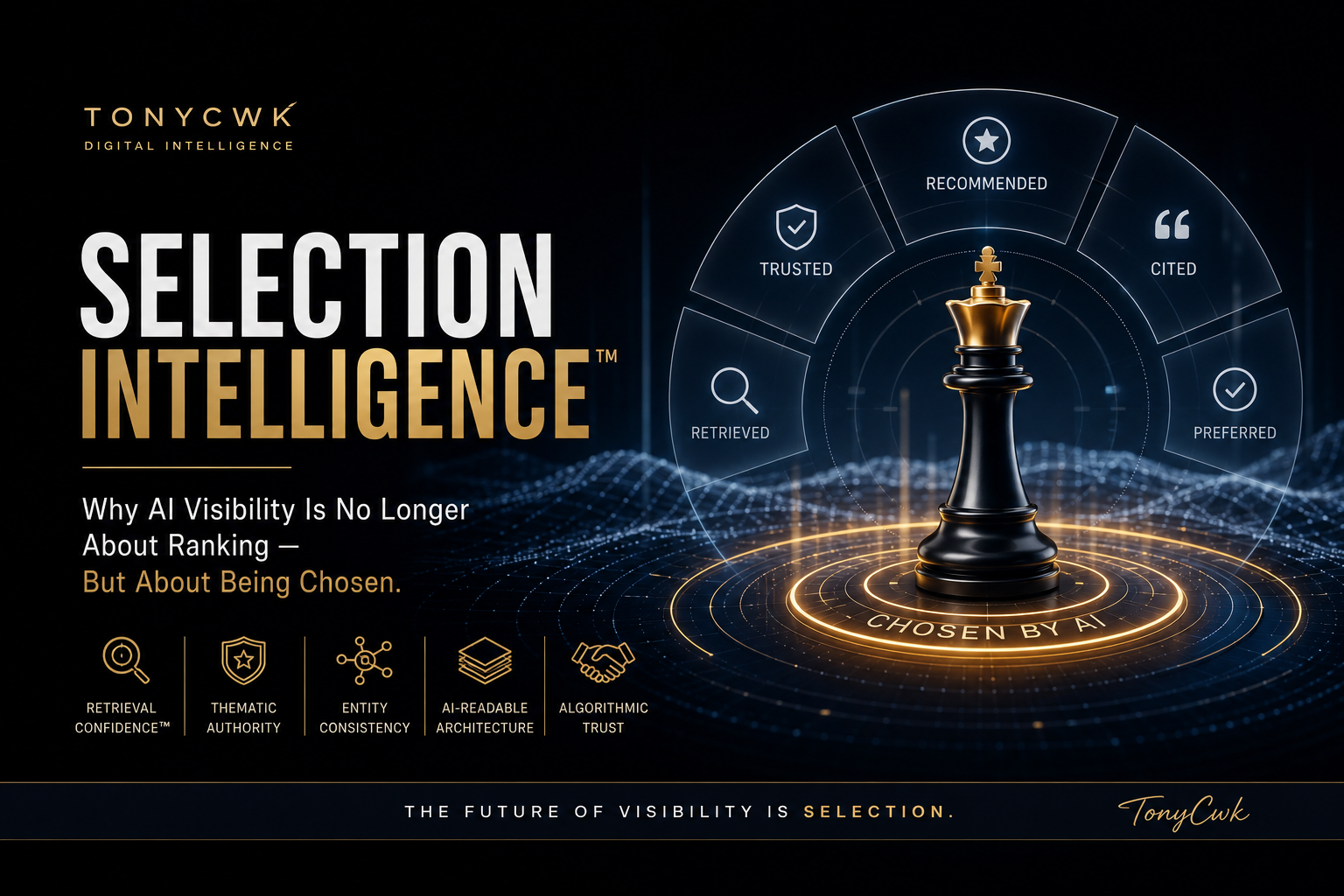
Why AI Visibility Is No Longer About Ranking — But About Being Chosen
In the traditional internet era, digital visibility was largely governed by search rankings.
Brands competed for:
- clicks
- impressions
- traffic
- keyword positions
- ad placements
The underlying assumption was simple:
If users can find you, visibility is achieved.
But in the age of AI systems, that assumption is collapsing.
Modern AI interfaces no longer merely retrieve information.
They increasingly:
- evaluate
- filter
- synthesize
- prioritize
- recommend
- decide
This introduces a new competitive layer in digital visibility:
Selection Intelligence™
Selection Intelligence™ refers to the capability of AI systems to determine which entities deserve inclusion, recommendation, retrieval priority, citation confidence, and algorithmic trust.
In other words:
AI systems are no longer optimizing for discoverability alone.
They are optimizing for selectability.
The Shift From Search Engines to Selection Engines
Traditional search engines primarily operated on:
- keyword matching
- backlinks
- page authority
- crawlability
- ranking signals
Modern AI systems operate differently.
Large Language Models (LLMs), recommendation systems, AI assistants, retrieval systems, and agentic AI increasingly evaluate:
- semantic coherence
- contextual authority
- retrieval confidence
- source consistency
- structured knowledge integrity
- citation reliability
- entity persistence
- cross-platform trust alignment
This transforms AI systems into:
Selection Engines
The key question is no longer:
“Can your content rank?”
The more important question becomes:
“Will the AI choose your brand when synthesizing an answer?”
That is the foundation of Selection Intelligence™.
Why Selection Intelligence™ Matters
In AI-driven environments, users increasingly consume:
- summarized answers
- AI recommendations
- synthesized comparisons
- agentic decisions
- conversational outputs
without visiting multiple websites.
This means:
The number of visible positions collapses dramatically.
Traditional search once offered:
- 10 blue links
- paid ads
- map listings
- featured snippets
- multiple browsing opportunities
AI systems may only present:
- 1 recommendation
- 3 cited brands
- 1 summarized answer
- 1 chosen workflow
- 1 preferred vendor
This creates a new visibility economy:
Selection Scarcity
As AI interfaces compress visibility surfaces, the value of being selected increases exponentially.
The Five Core Layers of Selection Intelligence™
1. Retrieval Confidence™
AI systems prioritize entities they can retrieve consistently and confidently.
This depends on:
- structured semantic alignment
- authoritative associations
- clear entity relationships
- consistent topical depth
- low ambiguity signals
If AI systems lack confidence in retrieving or interpreting your entity, recommendation probability decreases.
Selection begins with retrieval trust.
2. Thematic Authority
AI systems increasingly favor brands demonstrating deep expertise concentration.
Broad but shallow content becomes less effective.
Selection Intelligence™ rewards:
- topical depth
- semantic clustering
- ecosystem coherence
- contextual specialization
The future belongs to entities known for something specific and defensible.
3. Cross-Platform Entity Consistency
AI systems compare signals across ecosystems.
Your authority is increasingly shaped by consistency across:
- website content
- LinkedIn presence
- citations
- interviews
- guest features
- structured schema
- social discussions
- external references
AI systems build trust through corroboration.
Fragmented signals weaken Selection Intelligence™.
4. AI-Readable Knowledge Architecture
Content alone is insufficient.
AI systems increasingly depend on machine-readable structures.
This includes:
- schema markup
- entity relationships
- FAQ structures
- semantic hierarchy
- retrieval-friendly formatting
- extractable explanations
The easier your expertise is to interpret algorithmically, the easier it becomes to select.
5. Algorithmic Trust Signals
AI systems increasingly infer trust from:
- citation frequency
- recurring references
- source quality
- mention consistency
- engagement persistence
- semantic stability over time
Authority is becoming probabilistic.
The entities repeatedly reinforced across ecosystems gain stronger selection preference.
Selection Intelligence™ vs Traditional SEO
| Traditional SEO | Selection Intelligence™ |
|---|---|
| Optimize for rankings | Optimize for AI selection |
| Focus on traffic | Focus on recommendation inclusion |
| Keyword competition | Trust competition |
| SERP visibility | AI retrieval visibility |
| Backlinks | Retrieval confidence |
| Click-through rates | Selection rates |
| Search impressions | Recommendation frequency |
| Ranking position | Algorithmic preference |
| Content publishing | Knowledge architecture |
| Search engine optimization | AI selection optimization |
Why Many Brands Will Struggle
Many organizations still operate using:
- volume-based SEO
- keyword expansion strategies
- content scaling
- paid visibility dependency
- surface-level AI optimization
But AI systems increasingly reward:
- trust coherence
- semantic integrity
- ecosystem reinforcement
- authority concentration
- retrieval clarity
This means:
Smaller but highly coherent brands may outperform larger organizations with fragmented authority systems.
In the AI era:
Consistency may outperform scale.
The Rise of the AI Recommendation Economy
As AI assistants become:
- shopping advisors
- research assistants
- workflow agents
- decision companions
- business evaluators
digital competition evolves from:
Attention Competition
to:
Recommendation Competition
This is one of the most important shifts in modern marketing.
Businesses will increasingly compete not merely for user attention —
but for algorithmic preference.
Selection Intelligence™ and the Future of Digital Marketing
Future digital marketing will likely revolve around:
- recommendation eligibility
- AI retrieval optimization
- trust-layer engineering
- semantic ecosystem building
- authority reinforcement systems
- entity persistence
- AI memory reinforcement
This is why traditional SEO alone is no longer sufficient.
Visibility without selection becomes fragile.
Traffic without trust becomes replaceable.
Content without retrieval confidence becomes invisible inside AI systems.
The New Competitive Advantage
In the AI era, sustainable visibility belongs to brands that become:
- structurally understandable
- semantically trusted
- contextually reinforced
- repeatedly retrievable
- algorithmically preferred
This is the foundation of:
Selection Intelligence™
The future winners of digital visibility may not necessarily be the brands with:
- the most traffic
- the largest ad budgets
- the highest publishing volume
Instead, the winners may be the entities most consistently selected by AI systems.
Because in the age of AI:
Being found is no longer enough.
You must become the entity AI systems choose.
FAQ for Selection Intelligence™
1. What is Selection Intelligence™?
Selection Intelligence™ refers to the capability of AI systems to evaluate, prioritize, and choose which brands, entities, sources, or answers deserve to be included, cited, recommended, or surfaced in AI-generated responses.
2. Why does Selection Intelligence™ matter?
It matters because AI systems increasingly reduce many possible search results into a few selected answers, recommendations, or citations. Brands must now optimize not only to be found, but to be chosen.
3. How is Selection Intelligence™ different from SEO?
SEO focuses on ranking in search results. Selection Intelligence™ focuses on whether AI systems trust, retrieve, interpret, and recommend an entity when generating answers.
4. Is Selection Intelligence™ the same as AI Authority?
No. AI Authority is the broader system of trust, credibility, and visibility. Selection Intelligence™ is the specific decision layer where AI systems evaluate which entities should be selected.
5. What does it mean to be selected by AI?
Being selected by AI means your brand, content, product, or expertise is included in an AI-generated answer, cited as a source, recommended to users, or prioritized in a synthesized response.
6. Why is ranking no longer enough?
Ranking still matters, but AI interfaces often compress many results into a single answer or small set of recommendations. A brand may rank in search but still be excluded from AI-generated responses.
7. What signals influence Selection Intelligence™?
Key signals include semantic clarity, topical authority, structured data, source consistency, citation-worthiness, cross-platform credibility, and retrieval confidence.
8. How does Retrieval Confidence™ relate to Selection Intelligence™?
Retrieval Confidence™ supports Selection Intelligence™ by helping AI systems confidently identify, retrieve, and interpret an entity. If an AI system cannot retrieve a brand reliably, it is less likely to select it.
9. Can small businesses benefit from Selection Intelligence™?
Yes. Smaller businesses can benefit if they build strong topical focus, clear entity signals, consistent messaging, and trustworthy digital footprints across platforms.
10. How can brands improve Selection Intelligence™?
Brands can improve Selection Intelligence™ by publishing authoritative content, structuring knowledge clearly, using schema markup, building consistent entity signals, earning credible mentions, and reinforcing expertise across channels.
11. Does Selection Intelligence™ replace SEO?
No. It extends SEO. Traditional SEO helps content become discoverable, while Selection Intelligence™ helps entities become recommendable by AI systems.
12. Why is structured knowledge important?
Structured knowledge helps AI systems understand relationships between topics, entities, authors, services, and expertise areas. This improves interpretability and selection probability.
13. What role does content quality play?
Content quality remains important, but AI systems also evaluate whether content is consistent, extractable, authoritative, and supported by broader trust signals.
14. How does Selection Intelligence™ affect digital marketing?
It shifts digital marketing from traffic acquisition toward trust-building, recommendation eligibility, AI visibility, and authority reinforcement.
15. What is selection scarcity?
Selection scarcity refers to the limited number of brands, sources, or answers AI systems may surface in a response. When AI shows fewer options, being selected becomes more valuable.
16. How is Selection Intelligence™ connected to AI Discovery?
AI Discovery is the broader process of being found, interpreted, and surfaced by AI systems. Selection Intelligence™ is the decision-making layer that determines which entities are chosen.
17. Can paid ads improve Selection Intelligence™?
Paid ads may increase exposure, but they do not automatically create AI trust. Selection Intelligence™ depends more on authority, consistency, entity clarity, and credible reinforcement.
18. Why do AI systems prefer trusted entities?
AI systems are designed to reduce uncertainty and provide useful responses. Trusted entities with clear, consistent, and authoritative signals are easier to retrieve and recommend confidently.
19. What is the future of Selection Intelligence™?
Selection Intelligence™ will likely become more important as AI assistants, answer engines, and agentic systems increasingly influence user decisions, recommendations, and business discovery.
20. What is the main takeaway?
The main takeaway is that digital visibility is shifting from being found in search results to being selected by AI systems. In the AI era, brands must become not only discoverable, but recommendable.
Suggested Further Reading
- AI Selection Systems™ 👉 https://tonycwk.com/ai-selection-systems/
- AI Authority Framework 👉 https://tonycwk.com/ai-authority-framework/
- AI Discovery Flywheel 👉 https://tonycwk.com/ai-discovery-flywheel/
- Algorithmic Authority Recognition 👉https://tonycwk.com/algorithmic-authority-recognition/
- AI-Readable Knowledge Architecture 👉 https://tonycwk.com/the-rise-of-ai-content-optimization/
- The Future of AI Visibility 👉 https://tonycwk.com/the-new-visibility-model
- Why SEO Alone Is No Longer Enough
- Selection Rate vs CTR👉 https://tonycwk.com/seo-alone-is-no-longer-enough/
Written by Tony Chan (TonyCWK)
AI Authority & Digital Strategy Researcher
Leave a Reply