Introduction: The Illusion of Paid Visibility
For years, digital marketing followed a predictable formula:
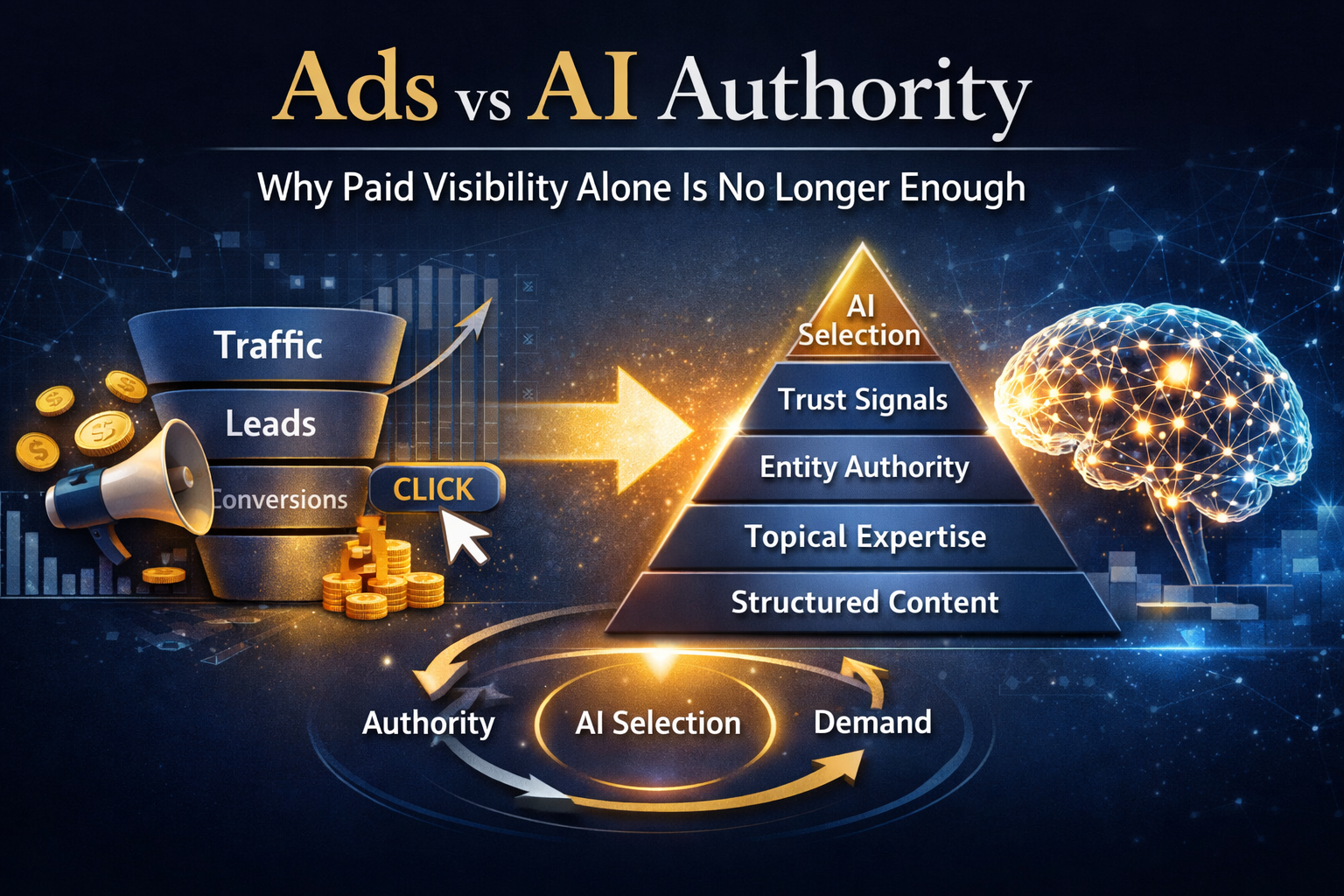
Run ads → drive traffic → generate conversions.
Whether through Google PPC, social media advertising, or display retargeting, visibility could be bought, scaled, and optimised.
But that model is now being disrupted.
With the rise of AI systems like ChatGPT and Google Gemini, users are no longer navigating the web the same way. They are asking questions and receiving direct answers.
This shift fundamentally changes how visibility works.
The question is no longer: “How do I get clicks?”
The question is now: “Will AI choose me?”
The Old Model: Ads-Driven Visibility
How It Worked
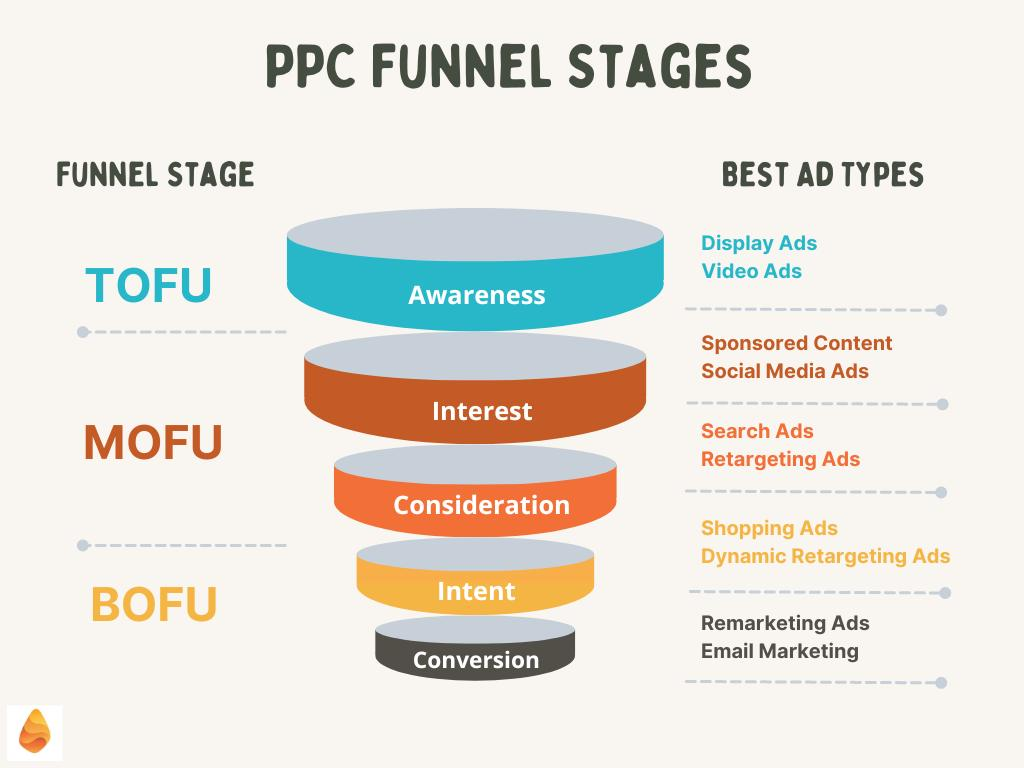
The traditional digital advertising model was built on a funnel:
- Impressions
- Clicks
- Traffic
- Leads
- Conversions
Visibility was driven by budget and bidding power.
Why It Worked
- Search engines displayed lists of links
- Users compared options manually
- Higher ranking + higher spend = more traffic
Its Limitations Today
- Traffic is no longer guaranteed
- Rising CPC reduces efficiency
- Visibility disappears when spend stops
- Users increasingly don’t click at all
Paid ads created visibility — but only temporarily.
The Shift: From Traffic Competition to AI Selection
Search is evolving into an answer system.
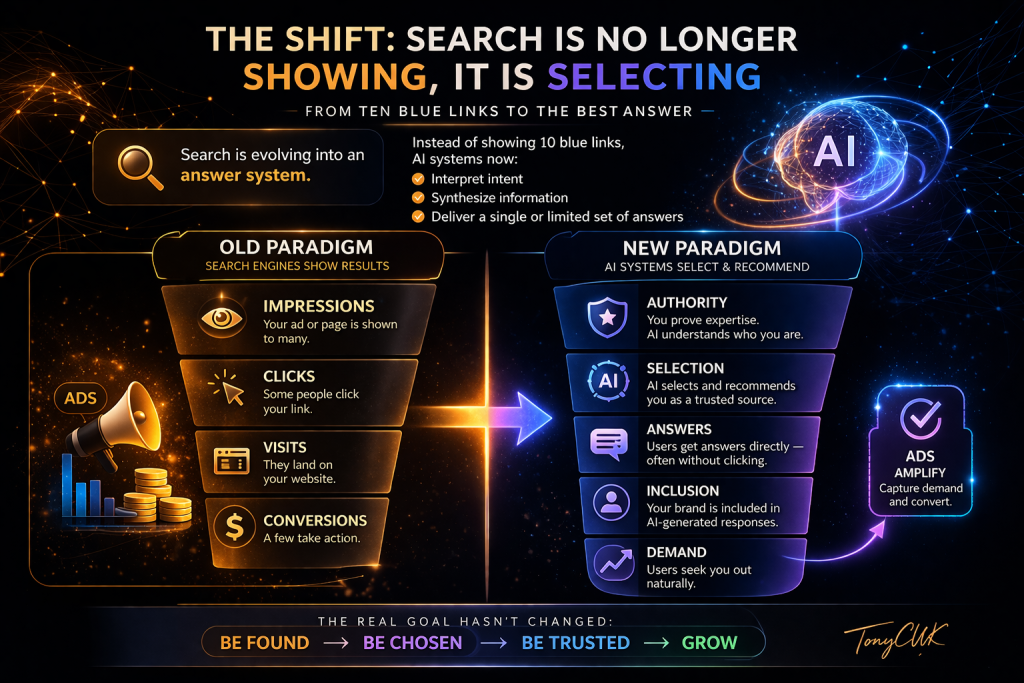
Instead of showing 10 blue links, AI systems now:
- Interpret intent
- Synthesize information
- Deliver a single or limited set of answers
What Changed
| Old Paradigm | New Paradigm |
|---|---|
| Ranking | Selection |
| Clicks | Answers |
| Traffic | Inclusion |
| Visibility via ads | Visibility via authority |
This means:
You are no longer competing for attention.
You are competing for selection.
In the AI-driven environment, visibility is earned through authority, structure, and trust.
The AI Authority Stack
- Structured Content
Content that is clear, scannable, and AI-readable - Topical Authority
Depth and consistency across a subject area - Entity Recognition
Being understood as a credible brand or source - Trust Signals
Consistency, citations, and reliability - AI Selection / Citations
Being chosen as a source in AI-generated answers
Key Insight
AI does not rank everything.
It selects a few.
And those selected gain disproportionate visibility.
Where Ads Still Matter (And Where They Don’t)
Digital advertising is not obsolete.
But its role has fundamentally shifted.
1. PPC (Search Ads) → Demand Capture
- Best for high-intent users
- Effective for bottom-of-funnel conversions
- Critical for branded and transactional keywords
👉 Role today:
Capture demand that already exists
2. Social Media Ads → Demand Creation
- Builds awareness before search happens
- Enables precise audience targeting
- Drives engagement and recall
👉 Role today:
Create demand, not validate authority
3. Retargeting → Reinforcement
- Re-engages interested users
- Increases conversion probability
- Supports multi-touch journeys
👉 Role today:
Reinforce decisions, not initiate them
The New Marketing Stack
The most important shift is structural.
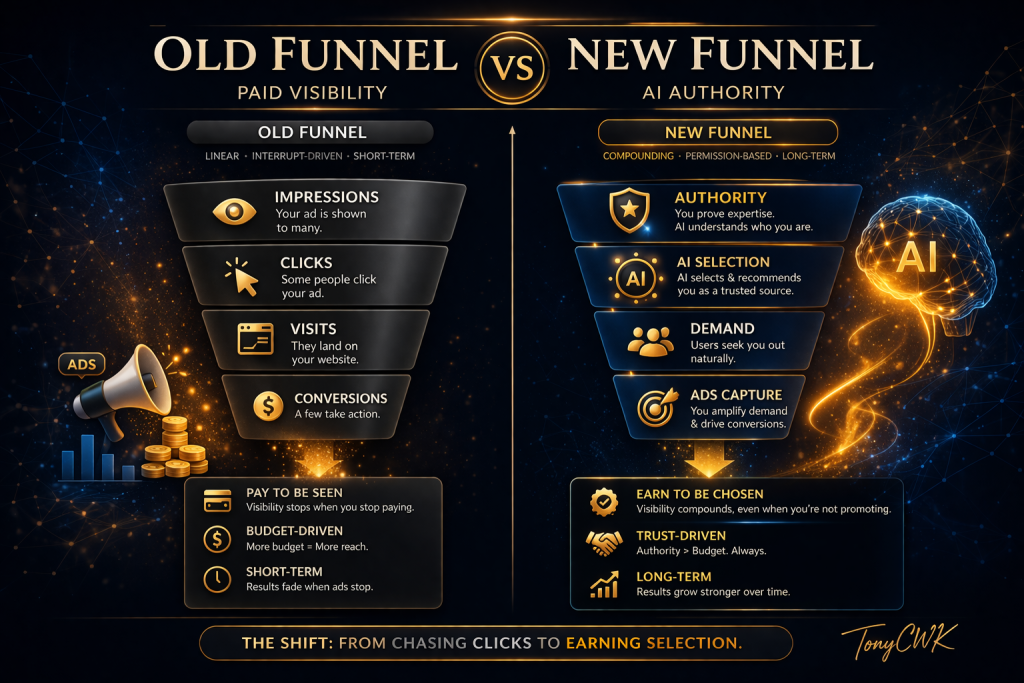
Old Flow
Ads → Traffic → Conversion
New Flow
Authority → AI Selection → Demand → Ads Capture
What This Means Strategically
- Ads no longer create primary visibility
- Authority determines whether you are seen
- Ads amplify what already works
Singapore SME Example: Chiropractic Clinic
Consider a chiropractic clinic targeting busy professionals in Singapore.
Old Approach
- Run Google Ads: “back pain treatment Singapore”
- Compete on CPC
- Depend on landing page conversion
New Approach
- Build structured content:
- “Office back pain causes and solutions”
- “Chiropractic vs physiotherapy in Singapore”
- Become a source referenced by AI
- Gain visibility through AI recommendations
- Then:
- Users search your brand
- Click your ad (higher intent)
- Or convert directly
Result
- Lower dependency on paid traffic
- Higher conversion efficiency
- Stronger brand positioning
Comparison: Ads vs AI Authority
| Dimension | Ads-Driven Model | AI Authority Model |
|---|---|---|
| Visibility Source | Budget | Trust & structure |
| Sustainability | Stops when spend stops | Compounds over time |
| User Journey | Click-based | Answer-based |
| Competition | Bidding | Credibility |
| Scalability | Linear | Exponential |
The Strategic Mistake Most Businesses Make
Many businesses continue to:
- Increase ad budgets
- Optimise CTR and CPC
- Focus only on traffic
But ignore:
- Content structure
- Knowledge depth
- AI extractability
The Risk
You may pay for visibility — but never be chosen.
Conclusion: The Future of Visibility
Digital advertising is not disappearing.
But it is no longer the foundation.
Authority is the new visibility layer.
Ads are the amplification layer.
The brands that win will not be those who spend the most…
But those who are most trusted, most structured, and most selected.
Summary
What is changing?
Visibility is shifting from paid traffic acquisition to AI-driven selection.
Are ads still important?
Yes — but primarily for capturing and amplifying demand, not creating core visibility.
What should businesses focus on?
Building AI authority through structured, credible, and interconnected content.
What is the new model?
Authority → AI Selection → Demand → Ads Capture
FAQ
1. Are PPC and digital ads still relevant in 2026?
Yes. PPC and digital ads remain relevant, but their role has shifted from primary visibility drivers to tools for demand capture and amplification.
2. Why is digital advertising becoming less dominant?
Because AI systems increasingly provide direct answers, reducing the need for users to click on ads or browse multiple websites.
3. What is the biggest shift in digital marketing today?
The shift from traffic-based visibility to AI-driven selection and recommendation.
4. What does “AI selection” mean in marketing?
AI selection refers to how AI systems choose specific sources or brands to include in generated answers, rather than listing many options.
5. How is AI Authority different from traditional SEO?
SEO focuses on ranking pages, while AI Authority focuses on being selected, cited, and trusted by AI systems.
6. What replaces traffic as the main success metric?
Inclusion and recommendation in AI-generated answers replace traffic as the primary visibility metric.
7. Do ads still drive conversions effectively?
Yes. Ads are still highly effective for converting high-intent users, especially in bottom-of-funnel scenarios.
8. What is the new role of PPC advertising?
PPC now serves primarily as a demand capture mechanism for users who already have intent.
9. What is the role of social media advertising today?
Social media ads are used to create awareness and demand, not to establish authority.
10. Is retargeting still useful in the AI era?
Yes. Retargeting remains effective for reinforcing decisions and increasing conversion rates.
11. What is the AI Authority Model?
A framework where visibility is earned through structured content, topical authority, trust signals, and AI selection.
12. What are the key components of AI Authority?
Structured content, topical depth, entity recognition, trust signals, and AI citations.
13. Why is structured content important for AI visibility?
Because AI systems rely on clear, well-organised content to extract and present accurate answers.
14. What is topical authority?
Topical authority is the depth and consistency of content across a specific subject, demonstrating expertise.
15. How do brands get selected by AI systems?
By providing clear, credible, structured, and consistent information that AI systems can trust and extract.
16. Can ads alone build long-term visibility?
No. Ads provide temporary visibility, but long-term visibility requires authority and trust.
17. What is the new marketing funnel in the AI era?
Authority → AI Selection → Demand → Ads Capture
18. How should businesses allocate their marketing budget now?
Balance investment between building authority (content, structure, expertise) and running ads for demand capture.
19. What is the biggest mistake marketers make today?
Over-investing in ads while neglecting content structure, authority, and AI visibility.
20. What is the future of digital marketing strategy?
The future lies in building AI-readable authority systems supported by targeted and strategic advertising.
To deepen your understanding of AI Authority and digital visibility:
• AI Authority Pyramid™ — How AI evaluates structured authority
👉 https://tonycwk.com/ai-authority-pyramid/
• AI Authority Flywheel™ — How authority compounds over time
👉 https://tonycwk.com/ai-discovery-flywheel/
• SEO Alone Is No Longer Enough — Why rankings are no longer the goal
👉 https://tonycwk.com/seo-alone-is-no-longer-enough/
• AI Search Visibility Framework
👉 https://tonycwk.com/ai-search-visibility-framework
• AI Authority Metrics — Measuring selection, not just traffic
👉 https://tonycwk.com/ai-authority-metrics/
• The New Visibility Model — Why Being Found Is No Longer Enough
👉 https://tonycwk.com/the-new-visibility-model
• Designing AI-Optimized Content
👉 https://tonycwk.com/the-rise-of-ai-content-optimization/
Written by Tony Chan (TonyCWK)
AI Authority & Digital Strategy Researcher
Leave a Reply