
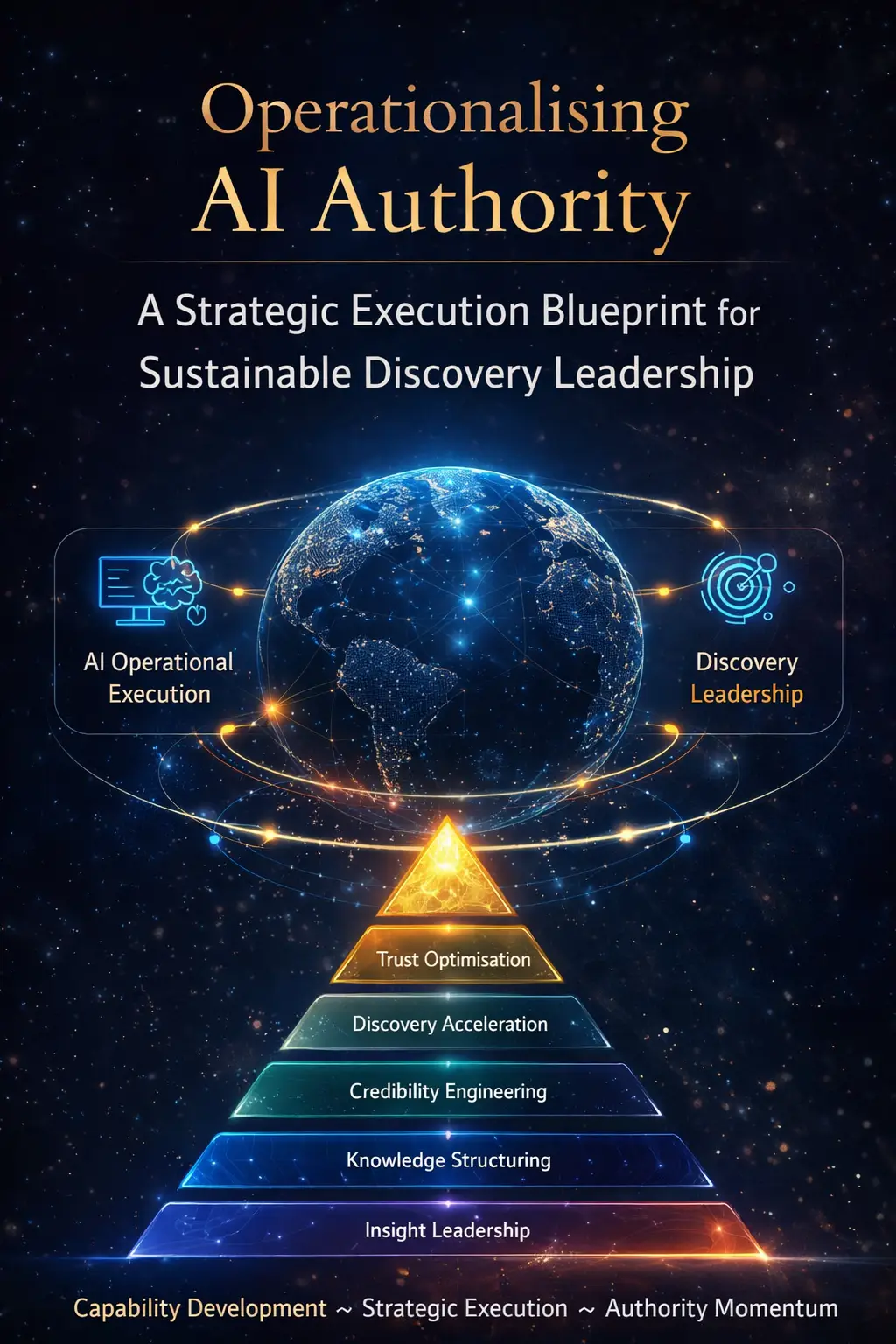
A Strategic Execution Blueprint for Sustainable Discovery Leadership
In an era where intelligent algorithms increasingly shape how information is discovered, interpreted, and prioritised, digital visibility can no longer be treated as a purely technical outcome. The emergence of AI-mediated search environments signals a structural transformation in how authority is formed and recognised. Organisations are no longer competing solely for rankings or impressions. Instead, they are competing for algorithmic trust, thematic credibility, and sustained discovery relevance.
The previously introduced TonyCWK AI Authority Architecture Model provides a strategic lens for understanding how structured expertise compounds into long-term discovery leadership. However, conceptual awareness alone is insufficient. The decisive differentiator in the coming decade will be an organisation’s ability to operationalise authority as a capability discipline, integrating content strategy, knowledge architecture, credibility reinforcement, and discovery momentum into a coherent execution system.
This article explores how organisations can move from architectural understanding to practical implementation — transforming strategic insight into measurable authority progression within AI-driven ecosystems.
The Strategy–Execution Gap in AI Discovery Environments
Many organisations acknowledge the importance of emerging AI discovery dynamics, yet few possess a structured roadmap for translating insight into action. Traditional marketing operating models remain campaign-centric, fragmented across channels, and optimised for short-term performance indicators. While such approaches may continue to deliver intermittent gains, they often fail to generate durable authority signals capable of influencing intelligent recommendation systems.
AI-mediated discovery environments reward consistency of expertise, structural coherence of knowledge, and credibility reinforcement across interconnected digital touchpoints. Without deliberate capability development, organisations risk remaining tactically active but strategically invisible.
Bridging this strategy–execution gap requires reframing authority not as an abstract branding aspiration, but as a systematically engineered growth capability.
Introducing the AI Authority Capability Stack
To operationalise authority effectively, organisations must cultivate an integrated set of competencies that reinforce one another over time. This can be conceptualised as the AI Authority Capability Stack — a progressive model describing how execution maturity supports discovery leadership.
Insight Leadership Capability forms the foundation. Organisations must generate original perspectives, research-driven analysis, and forward-looking interpretations that demonstrate intellectual ownership of key thematic domains. This extends beyond content production to encompass strategic narrative shaping and knowledge contribution.
Knowledge Structuring Capability builds upon this foundation by ensuring that expertise is organised into machine-interpretable formats. Structured content hierarchies, entity clarity, semantic relationships, and answer-optimised architectures enhance algorithmic comprehension, enabling intelligent systems to contextualise and synthesise organisational insights more effectively.
Credibility Signal Engineering strengthens authority recognition through deliberate reinforcement mechanisms. Partnerships with recognised institutions, citations from trusted sources, thought-leadership participation, and evidence-based validation all contribute to a credibility ecosystem that signals reliability to both human and machine evaluators.
Discovery Acceleration Systems introduce momentum dynamics. Consistent engagement patterns, multi-channel knowledge distribution, and community amplification increase the probability that structured expertise will surface across recommendation environments. Over time, such exposure compounds into algorithmic familiarity and preference.
Finally, Algorithmic Trust Optimisation represents the most advanced capability layer. Organisations operating at this level demonstrate sustained thematic leadership, trusted knowledge contributions, and ecosystem influence that collectively position them as authoritative reference points within AI discovery networks.
Execution Horizons: Phasing Authority Development
Operationalising AI authority requires strategic patience and phased investment. Organisations can conceptualise implementation across three execution horizons.
In the short term, priority should be given to establishing structural clarity. This includes optimising existing knowledge assets, implementing answer-focused formatting, strengthening entity associations, and improving topical consistency. These initiatives often yield early visibility improvements and provide a foundation for subsequent authority building.
The mid-term horizon focuses on thematic expansion and credibility reinforcement. Organisations should develop authoritative knowledge hubs, publish proprietary insights, and cultivate recognition within professional ecosystems. This stage represents the transition from tactical optimisation to strategic influence.
The long-term horizon is characterised by ecosystem leadership. Organisations begin to shape discovery narratives rather than merely respond to them. Algorithmic trust becomes increasingly self-reinforcing as structured expertise gains sustained citation momentum and recommendation prominence.
Organisational Readiness for Authority Engineering
Successful authority operationalisation depends not only on marketing execution, but also on broader organisational alignment. Leadership mindset plays a decisive role. Executives must recognise that discovery leadership is a strategic asset requiring long-term capability investment rather than episodic campaign expenditure.
Equally important is the maturity of knowledge governance processes. Clear ownership of thematic domains, coordinated content architecture, and cross-functional collaboration enable consistent authority signalling. Without such governance, fragmented messaging can dilute algorithmic confidence.
Data intelligence infrastructure also contributes significantly. Organisations that integrate performance analytics with knowledge strategy insights are better positioned to refine authority development pathways. Over time, this analytical feedback loop enhances strategic precision and resource allocation effectiveness.
Prioritising Authority Investments in Complex Environments
Given finite resources, organisations must balance initiatives that deliver immediate discoverability improvements with those that build enduring strategic advantage. Tactical enhancements such as structured content optimisation and search experience alignment may generate early visibility gains. However, deeper investments in thematic leadership, proprietary research, and ecosystem credibility are typically required to achieve sustained authority recognition.
By distinguishing between short-term performance activities and long-term authority capability building, organisations can deploy investments more intelligently. This disciplined prioritisation supports both operational efficiency and strategic resilience in evolving AI discovery landscapes.
Engineering the Future of Discovery Leadership
The evolution of intelligent search ecosystems marks a pivotal inflection point in digital strategy. Authority is no longer an emergent by-product of marketing visibility; it is becoming a deliberately engineered organisational capability. Structured expertise, reinforced credibility, and discovery momentum dynamics collectively shape how algorithms interpret relevance and trust.
Organisations that operationalise authority development today are likely to influence the standards of discovery leadership tomorrow. By adopting integrated execution frameworks and investing in long-term capability maturity, they can transition from reactive visibility management to proactive discovery influence.
In increasingly intelligent information environments, sustainable growth will favour those who recognise that authority is not simply communicated — it is architected, operationalised, and continuously compounded.
AI Authority Execution — Strategic Q&A
Core Authority Strategy Questions
1. What does operationalising AI authority mean in digital marketing?
Operationalising AI authority refers to transforming strategic authority frameworks into structured execution capabilities. It involves aligning insight leadership, knowledge architecture, credibility signals, and discovery momentum systems to enhance long-term visibility in AI-driven search environments.
2. Why is authority becoming more important than traditional SEO ranking factors?
As intelligent search systems increasingly synthesise knowledge rather than merely index content, thematic credibility and structured expertise play a larger role in determining visibility. Authority signals help algorithms assess trustworthiness, relevance, and contextual depth.
3. How does AI-mediated discovery differ from conventional search visibility?
Traditional search visibility prioritised keyword matching and technical optimisation. AI-mediated discovery emphasises semantic understanding, contextual recommendations, and knowledge synthesis, favouring entities that demonstrate sustained expertise and credibility.
Execution & Capability Questions
4. What organisational capabilities are required to build AI discovery authority?
Key capabilities include insight leadership development, structured knowledge management, credibility reinforcement strategies, discovery amplification systems, and algorithmic trust optimisation processes.
5. How can businesses structure their content to improve AI recognition?
Content should be organised into clear thematic clusters, supported by semantic hierarchy, entity clarity, answer-focused formatting, and interconnected knowledge pathways that enable algorithms to interpret relationships between topics.
6. What is the role of original insights in authority building?
Original insights signal intellectual ownership and contribute to thematic leadership. AI systems often prioritise content that introduces new perspectives or synthesises knowledge in meaningful ways.
Credibility & Trust Questions
7. How do credibility signals influence AI discovery visibility?
Credibility signals such as citations, partnerships, expert endorsements, and evidence-based research reinforce trust indicators that intelligent algorithms use to evaluate authority relevance.
8. Why are external validation and ecosystem partnerships important for authority development?
Recognition from trusted institutions or communities strengthens algorithmic confidence in an organisation’s expertise, increasing the likelihood of recommendation and citation in knowledge synthesis environments.
9. Can small or emerging brands build AI authority effectively?
Yes. While established entities may possess legacy credibility, emerging organisations can accelerate authority development through focused thematic leadership, structured expertise publishing, and strategic credibility collaborations.
Strategic Implementation Questions
10. What are the first practical steps to implement an AI authority strategy?
Initial priorities include auditing existing knowledge assets, improving structural clarity, strengthening topical consistency, and implementing answer-optimised content frameworks aligned with thematic expertise areas.
11. How long does it take to build sustainable AI discovery authority?
Authority development is typically a phased process. Early structural improvements may generate short-term visibility gains, while sustained recognition often emerges over mid- to long-term horizons as credibility and thematic influence compound.
12. How should organisations prioritise authority investments?
Balanced investment across tactical visibility improvements and long-term capability development ensures both operational performance and strategic resilience in evolving discovery ecosystems.
AI Search Evolution Questions
13. How will predictive discovery systems change digital marketing strategy?
Predictive discovery environments will reward organisations that consistently demonstrate structured expertise and contextual relevance. Marketing strategies will increasingly focus on knowledge leadership rather than campaign-centric exposure.
14. What is algorithmic trust and why does it matter?
Algorithmic trust refers to the confidence intelligent systems develop in recognising an entity as a reliable source of knowledge. High trust levels increase the probability of citation, recommendation, and sustained discovery visibility.
15. How can organisations influence AI recommendation ecosystems?
By maintaining consistent thematic authority, publishing credible insights, and reinforcing structured knowledge signals across channels, organisations can shape how algorithms interpret relevance within specific domains.
Future-Oriented Authority Questions
16. What defines discovery leadership in AI-driven digital ecosystems?
Discovery leadership is characterised by sustained thematic influence, trusted knowledge contributions, and proactive shaping of industry narratives within intelligent search environments.
17. Will traditional SEO practices become obsolete as AI search evolves?
Traditional SEO will remain foundational but insufficient on its own. Future visibility success will depend on integrating technical optimisation with authority capability development and credibility engineering.
18. Why is authority considered an engineered growth capability?
Authority results from deliberate strategic design rather than accidental visibility. Organisations that systematically structure expertise, reinforce credibility, and sustain discovery momentum are more likely to achieve long-term recognition in AI-mediated ecosystems.
Leave a Reply