
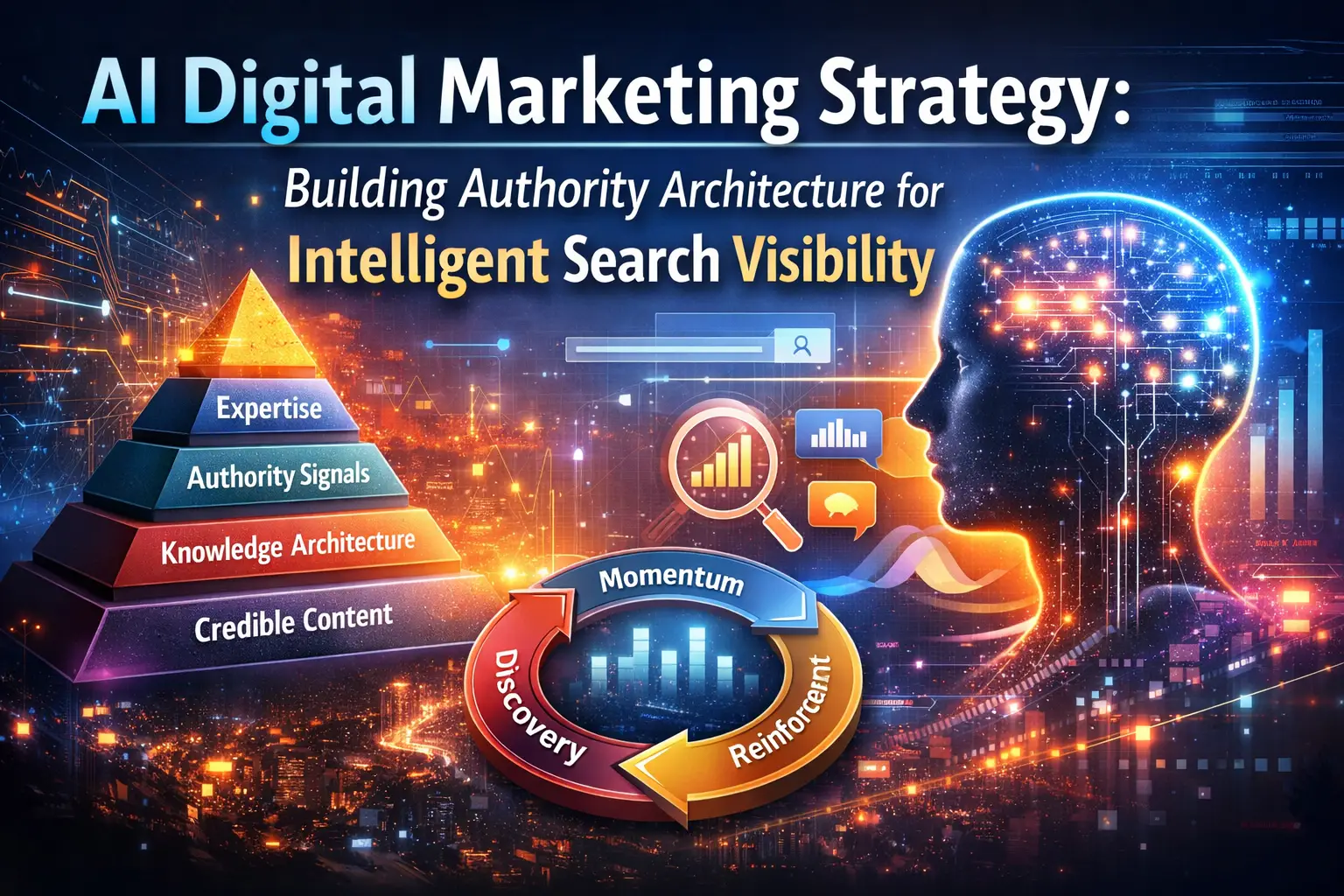
In the early decades of digital marketing, visibility was largely a function of technical optimisation and media investment. Brands competed for rankings, impressions, and clicks within relatively predictable search environments. Today, however, discovery itself is being redefined. As intelligent algorithms increasingly synthesise knowledge rather than simply index information, the determinants of visibility are shifting from tactical execution toward structured authority.
This transition marks more than a technological upgrade; it represents a fundamental transformation in how trust, expertise, and relevance are evaluated in digital ecosystems. Organisations that continue to prioritise fragmented channel tactics may achieve short-term performance gains, yet risk long-term erosion of discoverability as AI-mediated search experiences favour entities that demonstrate coherent knowledge architecture and credible thematic leadership.
Against this evolving landscape, marketers must move beyond conventional campaign planning toward the deliberate engineering of digital authority. The ability to design integrated visibility systems — encompassing structured expertise signals, credibility reinforcement mechanisms, and discovery momentum dynamics — is becoming a defining strategic capability. This article introduces the Digital Marketing Authority Framework for the AI Discovery Era, offering a forward-looking model for organisations seeking sustainable growth in increasingly intelligent search environments.
The Shift from Search Visibility to AI Discovery Authority
For much of the past two decades, digital marketing visibility has been shaped by the mechanics of search engine optimisation and performance media execution. Organisations invested heavily in keyword targeting, technical optimisation, and campaign-driven traffic acquisition strategies designed to improve rankings and generate measurable engagement. Within this environment, visibility was largely perceived as a competitive outcome of tactical efficiency — the ability to outperform rivals within defined algorithmic parameters.
However, the emergence of intelligent search systems is fundamentally redefining how discovery occurs. Increasingly, generative interfaces and AI-mediated recommendation environments are moving beyond simple index-based retrieval toward contextual knowledge synthesis. Instead of presenting users with a list of ranked results to evaluate independently, these systems are beginning to interpret intent, aggregate expertise, and surface consolidated insights that prioritise credibility and thematic coherence over isolated optimisation signals.
This transformation signals a decisive shift in the economics of digital attention. As discovery journeys become more guided and predictive, traditional visibility tactics that rely on episodic campaign bursts or fragmented channel execution risk diminishing returns. Brands may still achieve short-term performance improvements through tactical optimisation; yet over time, sustained discoverability is likely to depend more heavily on the depth, consistency, and structural integrity of their knowledge presence across digital ecosystems.
Consequently, marketers are entering a new strategic phase in which authority — rather than exposure alone — becomes the central determinant of competitive advantage. Authority in this context extends beyond brand awareness or thought leadership messaging. It reflects the extent to which an organisation’s expertise is recognised, validated, and repeatedly referenced within algorithmic decision frameworks that increasingly shape user journeys.
Understanding this shift is critical because it reframes digital marketing from a channel-centric discipline into a system design challenge. Organisations must now consider how content architecture, credibility signals, and thematic leadership interact to influence algorithmic interpretation and recommendation dynamics. Visibility is no longer merely achieved; it is engineered through the deliberate construction of structured expertise ecosystems that enable intelligent platforms to identify, trust, and amplify authoritative sources.
This evolving landscape creates both risk and opportunity. Companies that continue to operate with legacy visibility assumptions may experience gradual erosion of discovery relevance as AI systems prioritise integrated knowledge signals over tactical optimisation outputs. Conversely, organisations that invest early in authority-building capabilities — including structured content frameworks, expert-driven insights, and credibility reinforcement mechanisms — are more likely to shape their long-term discoverability trajectory in increasingly intelligent search environments.
The remainder of this article introduces a strategic model designed to help marketers navigate this transition. By examining how authority can be systematically developed and compounded over time, the Digital Marketing Authority Framework for the AI Discovery Era provides a forward-looking blueprint for organisations seeking sustainable visibility in the next phase of digital evolution.
Defining Digital Marketing Authority in the AI Era
As intelligent discovery systems mature, the concept of digital marketing authority is evolving from a qualitative branding aspiration into a measurable strategic capability. Traditionally, authority was often associated with brand reputation, market presence, or the perceived influence of corporate messaging. While these factors remain relevant, the mechanisms through which authority is recognised and operationalised in AI-mediated environments are becoming increasingly structured and data-driven.
In contemporary discovery ecosystems, authority is no longer determined solely by how frequently a brand communicates, but by how coherently its expertise is represented and reinforced across interconnected knowledge signals. Intelligent platforms are progressively designed to interpret thematic depth, contextual relevance, and credibility consistency as indicators of informational reliability. This means that organisations must think beyond isolated content initiatives and consider how their cumulative digital footprint contributes to algorithmic confidence.
Digital marketing authority in the AI era can therefore be understood as the degree to which an organisation’s expertise is systematically recognised within the interpretive frameworks of intelligent search and recommendation systems. It is shaped not only by the quality of individual assets, but by the structural alignment between content architecture, topical leadership, and validation signals distributed across digital touchpoints. Authority emerges when these elements converge to form a coherent knowledge presence that intelligent systems can reliably interpret and amplify.
A useful distinction can be drawn between content production and knowledge engineering. Content production focuses on the creation and distribution of informational assets designed to attract attention or generate engagement. Knowledge engineering, by contrast, involves the deliberate organisation of expertise into structured thematic clusters that reinforce credibility and contextual authority over time. While the former may deliver short-term visibility gains, the latter contributes to sustainable discoverability by enabling algorithms to associate a brand with recognised domains of competence.
This shift also reframes how marketers evaluate performance. Metrics traditionally centred on traffic volumes or conversion spikes may provide only partial insight into long-term authority development. Increasingly, organisations must monitor indicators such as citation frequency in AI-generated summaries, cross-platform expertise recognition, and the persistence of thematic relevance across evolving search contexts. These signals collectively reflect whether a brand is transitioning from being merely visible to being meaningfully authoritative.
Furthermore, authority in intelligent discovery environments is inherently cumulative. Each credible insight, validated perspective, or structured knowledge contribution strengthens the interpretive signals that algorithms use to determine informational trustworthiness. Over time, this compounding effect can create a reinforcing cycle in which authoritative brands benefit from preferential visibility in curated discovery experiences, thereby further enhancing their perceived expertise and influence.
Recognising digital marketing authority as a strategic capability rather than a by-product of promotional activity encourages organisations to adopt a more integrated and forward-looking approach to visibility planning. By intentionally designing systems that align expertise communication with algorithmic evaluation dynamics, marketers can move from reactive optimisation toward proactive authority engineering. This conceptual foundation sets the stage for the structured models explored in the following sections, beginning with an overview of the Digital Marketing Authority Framework and its role in guiding sustainable discovery success.
Introducing the Digital Marketing Authority Framework
As digital discovery environments become increasingly intelligent and context-driven, marketers require strategic models that move beyond linear campaign thinking toward integrated authority system design. Traditional planning approaches often rely on sequential funnel structures that prioritise awareness generation, engagement optimisation, and conversion acceleration. While these frameworks remain operationally useful, they do not fully capture the complex dynamics through which credibility and visibility now interact in AI-mediated search ecosystems.
The Digital Marketing Authority Framework is introduced as a holistic model to address this strategic gap. Rather than treating visibility as an outcome of isolated channel performance, the framework conceptualises discoverability as the cumulative result of structured expertise development, credibility reinforcement, and discovery momentum over time. In doing so, it reframes digital marketing success as a function of authority engineering — the deliberate orchestration of knowledge signals that intelligent systems use to evaluate informational trustworthiness.
At its core, the framework integrates two complementary strategic lenses. The first examines authority as a layered capability, emphasising the foundational importance of structured knowledge architecture and progressively strengthening credibility signals. The second considers authority as a dynamic growth mechanism, highlighting how discovery exposure, audience engagement, and algorithmic recognition can interact to create reinforcing cycles of visibility amplification. Together, these perspectives provide marketers with both a diagnostic tool for assessing current maturity and a roadmap for guiding long-term capability development.
This integrated approach is particularly relevant in environments where AI-generated summaries, predictive recommendations, and contextual content synthesis increasingly shape user journeys. In such settings, brands that demonstrate thematic depth and consistent expertise signals are more likely to be surfaced as trusted reference points within curated discovery experiences. Conversely, organisations that rely predominantly on episodic promotional activity may struggle to maintain sustained visibility as algorithmic evaluation models prioritise coherent authority indicators over fragmented optimisation tactics.
Importantly, the Digital Marketing Authority Framework does not seek to replace existing marketing disciplines, but to reposition them within a broader strategic architecture. Search optimisation, performance advertising, social engagement, and content marketing continue to play vital roles; however, their effectiveness is enhanced when aligned around a shared objective of authority development rather than short-term exposure alone. By integrating tactical execution with long-term credibility building, organisations can achieve a more resilient and scalable approach to digital growth.
The following sections explore the structural and dynamic components of the framework in greater detail. First, the AI Search Visibility Pyramid illustrates how authority can be progressively constructed through layered expertise and credibility signals. This is followed by the Discovery Momentum Flywheel, which demonstrates how sustained authority can generate compounding visibility advantages over time. Together, these models provide a strategic foundation for navigating the evolving realities of AI-driven discovery.
The AI Authority Development Pyramid
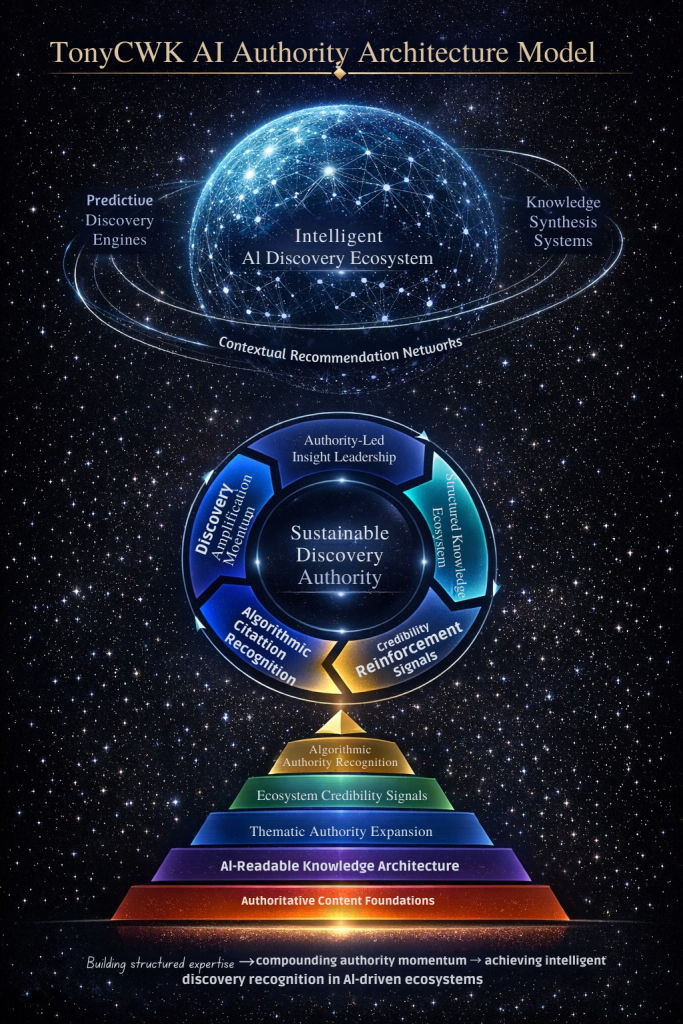
The AI Authority Development Pyramid provides a structured framework for understanding how digital authority is progressively engineered within intelligent discovery environments. In contrast to traditional marketing hierarchies that emphasise short-term traffic acquisition or isolated ranking gains, this model reflects the cumulative development of expertise signals that enable brands to achieve sustained algorithmic recognition and discovery relevance.
At the foundation of the pyramid lies Authoritative Content Foundations. This layer represents the disciplined creation of insight-driven content that demonstrates genuine subject-matter expertise. Rather than relying on superficial keyword optimisation, organisations must establish a coherent knowledge narrative through perspective-led analysis, proprietary observations, and contextually relevant interpretations of industry developments. These foundational assets form the intellectual infrastructure upon which higher-order authority signals are built.
Building upon this base is the layer of AI-Readable Knowledge Architecture. As intelligent search systems increasingly rely on semantic interpretation rather than purely lexical matching, the structuring of knowledge becomes a strategic imperative. This involves the systematic organisation of topical clusters, entity relationships, internal linking pathways, and schema-enhanced context signals that enable algorithms to interpret informational depth with greater confidence. Well-architected knowledge ecosystems reduce ambiguity, improve contextual coherence, and enhance the machine interpretability of expertise.
The next stage involves Thematic Authority Expansion, where organisations strengthen their domain relevance through sustained exploration of adjacent insights and emerging perspectives. At this level, authority evolves from isolated high-quality content into a recognisable pattern of intellectual leadership. By consistently contributing nuanced viewpoints, comparative analyses, and forward-looking strategic interpretations, brands signal to intelligent systems that their expertise extends beyond tactical content production toward thematic mastery.
Above this layer are Ecosystem Credibility Signals, which reinforce authority through external validation and recognition. In AI-mediated discovery environments, credibility is no longer shaped solely by traditional backlinks or media mentions. Instead, validation emerges from a broader constellation of signals, including citation inclusion within knowledge synthesis platforms, expert collaborations, community engagement indicators, and cross-platform authority acknowledgement. These signals collectively strengthen the perception that an organisation’s expertise is both trusted and contextually influential.
At the apex of the pyramid is Algorithmic Authority Recognition — the stage at which a brand’s insights are consistently surfaced within AI-generated summaries, predictive recommendations, and curated discovery interfaces. Achieving this level represents the maturation of an integrated authority architecture rather than the outcome of isolated optimisation tactics. Organisations that reach this stage benefit from disproportionate visibility advantages, as algorithmic recognition amplifies perceived expertise and extends discovery reach across multiple informational contexts.
Importantly, progression through the pyramid should not be interpreted as a strictly linear process. While foundational authority capabilities must be established to enable sustainable advancement, reinforcing feedback effects often accelerate momentum once structural coherence is achieved. For example, increased citation visibility may strengthen credibility perceptions, which in turn stimulates deeper audience engagement with expert content. This dynamic interplay underscores the importance of viewing authority development as an engineered strategic system rather than a sequence of disconnected initiatives.
Understanding the AI Authority Development Pyramid enables organisations to diagnose gaps within their discovery strategies and prioritise long-term capability building. Brands that focus primarily on visibility without investing in knowledge architecture or thematic expansion risk experiencing volatility in algorithmic recognition. Conversely, organisations that cultivate structured expertise and ecosystem credibility signals are better positioned to achieve stable, compounding discovery outcomes. In this sense, the pyramid serves both as a conceptual guide for authority engineering and as a practical framework for navigating the evolving dynamics of AI-driven search environments.
From Structural Authority to Momentum Dynamics
While the AI Authority Development Pyramid explains how structured expertise is progressively established, sustainable visibility in intelligent discovery environments ultimately depends on how this authority is activated and reinforced over time. Once foundational knowledge architecture, thematic depth, and ecosystem credibility signals are in place, authority does not remain static. Instead, it begins to operate as a self-reinforcing strategic system — generating momentum through repeated cycles of recognition, engagement, and contextual amplification.
This transition marks the shift from authority construction to authority acceleration, a process best understood through the dynamics of the Sustainable Discovery Authority Flywheel.
The Sustainable Discovery Authority Flywheel
The Sustainable Discovery Authority Flywheel illustrates how structurally established expertise evolves into a compounding growth mechanism within AI-mediated discovery ecosystems. In intelligent search environments, visibility is rarely a one-time achievement. Rather, authority tends to expand through reinforcing cycles of algorithmic recognition, audience engagement, and ecosystem validation.
At the starting point of the flywheel is Authority-Led Insight Leadership. This stage reflects the ongoing publication of perspective-driven expertise that helps intelligent systems interpret a brand’s intellectual positioning. Instead of producing content solely for ranking opportunities, organisations contribute strategic interpretations, original frameworks, and contextualised thought leadership that shape how complex topics are understood. These insight assets serve as catalysts for discovery activation, enabling algorithms to surface thematic expertise within curated knowledge summaries.
As authoritative insights gain exposure, they begin to form a Structured Knowledge Ecosystem. Interconnected content clusters, entity-based relationships, and coherent narrative pathways allow intelligent systems to map expertise more confidently across informational contexts. This structural clarity enhances machine interpretability while simultaneously improving the user’s discovery experience. Over time, such knowledge ecosystems create an environment in which authority signals can be consistently recognised rather than sporadically detected.
The next reinforcing stage involves Credibility Reinforcement Signals. As audiences engage with expert content and industry stakeholders reference authoritative insights, validation mechanisms accumulate across multiple platforms. Signals such as professional recognition, collaborative knowledge contributions, citation inclusion within synthesis interfaces, and expert community engagement strengthen the perception that a brand’s expertise is both trusted and influential. These credibility indicators play a critical role in shaping algorithmic confidence.
When credibility signals reach sufficient density, organisations begin to experience Algorithmic Citation Recognition. At this stage, authoritative insights are increasingly incorporated into AI-generated responses, predictive recommendations, and curated discovery interfaces. Citation recognition functions as a multiplier effect — amplifying perceived expertise while extending visibility beyond traditional search result environments. This form of recognition often accelerates authority perception faster than incremental ranking improvements alone.
The culmination of these reinforcing effects is Discovery Amplification Momentum. As algorithmic inclusion expands exposure and audience engagement deepens, the flywheel gains rotational force. Brands benefit from a virtuous cycle in which increased visibility attracts further validation, leading to broader contextual relevance and sustained discovery growth. Rather than relying on continuous campaign-driven amplification, organisations begin to experience organically compounding authority dynamics.
Importantly, the Sustainable Discovery Authority Flywheel should not be viewed as a purely reactive outcome of content performance. Instead, it represents an engineered strategic capability — one that emerges from the deliberate integration of structured knowledge architecture, thematic expertise development, and ecosystem credibility cultivation. When aligned effectively, these elements transform authority from a static attribute into a dynamic system capable of sustaining long-term visibility advantages within evolving AI discovery environments.
Understanding the interaction between the Pyramid and the Flywheel provides organisations with a holistic perspective on authority engineering. Structural expertise enables momentum activation, while momentum dynamics accelerate the maturation of authority signals. Together, they form an integrated strategic framework for navigating the transition from traditional search optimisation toward intelligent discovery leadership.
The Intelligent AI Discovery Ecosystem
While structured authority architecture and reinforcing visibility momentum form the strategic core of sustainable discovery growth, the ultimate effectiveness of these capabilities is shaped by the evolving environment in which digital visibility now operates. Increasingly, intelligent search experiences are no longer defined by static ranking hierarchies alone. Instead, they are influenced by dynamic discovery ecosystems in which predictive intelligence, contextual relevance modelling, and knowledge synthesis mechanisms collectively determine how expertise is surfaced and interpreted.
Within this emerging landscape, visibility is progressively mediated by predictive discovery systems that anticipate informational needs based on behavioural signals, intent patterns, and contextual cues. Rather than responding solely to explicit search queries, intelligent platforms are beginning to recommend expert insights proactively, integrating authoritative perspectives into curated informational journeys. Organisations that develop structured thematic expertise are therefore more likely to be recognised as trusted knowledge contributors within these predictive discovery flows.
Parallel to this shift is the rise of knowledge synthesis systems, where intelligent models aggregate, interpret, and contextualise insights from multiple authoritative sources. In such environments, visibility is not merely a function of ranking position but of inclusion within synthesised narratives that help audiences understand complex topics. Brands that invest in coherent knowledge architecture and sustained insight leadership increase their probability of being referenced within these synthesised informational constructs.
Equally significant is the growing influence of contextual recommendation networks, which personalise discovery experiences according to user intent evolution, professional relevance, and informational engagement patterns. These systems prioritise expertise signals that demonstrate not only topical depth but also interpretive clarity and applied relevance. As a result, organisations must move beyond isolated optimisation tactics and instead cultivate integrated authority ecosystems capable of supporting consistent recognition across diverse discovery contexts.
Understanding the dynamics of the intelligent AI discovery ecosystem reframes digital visibility as an environmental alignment challenge rather than a purely tactical execution exercise. Sustainable discovery leadership emerges when structured authority architecture and momentum-driven credibility signals converge with predictive and context-aware discovery mechanisms. In this sense, authority is not only built and amplified — it is also continuously validated by the evolving logic of intelligent information ecosystems.
This perspective highlights why organisations that proactively engineer authority capabilities are better positioned to shape future discovery standards rather than merely reacting to algorithmic change. As intelligent search environments continue to evolve toward anticipatory knowledge delivery and multi-modal discovery interfaces, brands that establish structured expertise today are more likely to achieve enduring visibility relevance in the discovery ecosystems of tomorrow.
Engineering Authority in Practice — A Strategic Execution Roadmap
While conceptual clarity is essential for understanding how sustainable discovery authority is constructed and reinforced, long-term visibility advantages ultimately depend on the disciplined execution of structured capability development. In AI-mediated discovery environments, authority is rarely the result of isolated optimisation tactics. Instead, it emerges from a coordinated strategic roadmap that aligns knowledge architecture maturity, thematic expertise expansion, and ecosystem credibility reinforcement over time.
The first stage of authority engineering involves establishing strategic content infrastructure maturity. Organisations must prioritise the creation of authoritative insight assets that articulate a coherent domain narrative. This requires moving beyond fragmented campaign-driven content production toward a structured editorial philosophy grounded in perspective-led analysis and knowledge depth. At this stage, the objective is not immediate visibility acceleration but the formation of intellectual credibility foundations that intelligent systems can reliably interpret.
Once foundational expertise signals are stabilised, the focus shifts toward knowledge architecture integration. This phase emphasises the systematic organisation of topical clusters, semantic entity relationships, internal linking hierarchies, and answer-optimised informational pathways. By strengthening machine interpretability, organisations improve their ability to communicate contextual authority signals to intelligent discovery systems. Structured knowledge ecosystems also enhance user comprehension, reinforcing the perception of expertise consistency across informational touchpoints.
The next phase centres on credibility signal orchestration. Authority maturity is accelerated when expert insights are validated across diverse professional and informational ecosystems. Strategic collaborations, industry knowledge contributions, citation visibility within synthesis interfaces, and multi-platform authorship presence collectively reinforce algorithmic confidence thresholds. At this stage, organisations begin to experience measurable improvements in discovery inclusion consistency, as credibility signals compound and extend contextual influence.
As structured expertise and ecosystem validation converge, organisations can activate authority momentum amplification strategies. Rather than relying solely on paid amplification or incremental ranking optimisation, brands strategically leverage insight leadership assets to generate reinforcing discovery cycles. Thought leadership dissemination, expert community engagement, and knowledge-driven content amplification initiatives contribute to sustained visibility acceleration, enabling the authority flywheel to gain rotational force.
Importantly, effective authority engineering requires recognising that execution sequencing should align with authority maturity staging. Premature attempts to scale visibility without establishing coherent knowledge architecture often result in volatility in algorithmic recognition. Conversely, organisations that adopt a phased roadmap — progressing from structured expertise formation to credibility reinforcement and momentum activation — are better positioned to achieve stable, compounding discovery outcomes.
In this context, the strategic execution roadmap functions as the operational bridge between conceptual authority architecture and measurable discovery performance. By translating structural authority principles into coordinated capability development initiatives, organisations transform authority from an abstract aspiration into a deliberate and sustainable strategic advantage within intelligent search ecosystems.
AI Discovery Environment Readiness–Preparing for the Next Phase of Intelligent Visibility
As authority architecture capabilities mature and momentum dynamics begin to generate reinforcing discovery outcomes, organisations must also recognise that digital visibility environments themselves are undergoing continuous transformation. Intelligent discovery systems are evolving toward increasingly predictive, context-aware, and multi-modal interaction models. In this shifting landscape, sustainable authority advantages will depend not only on how expertise is structured and amplified, but also on how effectively organisations prepare for emerging discovery paradigms.
AI Discovery Environment Readiness refers to the strategic capacity to anticipate and adapt to evolving mechanisms through which knowledge is surfaced, synthesised, and recommended. Rather than treating algorithmic change as a series of reactive optimisation challenges, forward-looking organisations cultivate organisational agility that enables them to align authority signals with new discovery logics as they emerge. This involves developing the capability to interpret shifts in user intent behaviour, platform-driven content mediation patterns, and the growing role of contextual intelligence in shaping informational journeys.
One critical dimension of readiness is the ability to support predictive visibility alignment. As intelligent platforms increasingly anticipate informational needs before explicit queries are expressed, brands must design content ecosystems that demonstrate not only topical depth but also situational relevance. Strategic scenario analysis, future trend mapping, and forward-looking insight development enable organisations to position their expertise within evolving discovery narratives rather than competing solely within established informational categories.
Another important element involves strengthening knowledge synthesis adaptability. In environments where intelligent systems aggregate insights from multiple authoritative sources to construct coherent knowledge responses, organisations benefit from presenting expertise in formats that enhance interpretability and contextual integration. Modular insight structuring, answer-optimised explanations, and cross-disciplinary perspective framing increase the likelihood that expert contributions can be effectively incorporated into synthesised informational constructs.
AI Discovery Environment Readiness also encompasses the integration of multi-modal discovery capabilities. As voice interfaces, visual search mechanisms, conversational agents, and immersive informational experiences become more prominent, authority signals must extend beyond text-centric optimisation approaches. Organisations that experiment with diversified content formats and adaptive engagement strategies improve their resilience within increasingly heterogeneous discovery ecosystems.
Ultimately, cultivating readiness for evolving AI discovery environments transforms authority development from a static strategic objective into an ongoing organisational capability. By embedding foresight-driven thinking into content architecture planning, credibility signal cultivation, and momentum activation initiatives, brands can sustain relevance even as discovery platforms continue to redefine how expertise is surfaced and interpreted. In this sense, AI Discovery Environment Readiness represents the future-orientation layer of authority engineering — ensuring that structured expertise not only achieves recognition today but remains discoverable within the intelligent ecosystems of tomorrow.
Designing AI-Readable Knowledge Architecture
As intelligent discovery systems increasingly rely on contextual interpretation and knowledge synthesis, the structural organisation of content ecosystems has become a critical determinant of sustained visibility. Designing AI-readable knowledge architecture involves more than improving technical optimisation signals; it requires the deliberate alignment of thematic expertise, semantic clarity, and informational coherence to enable intelligent platforms to recognise and trust a brand’s domain authority.
At its core, AI-readable architecture is grounded in the principle of structured expertise clustering. Rather than producing isolated articles or campaign-driven content bursts, organisations must develop interconnected topic ecosystems that signal depth and continuity. This involves mapping key thematic pillars aligned with strategic competencies, then systematically expanding these pillars through layered subtopics that reinforce contextual relevance. Over time, such clustering enables algorithms to associate a brand with clearly defined knowledge territories, strengthening interpretive confidence in its expertise signals.
Semantic internal linking plays a pivotal role in reinforcing this structural clarity. By intentionally connecting related insights through descriptive anchor pathways and logical narrative progression, marketers create navigational frameworks that support both user comprehension and algorithmic interpretation. These connections help intelligent systems understand not only the presence of content, but also the relationships between ideas, perspectives, and informational hierarchies. As discovery environments evolve toward knowledge synthesis rather than simple retrieval, such relational signals become increasingly influential in shaping visibility outcomes.
Equally important is the adoption of answer-optimised content design. AI-mediated search experiences frequently prioritise concise yet authoritative responses that demonstrate interpretive depth while remaining contextually accessible. Structuring content with clearly articulated definitions, thematic summaries, and insight-driven explanatory sections enhances the likelihood that key perspectives will be surfaced within curated discovery interfaces. This approach does not diminish the value of long-form analysis; rather, it complements it by ensuring that complex expertise can be effectively synthesised by intelligent platforms.
Metadata coherence and structured markup further contribute to architectural clarity. Consistent categorisation frameworks, descriptive schema implementation, and strategically aligned tagging systems enable algorithms to interpret topical relationships with greater precision. While technical optimisation alone cannot establish authority, it acts as an enabling infrastructure that allows deeper expertise signals to be recognised and amplified. Organisations that neglect these foundational elements may find their thought-leadership efforts under-represented in discovery experiences despite producing high-quality insights.
Designing AI-readable knowledge architecture also requires an organisational mindset shift. Marketing teams must collaborate more closely with content strategists, subject-matter experts, and data analysts to ensure that expertise communication is both strategically coherent and operationally scalable. This integrated approach supports the transition from reactive content production toward proactive authority engineering, aligning tactical execution with long-term discoverability objectives.
Ultimately, effective knowledge architecture transforms content ecosystems into strategic visibility assets. When expertise is systematically structured, reinforced through semantic connectivity, and supported by answer-optimised presentation, organisations are better positioned to influence how intelligent discovery systems interpret and prioritise information. This architectural foundation not only strengthens current visibility performance but also prepares brands to adapt as algorithmic evaluation models continue to evolve.
The next section explores how credibility signals and trust validation mechanisms further enhance authority development within increasingly complex algorithmic assessment environments.
Building Credibility in Algorithmic Evaluation Systems
In increasingly intelligent discovery environments, visibility is shaped not only by the presence of structured expertise but also by the strength of credibility signals that validate informational trustworthiness. As algorithms evolve toward more sophisticated evaluative frameworks, they are designed to interpret patterns of endorsement, consistency, and reputational alignment as indicators of authoritative knowledge. Consequently, building credibility has become a central strategic discipline in digital marketing authority development.
One of the most influential credibility drivers is recognised expertise attribution. Content that demonstrates clear authorship identity, professional domain relevance, and sustained thematic contribution provides intelligent systems with stronger contextual confidence. This does not imply that authority is conferred solely through personal branding; rather, it reflects the importance of transparent expertise representation in enabling algorithms to distinguish informed analysis from generic informational replication. Over time, consistent expert presence across multiple knowledge touchpoints strengthens interpretive trust signals.
External validation further reinforces credibility in algorithmic assessment processes. Citations from reputable platforms, collaborative contributions within professional ecosystems, and references from industry peers collectively function as distributed indicators of informational reliability. These signals help intelligent discovery systems contextualise a brand’s expertise within a broader network of recognised knowledge sources. As such validation accumulates, it contributes to a reputational momentum that enhances the probability of sustained algorithmic recognition.
Audience engagement quality also plays a nuanced role in credibility formation. Intelligent platforms increasingly differentiate between superficial interaction metrics and meaningful engagement patterns that reflect genuine informational value. Indicators such as extended reading behaviour, cross-platform knowledge sharing, and recurring thematic exploration suggest that content resonates at a deeper interpretive level. These engagement dynamics provide algorithms with behavioural evidence that reinforces the perceived trustworthiness of authoritative insights.
Consistency across digital presence is another critical dimension of credibility development. Fragmented messaging, contradictory expertise signals, or abrupt thematic shifts can dilute algorithmic confidence, even when individual content assets demonstrate high quality. By contrast, organisations that maintain coherent knowledge narratives across owned media, professional networks, and collaborative platforms are more likely to be interpreted as stable authority contributors. This stability enhances long-term discoverability by reducing ambiguity in algorithmic evaluation processes.
Importantly, credibility building should be viewed as a cumulative strategic investment rather than a reactive reputation management activity. Each validated insight, peer acknowledgement, or trusted reference contributes incrementally to the broader authority ecosystem within which intelligent discovery systems operate. Over time, this accumulation of trust signals can influence how algorithms prioritise sources when synthesising complex informational landscapes, thereby shaping the contours of digital visibility in subtle yet significant ways.
As algorithmic evaluation models continue to mature, the interplay between structured knowledge architecture and credibility reinforcement will become increasingly central to marketing strategy. Organisations that proactively cultivate trust validation mechanisms are better positioned to transform expertise into enduring discovery advantages. The following section explores the forward trajectory of these dynamics through a strategic examination of the evolving AI Discovery Timeline.
The Evolving AI Discovery Timeline
To fully appreciate the strategic importance of authority development in digital marketing, organisations must consider how intelligent discovery systems are likely to evolve over the coming years. The trajectory of search innovation suggests a gradual transition from reactive information retrieval toward increasingly predictive and context-aware knowledge experiences. Understanding this progression enables marketers to anticipate capability requirements rather than merely responding to algorithmic change after it occurs.
In the current phase of AI-mediated discovery, generative summaries and contextual recommendations are beginning to reshape user expectations of search efficiency. Rather than navigating multiple sources independently, audiences are increasingly guided by synthesised insights that highlight perceived expertise and informational clarity. This shift places greater emphasis on structured authority signals, as intelligent platforms seek to prioritise sources capable of contributing meaningful context within condensed knowledge narratives.
The next stage of evolution is likely to involve more personalised knowledge synthesis. As data interpretation models improve, discovery environments may increasingly adapt to individual intent patterns, professional contexts, and behavioural preferences. In such scenarios, brands that have established coherent thematic authority will be better positioned to remain relevant across diverse user journeys. Visibility may become less dependent on broad keyword targeting and more influenced by the degree to which expertise aligns with nuanced informational needs.
Further along the timeline, predictive discovery mechanisms are expected to play a more prominent role. Intelligent systems may proactively surface insights before explicit queries are formulated, drawing upon historical engagement signals and contextual inference to anticipate emerging interests. This development could significantly alter the economics of digital attention, rewarding organisations that maintain sustained knowledge leadership capable of influencing recommendation algorithms over extended periods.
In parallel, the integration of multimodal search interfaces — encompassing voice interaction, visual recognition, and augmented contextual overlays — is likely to expand the scope of discovery touchpoints. Authority signals will therefore need to transcend traditional text-based optimisation frameworks, incorporating diverse content formats that collectively reinforce credibility and interpretive depth. Brands that cultivate flexible knowledge architectures will be better equipped to adapt as these new interaction paradigms mature.
Ultimately, the evolving AI Discovery Timeline underscores the strategic imperative of long-term authority engineering. Rather than viewing search transformation as a series of discrete technological disruptions, marketers can interpret it as a continuous progression toward more intelligent, trust-driven visibility ecosystems. By investing early in structured expertise development and credibility reinforcement mechanisms, organisations increase their capacity to shape how future discovery environments interpret and amplify their knowledge contributions.
This forward-looking perspective prepares the foundation for the final strategic discussion: how insights from the Digital Marketing Authority Framework can be translated into practical execution priorities that balance immediate performance needs with sustainable authority growth.
Translating Authority Strategy into Execution Priorities
While the Digital Marketing Authority Framework provides a strategic lens for understanding the future of discovery, its true value emerges when organisations translate conceptual insight into structured execution priorities. In practice, marketers must balance the immediate demands of performance-driven outcomes with the longer-term investments required to cultivate sustainable authority. Achieving this balance requires a disciplined approach to resource allocation, capability development, and strategic sequencing.
A useful starting point involves distinguishing between tactical visibility optimisation and authority capability building. Tactical initiatives — such as refining answer-focused content formatting, improving internal linking coherence, or enhancing semantic metadata clarity — can deliver relatively quick improvements in discoverability signals. These actions help intelligent platforms interpret expertise more efficiently, often resulting in incremental gains in visibility performance. However, while such measures are valuable, they represent only the initial phase of authority maturation.
Longer-term strategic priorities centre on the systematic development of thematic leadership and credibility reinforcement mechanisms. Organisations must identify core knowledge domains aligned with their competitive strengths, then invest consistently in producing interpretive insights that deepen contextual relevance within those areas. Over time, this sustained intellectual contribution enhances the likelihood of algorithmic recognition, particularly as discovery systems increasingly prioritise expertise continuity over episodic promotional intensity.
Execution planning should also incorporate a maturity roadmap that reflects progressive authority development stages. Early-phase organisations may focus on establishing structural content foundations and clarifying domain positioning. As authority signals strengthen, attention can shift toward amplifying credibility through collaborative knowledge engagement, cross-platform presence, and thought-leadership visibility. Mature organisations, by contrast, may prioritise refining discovery momentum dynamics — ensuring that accumulated authority continues to translate into compounding exposure advantages across evolving search environments.
Importantly, effective authority strategy execution requires organisational alignment beyond the marketing function alone. Subject-matter experts, brand strategists, data analysts, and leadership teams must collaborate to ensure that expertise communication reflects both strategic intent and operational consistency. This integrated approach enables organisations to transition from reactive campaign cycles toward proactive authority engineering, transforming visibility planning into a long-term strategic discipline.
By approaching authority development as a staged capability journey rather than a one-time optimisation initiative, marketers can better navigate the complexities of AI-driven discovery ecosystems. Structured execution priorities not only improve present performance metrics but also establish the conditions for enduring discoverability resilience. This practical perspective reinforces the broader thesis of the Digital Marketing Authority Framework: that sustainable visibility in intelligent search environments is ultimately achieved through deliberate, cumulative strategic design.
Framework Summary: Integrating Structure, Momentum and Authority
The Digital Marketing Authority Framework can be understood as an integrated strategic system that combines structural capability development with dynamic visibility acceleration mechanisms. While individual tactics may contribute to short-term discoverability improvements, sustainable authority emerges when organisations align knowledge architecture design, credibility reinforcement strategies, and discovery momentum optimisation into a coherent long-term growth model.
To support practical interpretation, the following summary highlights the core components of the framework and their respective strategic roles in shaping AI-driven visibility outcomes.
Digital Marketing Authority Architecture — Strategic Framework Overview
| Framework Dimension | Strategic Role | Core Capability Focus | Long-Term Visibility Impact |
|---|---|---|---|
| AI Authority Development Pyramid | Establish structured expertise foundations that enable progressive authority maturation | Authoritative content creation, AI-readable knowledge architecture, thematic authority expansion, ecosystem credibility cultivation | Builds durable algorithmic trust and stabilises long-term discovery visibility across intelligent search environments |
| Sustainable Discovery Authority Flywheel | Activate and compound visibility momentum through reinforcing authority cycles | Insight-led thought leadership, structured knowledge ecosystem development, credibility signal accumulation, algorithmic citation amplification | Accelerates authority recognition velocity and enables self-reinforcing discovery growth dynamics |
| AI-Readable Knowledge Architecture Strategy | Enhance machine interpretability of expertise signals within semantic discovery systems | Topical clustering, entity relationship mapping, internal knowledge structuring, answer-optimised content design | Improves contextual relevance signals and increases likelihood of inclusion within AI-generated synthesis interfaces |
| Ecosystem Credibility Signal Engineering | Strengthen perceived authority through multi-platform validation and expert recognition pathways | Professional authorship positioning, collaborative knowledge contributions, citation visibility expansion, cross-channel authority presence | Elevates algorithmic confidence thresholds and supports preferential discovery surfacing mechanisms |
| AI Discovery Environment Readiness | Prepare organisations for evolving predictive and contextual discovery behaviours | Predictive visibility optimisation, knowledge synthesis adaptability, personalised discovery alignment, multi-modal content integration | Ensures sustained relevance as intelligent recommendation ecosystems reshape digital visibility dynamics |
| Strategic Authority Execution Roadmapping | Translate long-term authority architecture into actionable capability development sequencing | Authority maturity staging, resource prioritisation alignment, momentum activation planning, performance signal monitoring | Enables balanced short-term performance gains while systematically building enduring discovery authority advantages |
Strategic Key Takeaways – Designing Sustainable Visibility Leadership in the Age of Intelligent Discovery
The accelerating evolution of intelligent search environments is redefining the foundations of digital visibility. Organisations that continue to rely solely on traditional optimisation tactics risk experiencing increasing volatility as discovery systems become more predictive, context-aware, and synthesis-driven. In contrast, brands that adopt a structured authority engineering mindset are better positioned to navigate this transition with resilience and strategic clarity.
A central insight emerging from the AI Authority Architecture Model is that sustainable discovery leadership is built upon integrated capability development rather than isolated performance interventions. Authoritative content foundations and AI-readable knowledge architecture provide the structural stability necessary for long-term recognition. When reinforced through thematic authority expansion and ecosystem credibility cultivation, these capabilities form a durable platform from which momentum dynamics can emerge.
Equally important is the recognition that authority growth is inherently self-reinforcing once momentum cycles are activated. Insight-led leadership, structured knowledge ecosystems, credibility signal accumulation, and algorithmic citation inclusion collectively contribute to compounding visibility advantages. Organisations that understand and deliberately activate these reinforcing mechanisms can achieve disproportionate discovery impact relative to short-term tactical investments.
Another key takeaway is the strategic importance of environmental alignment. Intelligent discovery ecosystems continuously reinterpret expertise signals according to evolving user intent patterns and informational relevance frameworks. This means that authority is not a static achievement but an ongoing process of validation within predictive discovery systems, knowledge synthesis interfaces, and contextual recommendation networks. Organisations that monitor and adapt to these environmental dynamics enhance their capacity to maintain sustained visibility relevance.
The model also highlights the necessity of disciplined execution sequencing. Attempting to scale discovery exposure without first establishing coherent knowledge architecture and credibility signals often results in fragmented recognition outcomes. Conversely, a phased authority engineering roadmap — progressing from structural expertise formation to momentum activation and future readiness — enables organisations to convert strategic insight into measurable performance stability.
Ultimately, the AI Authority Architecture perspective reframes digital marketing as a long-term strategic discipline centred on expertise development, credibility reinforcement, and intelligent discovery alignment. Visibility leadership in the AI era will increasingly favour organisations that invest in structured knowledge ecosystems capable of compounding recognition over time. By embracing this integrated approach, brands can move beyond reactive optimisation cycles and begin shaping the evolving standards of digital authority within intelligent information environments.
Digital Marketing Authority in the AI Discovery Era Q&A
⭐ What is digital marketing authority in AI-driven search environments?
Digital marketing authority refers to the degree to which a brand’s expertise is consistently recognised and trusted by intelligent discovery systems. It is built through structured knowledge architecture, credible thematic leadership, and validated informational signals across digital ecosystems.
⭐ How is AI discovery different from traditional search visibility?
Traditional search visibility focuses on ranking positions and traffic acquisition. AI discovery emphasises contextual relevance, knowledge synthesis, and algorithmic trust, often presenting users with curated insights instead of simple result lists.
⭐ Why is authority becoming more important than rankings in modern SEO strategy?
As generative search interfaces evolve, algorithms increasingly prioritise reliable sources that demonstrate interpretive depth and credibility consistency. Authority therefore becomes a stronger determinant of sustained discoverability than short-term ranking fluctuations.
⭐ What is the AI Search Visibility Pyramid?
The AI Search Visibility Pyramid is a strategic model that illustrates how authority is progressively built through structured knowledge foundations, expert insight development, credibility reinforcement, and eventual algorithmic citation recognition.
⭐ How does the Discovery Momentum Flywheel influence digital marketing growth?
The Discovery Momentum Flywheel explains how visibility can compound over time as engagement quality, citation exposure, and ecosystem validation reinforce each other. This dynamic creates sustained discovery advantages for authoritative brands.
⭐ What is AI-readable knowledge architecture in content strategy?
AI-readable knowledge architecture involves organising content into coherent thematic clusters supported by semantic linking, structured metadata, and answer-optimised formatting. This enables intelligent systems to interpret expertise more effectively.
⭐ How can brands build credibility signals for algorithmic trust?
Brands can strengthen credibility by demonstrating recognised authorship expertise, earning citations from reputable platforms, maintaining consistent thematic messaging, and fostering meaningful audience engagement patterns.
⭐ What role does thought leadership play in AI search visibility?
Thought leadership contributes to authority development by providing interpretive insights that extend beyond generic informational content. Unique perspectives help algorithms associate brands with deeper contextual expertise.
⭐ How does structured content improve AI search performance?
Structured content enhances interpretive clarity by organising information into logical hierarchies, summaries, and definitional segments. This increases the likelihood that insights will be synthesised within AI-generated discovery experiences.
⭐ Why is semantic internal linking important for authority building?
Semantic internal linking helps intelligent platforms understand relationships between topics, strengthening contextual relevance signals. Over time, this connectivity reinforces thematic leadership positioning.
⭐ How will predictive discovery change digital marketing strategy?
Predictive discovery systems may proactively surface insights based on behavioural patterns and contextual inference. This shift will reward brands that maintain sustained authority within clearly defined knowledge domains.
⭐ What is algorithmic citation authority?
Algorithmic citation authority occurs when a brand’s insights are repeatedly referenced within AI summaries, recommendations, or curated knowledge narratives. This recognition significantly amplifies perceived expertise and visibility reach.
⭐ Can small businesses compete in AI-driven discovery ecosystems?
Yes. SMEs that focus on niche thematic authority, structured expertise development, and credible knowledge contributions can achieve strong visibility outcomes even without large advertising budgets.
⭐ How should marketers balance performance marketing and authority strategy?
Marketers should combine short-term optimisation initiatives with long-term authority investments. Tactical visibility gains can support immediate results, while structured knowledge leadership ensures sustainable discoverability.
⭐ What metrics indicate growing digital marketing authority?
Indicators may include increased citation visibility, improved thematic ranking consistency, deeper engagement quality signals, and broader cross-platform expertise recognition.
⭐ How does multimodal search affect authority development?
As voice, visual, and contextual interfaces expand discovery touchpoints, brands must develop flexible knowledge ecosystems that reinforce credibility across diverse content formats.
⭐ Why is consistency important in authority-driven marketing strategy?
Consistent thematic messaging reduces algorithmic ambiguity and strengthens interpretive trust. Fragmented content strategies can dilute authority signals even when individual assets perform well.
⭐ What is the future of digital marketing visibility in the AI era?
The future of visibility will likely be shaped by intelligent knowledge synthesis, predictive recommendations, and authority-driven discovery ecosystems. Organisations that engineer structured expertise systems today will be better positioned for long-term growth.
Leave a Reply