
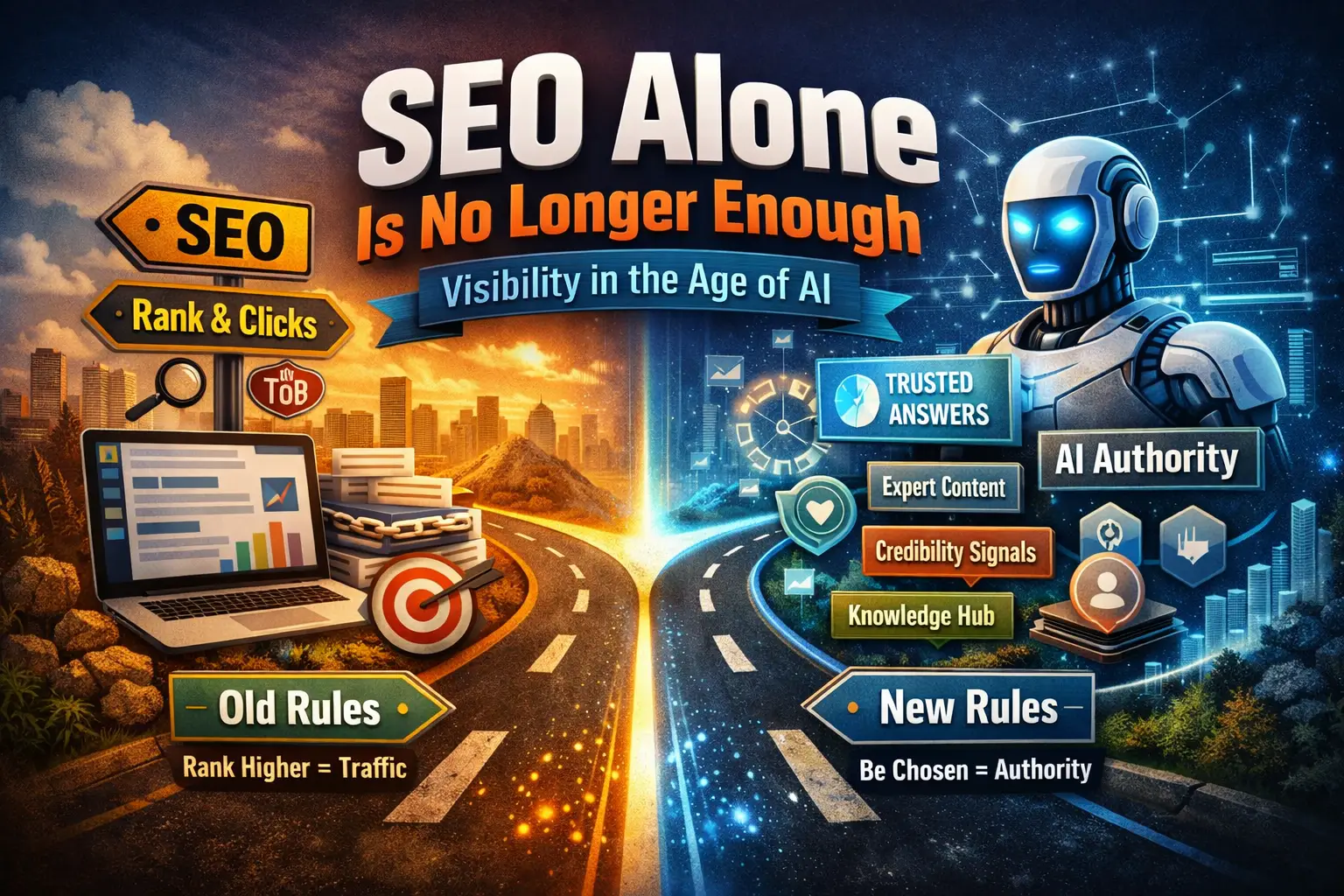
Introduction: SEO Didn’t Die — It Was Outgrown
SEO is not dead.
But it is no longer enough.
For years, digital visibility was simple:
- Rank higher
- Get clicks
- Drive traffic
Today, that model is quietly breaking.
Because users are no longer just searching.
They are asking AI for answers.
The Shift Most Marketers Haven’t Fully Understood
Search has changed from:
🔍 Finding websites
➡️ 🤖 Receiving answers
This changes everything.
AI systems no longer ask:
“Which page should rank?”
They ask:
“Which answer should we trust?”
👉 And many websites are not built for this new question.
Why SEO Alone Is Falling Short
Traditional SEO still helps with:
- Indexing
- Discoverability
- Initial visibility
But here’s what’s breaking:
1. Ranking No Longer Guarantees Visibility
Your page can rank…
…but never be seen if AI answers the question directly.
2. Clicks Are Declining
Users often get what they need without clicking.
This is the rise of:
👉 Zero-click search behaviour
3. Content Is Not Always Selected
Even strong SEO content may be ignored if it is:
- Unstructured
- Hard to extract
- Lacking authority signals
The New Visibility Equation
Here’s the reality:
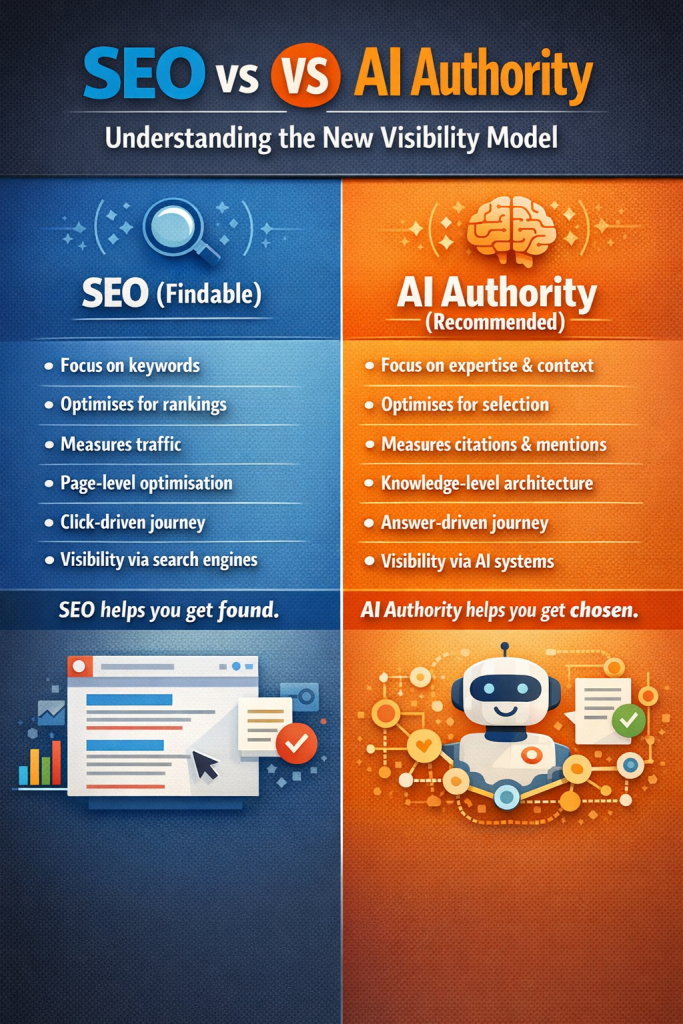
- SEO = Findable
- AI Authority = Recommended
👉 And in today’s search environment:
Recommended beats findable.
What AI Actually Looks For
AI systems evaluate content differently from traditional search engines.
They prioritise:
1. Clarity
- Direct answers
- Simple explanations
- No fluff
2. Structure
- Clear headings
- Logical flow
- Easy extraction
3. Expertise
- Depth of knowledge
- Real insights
- Topic consistency
4. Trust Signals
- Mentions
- Reputation
- Cross-platform consistency
Real-World Observation
Look at what AI frequently surfaces:
- Educational platforms
- Strong knowledge hubs
- Deep topic coverage
Not:
- Thin blog posts
- Keyword-stuffed pages
- Isolated articles
👉 This is not an SEO shift.
It is a knowledge shift.
What This Means for Businesses
If your strategy is still:
- “Write blog posts”
- “Optimise keywords”
- “Build backlinks”
You are operating in the previous era of search.
The New Game: Authority Over Optimisation
Winning in AI search requires:
- Structured knowledge systems (not just content)
- Thematic authority (not just topics)
- Credibility ecosystems (not just backlinks)
👉 Visibility is no longer about content volume.
It is about trusted expertise.
How This Connects to the Bigger Shift
This article is part of a larger transformation:
👉 Search is evolving into an intelligent recommendation system.
To understand the full model, read:
“How Search Has Evolved in the Age of AI — From Rankings to Recommendations”
(This is your pillar—link this internally)
What You Should Do Next (Practical Steps)
1. Stop Thinking in Keywords → Start Thinking in Topics
Build clusters, not isolated posts.
2. Make Content AI-Readable
- Add structured headings
- Include direct answers
- Use FAQ sections
3. Build Thematic Authority
Own a niche deeply instead of covering everything shallowly.
4. Strengthen Credibility Signals
- Consistent messaging
- External mentions
- Recognisable expertise
5. Design for Selection, Not Just Ranking
Ask:
“Will AI choose this as the answer?”
Key Takeaway
SEO is still part of the system.
But it is no longer the system.
Conclusion
The future of search will not reward those who:
- optimise the most
- publish the most
- rank the highest
It will reward those who:
- structure knowledge clearly
- demonstrate expertise consistently
- earn algorithmic trust
Because in the AI era:
You are not competing to rank.
You are competing to be chosen.
🔎 People Also Ask — SEO Alone Is Not Enough
1. What does “SEO alone is not enough” mean?
It means that traditional SEO strategies like keyword optimisation and rankings are no longer sufficient. Today, content must also be trusted, structured, and selected by AI systems to remain visible.
2. Is SEO still important in 2026?
Yes, SEO is still important for discoverability. However, it must be combined with AI authority strategies to ensure content is recommended, not just ranked.
3. Why is SEO becoming less effective?
SEO is becoming less effective because AI systems now provide direct answers, reducing reliance on search result clicks and traditional rankings.
4. What is AI authority in search?
AI authority refers to how likely your content is to be selected, cited, and recommended by AI systems based on trust, expertise, and structure.
5. What is the difference between SEO and AI authority?
SEO focuses on ranking content in search engines, while AI authority focuses on being chosen as the best answer in AI-generated responses.
6. What is zero-click search?
Zero-click search happens when users get answers directly from search results or AI summaries without clicking on any website.
7. Why are website clicks declining?
Clicks are declining because AI systems summarise information instantly, allowing users to get answers without visiting multiple pages.
8. How do AI systems choose content?
AI systems select content based on:
- Clarity
- Structure
- Expertise
- Trust signals
- Consistency
9. What is AI-readable content?
AI-readable content is structured in a way that makes it easy for AI to extract and understand, including clear headings, concise answers, and logical flow.
10. What is thematic authority?
Thematic authority is when a brand demonstrates deep expertise across a topic through comprehensive and interconnected content.
11. What are credibility signals in AI search?
Credibility signals include brand mentions, backlinks, expertise, and consistency across platforms, helping AI systems determine trustworthiness.
12. How can businesses adapt beyond SEO?
Businesses should:
- Build topic clusters
- Create structured content
- Strengthen authority signals
- Focus on expertise and trust
13. What is Answer Engine Optimisation (AEO)?
AEO is the process of optimising content so AI systems can easily extract and use it as a direct answer to user queries.
14. Can small businesses compete in AI search?
Yes. By focusing on niche expertise, structured content, and strong credibility signals, small businesses can compete effectively in AI-driven search.
15. What is the future of search?
Search is evolving into a system that prioritises trusted answers over ranked pages, where visibility depends on authority rather than optimisation alone.
Leave a Reply