
By TonyCWK
Introduction
As AI-powered search and recommendation systems become the primary gateway to information, many organizations are racing to improve their AI visibility.
They invest in structured data, entity optimization, semantic content, knowledge graphs, citations, and AI-friendly content architecture.
These are all important.
But they also raise a fundamental question:
Where does AI Authority actually come from?
The answer is surprisingly simple.
It doesn’t begin with AI.
It begins with people.
Long before an AI assistant recommends your business, customers have already experienced your products, interacted with your employees, shared their opinions, written reviews, recommended you to others, and decided whether your brand deserves their trust.
AI doesn’t invent that trust.
It recognizes it.
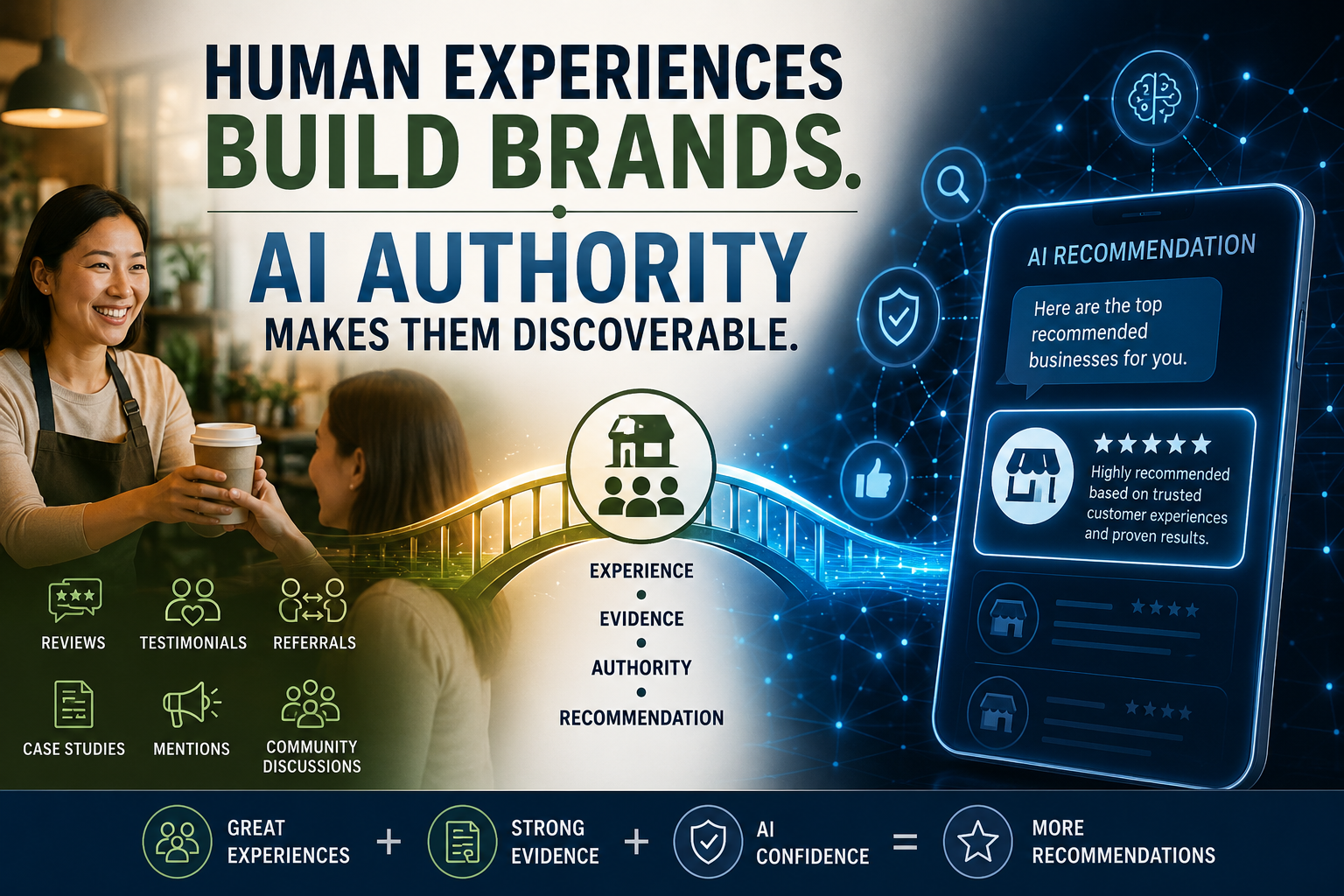
Human experiences build brands.
AI Authority makes those brands discoverable.
The Misconception About AI Authority
As AI becomes more influential in customer decision-making, it’s easy to assume that AI Authority™ is simply another optimization exercise.
Publish more content.
Add more schema.
Build more backlinks.
Create more entities.
These activities improve discoverability.
But discoverability alone does not create authority.
Authority exists before AI recognizes it.
AI simply looks for evidence that authority already exists.
This is why two companies with similar websites can receive very different recommendation outcomes.
One has years of positive customer experiences.
The other only has well-optimized content.
AI increasingly distinguishes between the two.
Brand Authority Is Earned Offline Before It Is Recognized Online
Every memorable customer interaction creates something valuable.
Not just satisfaction.
Evidence.
A customer leaves a review.
Another shares a recommendation.
A journalist writes about the company.
An industry expert cites its research.
A client publishes a case study.
Employees speak positively about their workplace.
Partners continue long-term collaborations.
None of these activities are created for AI.
They are created by genuine human experiences.
Collectively, they become signals that AI systems can observe, interpret, and reinforce.
This is why customer experience has become one of the strongest long-term investments in AI Authority.
AI Doesn’t Experience Your Brand
AI has never used your product.
It has never visited your office.
It has never spoken to your customer support team.
It cannot personally judge your service quality.
Instead, AI evaluates the digital evidence generated by people who have.
It analyzes patterns across multiple sources, including:
- Customer reviews
- Testimonials
- Case studies
- Industry publications
- Expert citations
- News coverage
- Community discussions
- Educational content
- Independent recommendations
- Brand consistency across channels
The stronger and more consistent these signals become, the more confidence AI develops in recommending your organization.
AI doesn’t trust brands.
Experience Creates Authority. Evidence Makes It Visible.
Many businesses focus heavily on producing content.
Content certainly matters.
Without content, AI has very little information to understand your expertise.
However, content alone rarely creates lasting authority.
Real authority is supported by experiences that other people can validate.
Think of the relationship this way:
Content explains your expertise.
Experiences prove your expertise.
Evidence documents your expertise.
AI recognizes your expertise.
Each layer reinforces the next.
Without experiences, content becomes marketing claims.
Without evidence, experiences remain invisible.
Without AI Authority, evidence may never reach future customers.
The AI Discovery Flywheel™
One of the most powerful outcomes of AI Authority™ is the AI Discovery Flywheel™. As AI gains confidence in recommending a brand, every positive customer experience generates new evidence that strengthens future recommendations, creating a self-reinforcing cycle of discovery and growth.
Positive experiences generate evidence.
Evidence strengthens AI confidence.
Higher AI confidence leads to more recommendations.
More recommendations create more customers.
More customers create more experiences.
Those experiences generate even stronger evidence.
The cycle continues.
Customer Experiences
          ↓
Public Evidence
          ↓
AI Confidence
          ↓
AI Recommendations
          ↓
New Customers
          ↓
More Experiences
This is not merely a marketing flywheel.
It is a discovery flywheel.
Organizations that consistently deliver exceptional experiences steadily accumulate recommendation advantages that become increasingly difficult for competitors to replicate.
Why Technical SEO Alone Is No Longer Enough
Technical optimization remains essential.
Search engines and AI systems still need websites that are accessible, structured, fast, and understandable.
But technical excellence cannot compensate for weak customer experiences.
Likewise, outstanding customer experiences cannot reach their full potential if AI cannot discover and interpret them.
Modern AI visibility requires both.
One builds the authority.
The other exposes it.
This is why AI Authority™ should never be viewed as a replacement for branding or customer experience.
Instead, it serves as the bridge that connects authentic human trust with machine recommendation.
Human Experiences Are the Foundation of AI Authority™
Within the AI Authority Pyramid™, this relationship becomes clear.
Technical foundations make your content accessible.
Knowledge architecture helps AI understand your expertise.
Thematic authority demonstrates depth.
Ecosystem credibility signals validate your reputation.
Algorithmic Authority Recognition reflects how confidently AI recommends your organization.
Yet none of these higher layers emerge without the experiences that created them.
Every satisfied customer.
Every successful implementation.
Every thoughtful conversation.
Every solved problem.
Every recommendation.
Every long-term relationship.
These are the true origins of AI Authority.
The Future Belongs to Brands That Create Evidence
The next generation of digital marketing is no longer about publishing the most content.
It is about generating the strongest evidence.
Organizations that consistently create remarkable customer experiences naturally produce:
- Better reviews
- Better case studies
- Better testimonials
- Better citations
- Better referrals
- Better community conversations
- Better reputation signals
Those signals strengthen AI confidence.
Greater AI confidence increases recommendation frequency.
Recommendation frequency drives future growth.
This is how human experiences become machine-recognized authority.
Real-World Example: Human Experiences Create AI Recommendation Confidence
Consider Apple.
Apple’s products are not always the cheapest, nor do they always have the highest technical specifications.
Yet when people ask AI assistants questions such as:
- “What’s the best smartphone for most people?”
- “Which laptop is good for students?”
- “What’s a reliable smartwatch?”
- “Which tablet should I buy?”
Apple products are frequently among the recommendations.
Why?
It’s not because Apple publishes the most content.
It’s because decades of positive customer experiences have generated enormous amounts of publicly available evidence, including:
- Millions of customer reviews
- Independent product testing
- Expert evaluations
- Media coverage
- Customer satisfaction studies
- Long-term reliability reports
- Community discussions
- Brand loyalty
- High customer retention
- Extensive case studies across education, business, and creative industries
AI systems observe these signals collectively.
The recommendation is not based on a single review or marketing campaign. It reflects years of accumulated human experiences that consistently reinforce Apple’s reputation.
In other words:
People built Apple’s brand. AI simply recognizes the evidence.
Why this matters for every business
The same principle applies whether you’re a global technology company or a local business.
A Singapore accounting firm that consistently delights its clients may accumulate:
- Excellent Google Reviews
- Positive LinkedIn recommendations
- Referral business
- Client testimonials
- Industry awards
- Case studies
- Media interviews
- Repeat engagements
Individually, each signal has value.
Together, they create a body of evidence that strengthens AI’s confidence when deciding whether to recommend that firm.
This is why AI Authority™ is not something businesses “manufacture” overnight.
It is something they earn through experiences and amplify through discoverable evidence.
Here is one diagram which illustrates a complete feedback loop between the human world and the AI world
Great Customer Experiences
↓
Customer Trust
↓
Reviews • Testimonials • Referrals • Case Studies
↓
Digital Evidence
↓
AI Confidence
↓
AI Recommendations
↓
New Customers
↓
More Great Experiences
Humans create the experiences. Evidence preserves them. AI recognizes them. Recommendations scale them.
This progression clearly explains why customer experience remains the true foundation of AI Authority™, even as AI becomes increasingly responsible for discovery and recommendations.
Final Thoughts
The future of AI visibility will not be won by organizations that simply optimize for algorithms.
It will be won by organizations that create experiences worthy of recommendation.
AI Authority does not replace customer experience.
It amplifies it.
It does not manufacture trust.
It recognizes trust that humans have already earned.
In an AI-driven economy, the brands most frequently recommended will not necessarily be those that publish the most content.
They will be the ones that consistently create meaningful human experiences—and make those experiences visible through structured, credible, and discoverable evidence.
Because in the age of AI:
Human experiences build brands.
AI Authority makes them discoverable.
Key Takeaways
- AI Authority begins with human experiences, not algorithms.
- Customer experiences generate evidence that AI uses to evaluate brands.
- Content explains expertise, but experiences validate it.
- Reviews, case studies, citations, and testimonials strengthen AI confidence.
- Technical SEO and AI optimization improve discoverability but cannot replace authentic customer trust.
- The strongest AI recommendations are built upon consistently positive human experiences.
- Sustainable AI Authority compounds through a continuous cycle of experiences, evidence, confidence, and recommendations.
FAQ
1. What is the main idea behind “Human Experiences Build Brands. AI Authority Makes Them Discoverable”?
The main idea is that brand authority begins with real human experiences. AI does not create trust by itself. It recognizes and amplifies the evidence created by customers, partners, experts, and communities.
2. Is AI Authority more important than customer experience?
No. Customer experience is the foundation. AI Authority makes that experience more discoverable, understandable, and recommendable by AI systems.
3. How do human experiences influence AI recommendations?
Human experiences create signals such as reviews, testimonials, case studies, referrals, media mentions, expert citations, and community discussions. AI systems use these signals to evaluate whether a brand is credible and recommendation-worthy.
4. Can a brand build AI Authority without strong customer experience?
Only temporarily. A brand may gain visibility through content and optimization, but weak customer experiences eventually create negative evidence that can reduce trust, credibility, and recommendation confidence.
5. Why is online evidence important for AI Authority?
AI cannot personally experience a brand. It depends on available evidence. If positive customer experiences are not documented online, AI may not be able to recognize or recommend the brand confidently.
6. What types of evidence strengthen AI Authority?
Useful evidence includes customer reviews, testimonials, case studies, expert mentions, independent citations, industry recognition, educational content, social proof, and consistent brand information across trusted sources.
7. Does technical SEO still matter in the AI era?
Yes. Technical SEO helps AI and search systems access, understand, and interpret a brand’s information. However, technical SEO alone cannot replace authentic trust created through real customer experiences.
8. How can businesses turn customer experience into AI Authority?
Businesses can document customer success stories, collect genuine reviews, publish case studies, build consistent brand profiles, earn credible citations, and structure their knowledge so AI systems can understand and trust the evidence.
9. What is the relationship between customer experience and AI confidence?
Positive customer experiences generate credible signals. When those signals are consistent across multiple sources, AI systems gain more confidence in recommending the brand.
10. What is the biggest takeaway for businesses?
The future of AI visibility belongs to brands that create experiences worthy of recommendation and make those experiences visible through structured, credible, and discoverable evidence.
Leave a Reply