
By TonyCWK
Introduction
Before artificial intelligence can evaluate your expertise, assess your credibility, or recommend your business, it must first answer a deceptively simple question:
Who are you?
Humans often answer that question intuitively. They combine context, experience, reputation, and conversation to build an understanding of a business.
AI systems work differently.
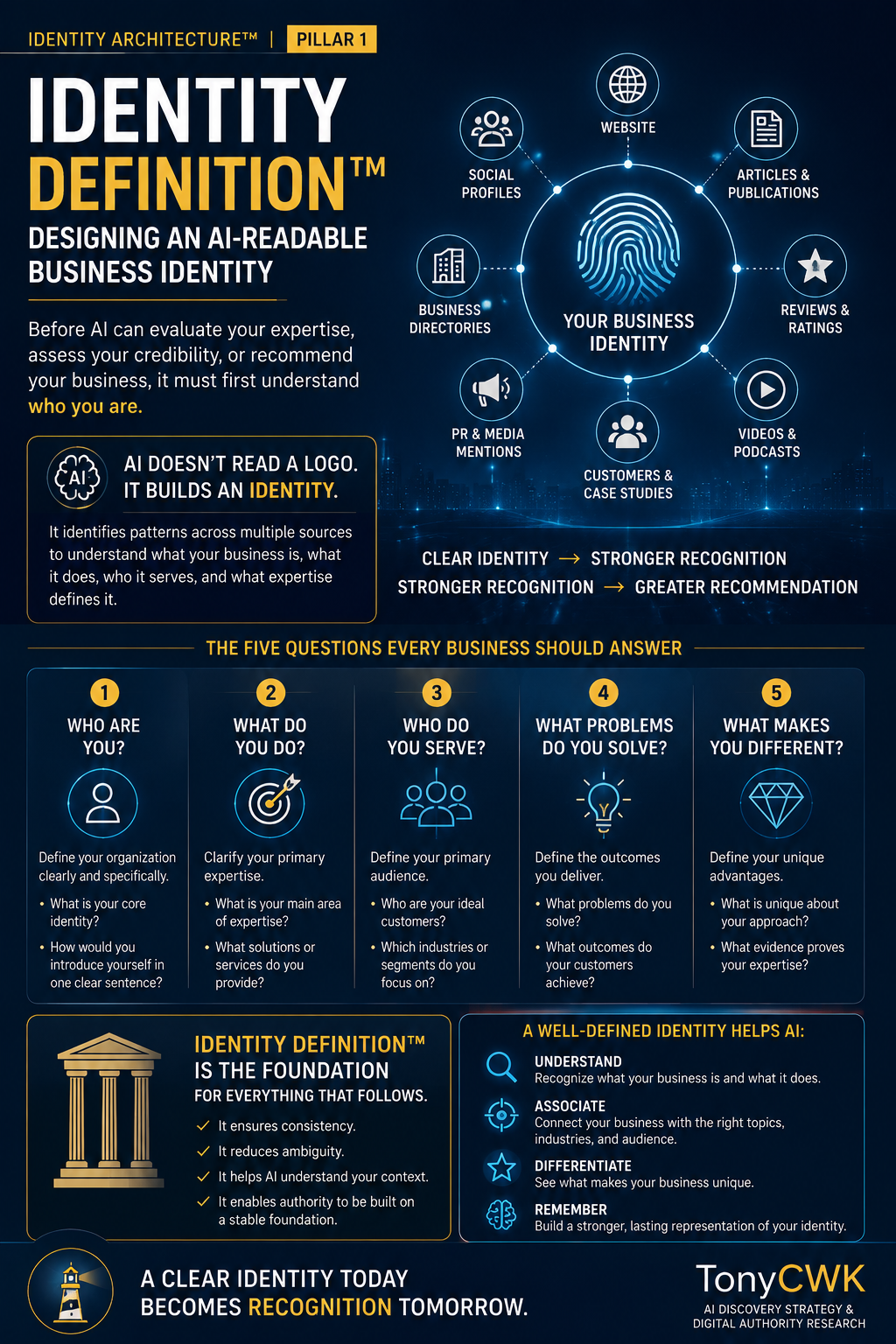
They construct an identity from the digital signals they encounter across websites, business profiles, articles, directories, social platforms, reviews, publications, and other sources.
When those signals consistently reinforce the same identity, AI develops a clearer understanding of the organization.
When they conflict, identity becomes ambiguous.
That is why the first pillar of Identity Architecture™ is Identity Definition™.
What Is Identity Definition™?
Identity Definition™ is the deliberate process of defining how an organization should be consistently understood by AI systems and people across the digital ecosystem.
It establishes the foundation upon which every other pillar of Identity Architecture™ is built.
Rather than asking, “How should we market ourselves?”, Identity Definition™ asks:
- Who are we?
- What do we actually do?
- Which problems do we solve?
- Who do we serve?
- What expertise defines us?
- What should AI consistently associate with us?
Without clear answers, every subsequent marketing effort risks reinforcing different versions of the same business.
AI Doesn’t Read A Logo. It Builds An Identity.
Many organizations believe their brand identity is defined by a logo, slogan, or visual style.
These elements matter to people.
AI, however, is trying to understand meaning rather than appearance.
It identifies recurring patterns across multiple sources to answer questions such as:
- What category does this business belong to?
- Which products or services are central to its identity?
- Which industries does it operate in?
- Which topics consistently appear alongside its name?
- Which expertise is repeatedly demonstrated?
- Which audience does it primarily serve?
Over time, AI develops an internal representation of the organization based on these recurring signals.
Identity Definition™ ensures those signals describe the same business rather than multiple conflicting versions.
The Five Questions Every Business Should Answer
A well-defined AI-readable identity begins with five fundamental questions.
1. Who Are You?
Define the organization clearly.
Avoid vague statements.
Instead of saying:
“We provide innovative business solutions.”
Be specific.
“We help small and medium-sized businesses improve AI discoverability, digital authority, and recommendation readiness.”
Specificity creates recognition.
2. What Do You Do?
Clearly define your primary expertise.
Many businesses attempt to describe everything they can do.
Primary expertise should be immediately recognizable.
Additional capabilities can reinforce rather than dilute the core identity.
3. Who Do You Serve?
Audience definition matters.
Examples include:
- Small and medium-sized businesses
- Enterprise organizations
- Healthcare providers
- Financial institutions
- Manufacturers
- Professional services firms
The clearer the audience, the easier it becomes for AI to understand the context in which your expertise applies.
4. What Problems Do You Solve?
Businesses are remembered by the problems they solve.
Instead of listing features, define outcomes.
Examples include:
- Improving AI discoverability
- Building recommendation readiness
- Strengthening digital authority
- Increasing operational efficiency
- Reducing cybersecurity risk
Problems create context.
Solutions create identity.
5. What Makes You Different?
Differentiation should extend beyond marketing slogans.
AI looks for evidence of uniqueness through:
- Proprietary frameworks
- Original methodologies
- Unique research
- Recognized expertise
- Consistent thought leadership
- Demonstrated outcomes
Distinctiveness strengthens identity.
Identity Before Positioning
Positioning is often viewed as a marketing exercise.
Identity Definition™ comes earlier.
Positioning explains how you compare with competitors.
Identity explains what you fundamentally are.
Without identity, positioning becomes inconsistent.
Without positioning, identity remains understandable but less differentiated.
The two complement one another rather than compete.
Identity Is A Long-Term Asset
Identity should remain stable even as products, campaigns, or technologies evolve.
Organizations frequently launch new services or adopt emerging technologies.
Their identity should remain recognizable throughout those changes.
For example, an organization known for AI discovery strategy may later expand into agentic commerce or AI governance.
Its expertise evolves.
Its identity remains coherent.
Consistency enables AI to accumulate confidence over time.
Identity Definition™ Within Identity Architecture™
Identity Definition™ is only the first pillar.
The remaining pillars ensure that identity becomes consistently represented, reinforced, and recognized across the broader digital ecosystem.
The six pillars work together:
- Identity Definition™ establishes who you are.
- Identity Consistency™ ensures every platform tells the same story.
- Identity Relationships™ connects your people, expertise, products, and services.
- Identity Representation™ makes identity understandable to AI systems.
- Identity Reinforcement™ strengthens confidence through independent validation.
- Identity Persistence™ enables long-term recognition across AI systems and time.
Without a clearly defined identity, the remaining pillars lack a stable foundation.
Practical Questions To Evaluate Your Identity
Ask yourself:
- Could AI describe my business in one consistent sentence?
- Would different platforms describe my organization similarly?
- Is my primary expertise immediately obvious?
- Do my products and services reinforce the same identity?
- Does my content consistently support that identity?
- Would someone encountering my brand for the first time understand exactly what I do?
If these questions produce inconsistent answers, your identity may require refinement before focusing on authority-building initiatives.
Looking Ahead
Once an organization has clearly defined its identity, the next challenge is ensuring that identity remains consistent across every digital touchpoint.
The next article explores the second pillar of Identity Architecture™:
Identity Consistency™ — Why AI Gets Confused By Inconsistent Businesses.
Conclusion
AI systems cannot recommend what they do not clearly understand.
Before organizations pursue authority, trust, citations, or recommendation readiness, they must first establish a precise and consistent identity.
Identity Definition™ provides that foundation.
It transforms identity from a marketing message into an architectural asset that supports long-term AI recognition, recommendation confidence, and digital authority.
FAQ
1. What is Identity Definition™?
Identity Definition™ is the deliberate process of defining how an organization should be consistently understood by AI systems and people across the digital ecosystem.
2. Why is Identity Definition™ important for AI visibility?
AI needs a clear understanding of who a business is, what it does, who it serves, and what expertise it represents before it can confidently evaluate or recommend it.
3. Is Identity Definition™ the same as branding?
No. Branding shapes perception, while Identity Definition™ clarifies the core meaning of the business so AI systems can understand and associate it with the right expertise, audience, and problems.
4. What should a business define first?
A business should first define who it is, what it does, who it serves, what problems it solves, and what makes it different.
5. Why does AI get confused by unclear business identity?
AI may encounter conflicting descriptions across websites, social profiles, directories, reviews, and other sources. When these signals do not align, the business identity becomes harder to interpret consistently.
6. How does Identity Definition™ support Identity Architecture™?
Identity Definition™ is the first pillar of Identity Architecture™. It gives the remaining pillars a stable foundation by clarifying what identity should be represented, reinforced, and recognized.
7. How does Identity Definition™ support AI Authority™?
AI Authority™ depends on knowing what an organization is authoritative about. Identity Definition™ clarifies the category, expertise, audience, and problems that authority should be associated with.
8. Can a business have more than one identity?
A business may have multiple services or audiences, but its core identity should remain coherent. Too many disconnected identities can dilute AI understanding and weaken recognition.
9. What makes an identity AI-readable?
An identity becomes AI-readable when it is specific, consistent, context-rich, and repeatedly reinforced across content, platforms, entities, and external references.
10. What is the main goal of Identity Definition™?
The main goal is to make the business clear enough for AI systems to consistently understand who it is before evaluating credibility, authority, or recommendation potential.
Leave a Reply