
By TonyCWK
Introduction
For years, digital marketing has focused on helping people discover businesses.
SEO improved rankings.
Content marketing attracted audiences.
Advertising generated awareness.
Social media increased visibility.
These disciplines were built around a simple objective: be found.
Today, artificial intelligence is changing that objective.
Modern AI systems are no longer just retrieving webpages. They are interpreting information, comparing alternatives, and increasingly recommending businesses, products, services, and experts as part of decision support.
Before an AI system can confidently recommend you, it must first answer a more fundamental question:
Who are you?
That question lies at the heart of Identity Architecture™.
The Shift From Visibility To Identity
Traditional search engines largely evaluated pages.
AI systems evaluate identities.
Instead of treating every webpage independently, AI attempts to construct a coherent understanding of an organization across multiple sources.
It looks for patterns that answer questions such as:
- What does this organization actually do?
- Which industry does it belong to?
- What expertise does it consistently demonstrate?
- What products or services define it?
- How do independent sources describe it?
- Does its identity remain consistent across platforms?
This process extends beyond keywords or rankings. AI is building an internal model of your business before deciding whether your information is suitable for recommendation.
In the AI era, visibility alone is no longer sufficient. AI must first recognize your identity before it can develop confidence in recommending you.
What Is Identity Architecture™?
Identity Architecture™ is the deliberate design, organization, and reinforcement of a business’s digital identity so that AI systems can consistently understand, interpret, and recognize who the organization is across the digital ecosystem.
It is not branding.
It is not web design.
It is not simply SEO.
Instead, it provides the structural foundation that allows AI systems to develop a stable understanding of an organization before evaluating its authority or credibility.
Identity Architecture™ focuses on reducing ambiguity.
When AI encounters conflicting descriptions across websites, social profiles, directories, articles, and other digital assets, its confidence decreases.
When every signal consistently reinforces the same identity, AI gains greater certainty about who the organization is.
That certainty becomes the foundation for recommendation.
Why Identity Matters More In The AI Era
AI systems increasingly act as interpreters rather than search engines.
Instead of presenting ten blue links, they often summarize information into a single answer.
Instead of asking users to compare multiple websites, they compare the available information on the user’s behalf.
This changes what organizations must optimize.
Success is no longer determined solely by whether AI can retrieve your content.
It increasingly depends on whether AI can confidently explain who you are.
Businesses that lack a clearly defined digital identity may still be visible, but they become more difficult for AI to describe consistently.
Identity Before Authority
Authority depends upon identity.
Before AI can determine whether you are authoritative, it must first determine what you are authoritative about.
Without a clear identity:
- Expertise becomes difficult to categorize.
- Content appears fragmented.
- Recommendations become less confident.
- Citations become inconsistent.
- Recognition becomes weaker.
Identity Architecture™ therefore becomes the foundation upon which AI Authority™, Recommendation Readiness™, Confidence Accumulation™, and Delegation Confidence™ can later develop.
In other words:
Identity explains who you are.
Authority explains why you are recommended.
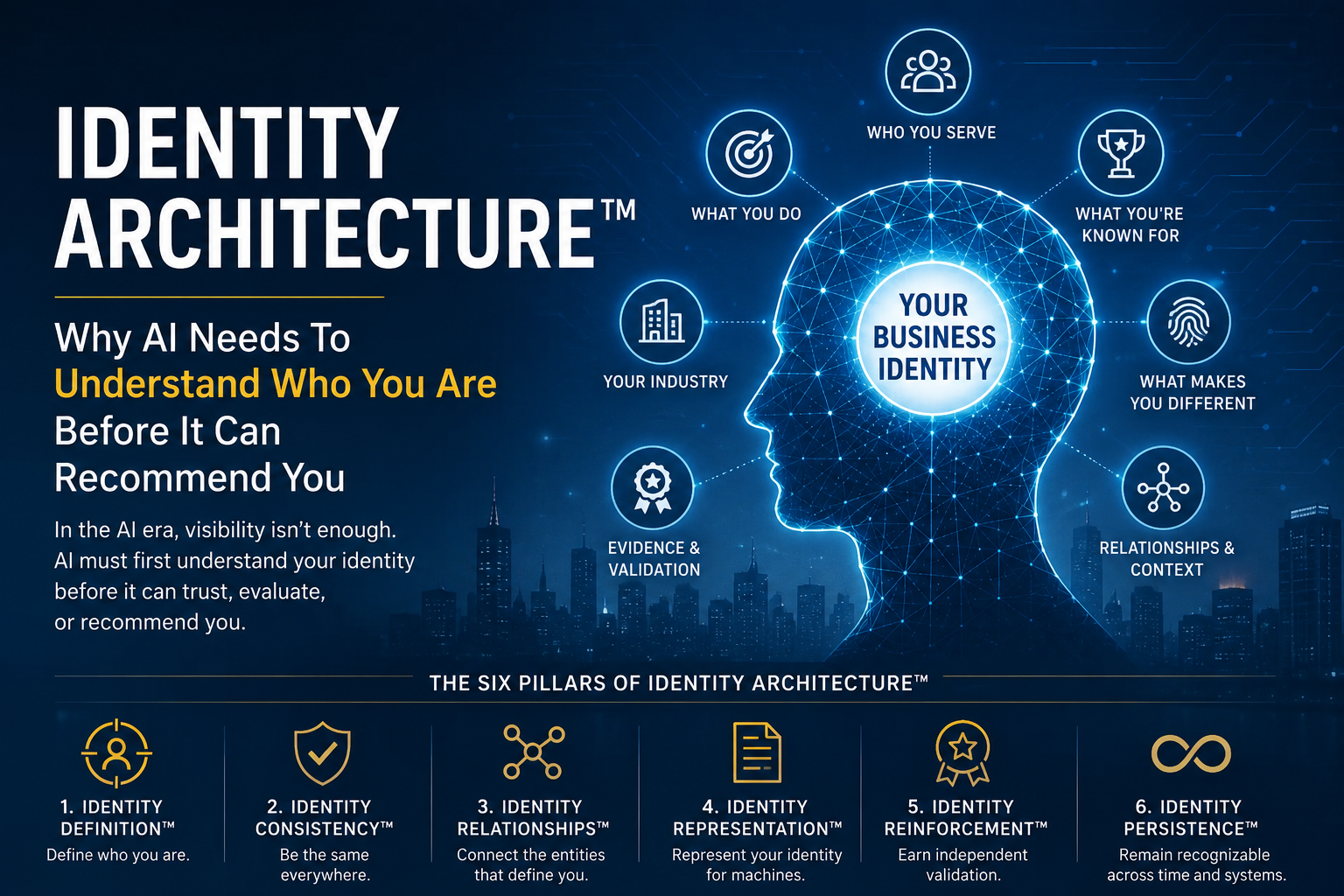
The Six Pillars Of Identity Architecture™
Identity Architecture™ is built upon six interconnected pillars.
1. Identity Definition™
Clearly defining who the organization is, what it does, whom it serves, and how it should be consistently understood.
2. Identity Consistency™
Ensuring every digital touchpoint reinforces the same identity instead of presenting conflicting descriptions.
3. Identity Relationships™
Establishing meaningful relationships between people, products, services, industries, organizations, and areas of expertise.
4. Identity Representation™
Representing identity using machine-readable structures that AI systems can interpret consistently.
5. Identity Reinforcement™
Strengthening identity through independent validation, citations, reviews, references, and ecosystem credibility.
6. Identity Persistence™
Maintaining a stable identity across platforms, AI models, and time so that recognition remains consistent despite changing technologies.
Future articles in this series will examine each pillar in greater detail.
Identity Architecture™ And AI Authority™
Identity Architecture™ is not a replacement for AI Authority™.
Instead, it serves as the layer that enables authority to develop.
AI Authority™ explains why AI systems recommend an organization.
Identity Architecture™ explains how AI systems consistently recognize that organization in the first place.
Without identity, authority becomes fragmented.
Without authority, identity remains descriptive but lacks influence.
Together, they form complementary components of AI discoverability.
Looking Ahead
As AI continues evolving from information retrieval toward recommendation and decision support, organizations will need to think beyond webpages and keywords.
They will need to deliberately design the identity AI learns about them.
Businesses that treat identity as an architectural discipline rather than an accidental by-product of marketing will be better positioned to achieve consistent recognition across search engines, AI assistants, recommendation systems, and future intelligent agents.
The future of AI visibility begins long before recommendation.
It begins with identity.
Real-World Example:
Two accounting firms offer identical services, but only one has structured entities, services, and expertise that AI can understand.
Conclusion
The next evolution of digital optimization is not simply producing more content or improving rankings.
It is ensuring that AI systems consistently understand who you are before asking them to recommend you.
That is the purpose of Identity Architecture™.
In the articles that follow, we will explore each of the six pillars in depth and examine how organizations can build identities that remain understandable, consistent, and resilient across an increasingly AI-driven digital ecosystem.
FAQ
1. What is Identity Architecture™?
Identity Architecture™ is the deliberate design, organization, and reinforcement of a business’s digital identity so AI systems can consistently understand who the organization is across the digital ecosystem.
2. Why does AI need to understand identity before making recommendations?
AI needs to know what a business is, what it does, who it serves, and what it is credible for before it can confidently recommend it.
3. Is Identity Architecture™ the same as branding?
No. Branding shapes how humans perceive a business. Identity Architecture™ shapes how AI systems interpret and recognize that business across websites, platforms, citations, and digital signals.
4. How is Identity Architecture™ different from SEO?
SEO helps businesses become discoverable in search. Identity Architecture™ helps AI systems form a consistent understanding of who the business is before evaluating authority or recommendation confidence.
5. What are the six pillars of Identity Architecture™?
The six pillars are Identity Definition™, Identity Consistency™, Identity Relationships™, Identity Representation™, Identity Reinforcement™, and Identity Persistence™.
6. How does Identity Architecture™ support AI Authority™?
Identity Architecture™ gives AI systems a stable understanding of who the organization is. AI Authority™ then builds on that identity to explain why the organization should be recommended.
7. Why is identity consistency important for AI visibility?
When a business is described differently across platforms, AI may struggle to form a reliable understanding of it. Consistent identity signals reduce ambiguity and improve recognition.
8. Does Identity Architecture™ require schema markup?
Schema markup can support Identity Architecture™, but it is only one part of the broader discipline. The foundation begins with clear identity definition, consistency, relationships, and reinforcement.
9. Who should care about Identity Architecture™?
Businesses, consultants, experts, agencies, and organizations that want to be accurately understood, recognized, and recommended by AI systems should care about Identity Architecture™.
10. What is the main goal of Identity Architecture™?
The main goal is to make a business’s identity clear, consistent, and recognizable enough for AI systems to understand who it is before deciding whether to recommend it.
Leave a Reply