
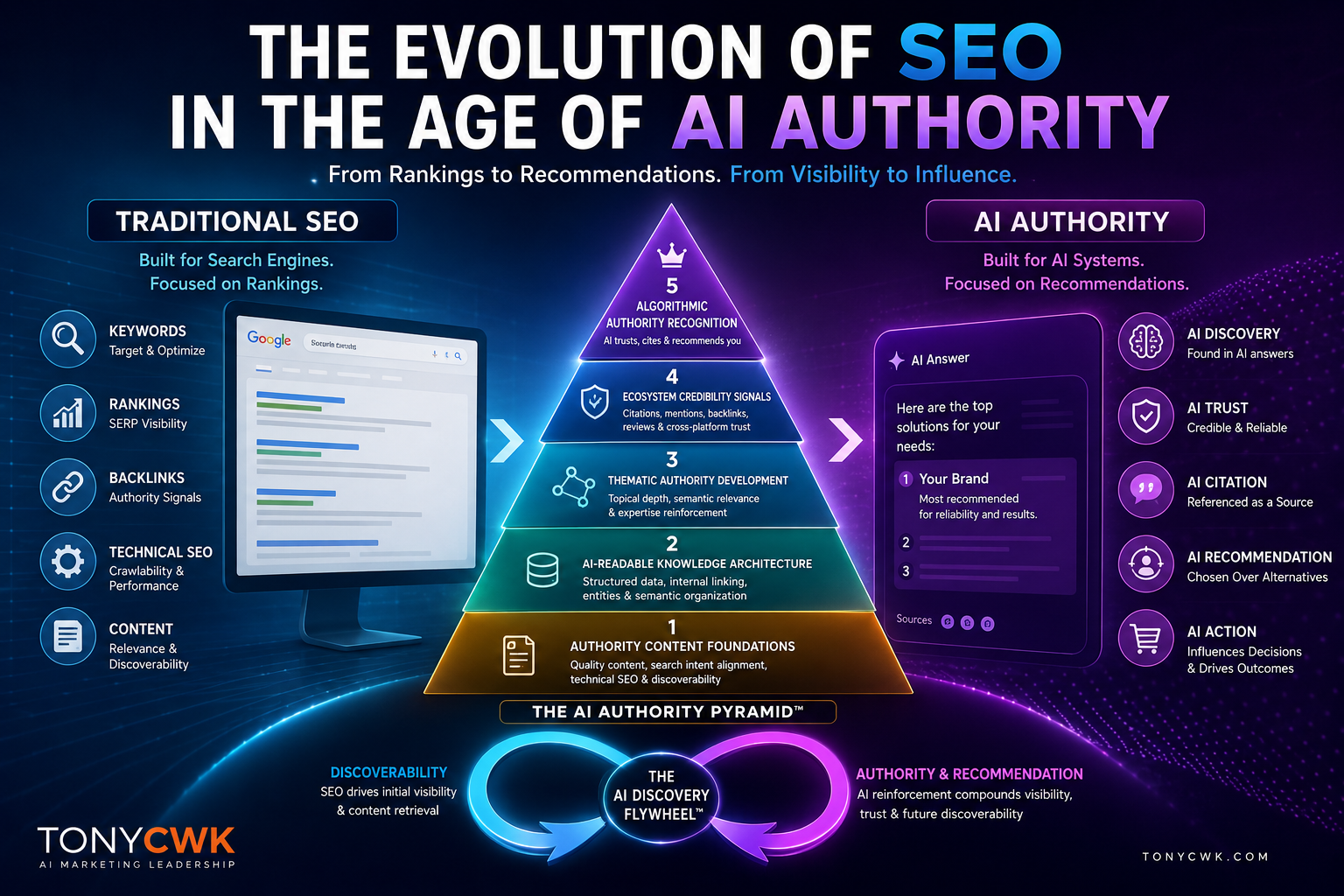
For more than two decades, SEO has been one of the foundational disciplines of digital marketing.
Businesses invested heavily in:
- keyword optimization
- rankings
- backlinks
- metadata
- technical performance
- content discoverability
And for many years, this model worked exceptionally well.
If a brand ranked highly on search engines, visibility often translated into traffic, leads, and revenue.
But the rise of AI-powered discovery systems is fundamentally changing how digital visibility works.
Today, users are increasingly receiving:
- AI-generated summaries
- conversational answers
- synthesized recommendations
- delegated decision support
- AI-assisted purchasing suggestions
The modern visibility battle is no longer only about being ranked.
It is increasingly about being selected.
This does not mean SEO is dead.
In reality, SEO remains highly relevant — but its role has evolved.
Traditional SEO is no longer the final objective of digital visibility.
Instead, it has become part of a much larger system:
AI Authority.
SEO Was Originally Built for Search Retrieval
Traditional SEO was designed around a relatively straightforward objective:
Help search engines discover, understand, index, and rank web pages.
This led to the development of practices such as:
- keyword targeting
- technical optimization
- link building
- metadata enhancement
- internal linking
- structured content formatting
- topical relevance
Search engines evaluated:
- page relevance
- authority
- crawlability
- engagement signals
- backlink profiles
The reward was visibility in search rankings.
For many years, this model shaped the entire digital marketing ecosystem.
But AI systems are now changing how information is surfaced and consumed.
The Shift From Retrieval to Recommendation
Modern AI systems do not behave exactly like traditional search engines.
Instead of merely retrieving pages, AI increasingly attempts to:
- synthesize information
- compare entities
- evaluate credibility
- summarize expertise
- infer trustworthiness
- generate recommendations
- assist decision-making
This creates a major shift in digital visibility dynamics.
Traditional search primarily answered:
“Which pages are relevant?”
AI systems increasingly ask:
“Which sources are trustworthy enough to recommend?”
This is a completely different optimization challenge.
And this is where AI Authority begins to emerge as a critical competitive advantage.
SEO Is Still Foundational in the AI Era
Despite dramatic changes in AI-powered discovery, traditional SEO remains highly important.
In fact, many AI systems still rely heavily on the open web ecosystem that SEO helps structure.
SEO continues to contribute to:
- discoverability
- crawlability
- semantic understanding
- structured retrieval
- entity association
- topical reinforcement
- ecosystem visibility
Without strong SEO foundations:
- content may not be properly indexed
- entities may not be consistently recognized
- AI systems may struggle to retrieve information accurately
- authority signals may weaken
In many ways, SEO remains the infrastructure layer of digital discoverability.
However, infrastructure alone is no longer enough.
Why Traditional SEO Alone Is Becoming Insufficient
Traditional SEO was largely optimized for:
- rankings
- clicks
- impressions
- traffic acquisition
But AI systems increasingly evaluate additional dimensions such as:
- semantic coherence
- recommendation confidence
- entity consistency
- cross-platform credibility
- citation reinforcement
- extractability
- ecosystem authority
- trust persistence
A webpage that ranks well does not automatically become highly recommendable by AI systems.
This creates a growing gap between:
- discoverability
and - recommendation readiness
Brands that fail to adapt may still receive impressions while gradually losing influence inside AI-generated experiences.
The Emergence of AI Authority
AI Authority represents the evolution of digital visibility beyond traditional rankings.
It focuses on whether AI systems can:
- understand a brand clearly
- retrieve information confidently
- associate expertise accurately
- reinforce credibility consistently
- recommend entities reliably
This changes the optimization target from:
“How do we rank?”
to:
“How do we become recommendable?”
The future competitive advantage is increasingly built around:
- structured trust
- semantic depth
- ecosystem reinforcement
- entity clarity
- recommendation reliability
How Traditional SEO Fits Into the AI Authority Pyramid™
The AI Authority Pyramid™ does not replace SEO.
Instead, it expands and elevates it.
Traditional SEO continues to play an important role across multiple layers of the framework.
Layer 1 — Authority Content Foundations
This layer includes:
- keyword strategy
- content quality
- search intent alignment
- discoverability optimization
- technical SEO foundations
Traditional SEO remains highly important here.
Without discoverable content, AI systems cannot consistently retrieve or evaluate expertise.
Layer 2 — AI-Readable Knowledge Architecture
This layer extends beyond traditional SEO into:
- semantic structuring
- entity relationships
- schema implementation
- structured knowledge organization
- AI extractability
SEO contributes strongly here through:
- internal linking
- semantic hierarchy
- structured formatting
- crawlable architecture
However, AI Authority expands this into machine-readable trust systems.
Layer 3 — Thematic Authority Development
Traditional topical SEO evolves into:
- ecosystem-wide expertise reinforcement
- semantic depth
- authority clustering
- sustained subject consistency
AI systems increasingly evaluate:
- thematic continuity
- subject specialization
- expertise persistence over time
This goes beyond isolated keyword optimization.
Layer 4 — Ecosystem Credibility Signals
Traditional SEO historically emphasized backlinks.
AI Authority expands credibility evaluation into:
- citations
- mentions
- cross-platform consistency
- ecosystem trust reinforcement
- entity validation
AI systems increasingly assess whether authority signals remain coherent across the broader digital ecosystem.
Layer 5 — Algorithmic Authority Recognition
This is where AI systems begin to:
- repeatedly surface
- trust
- cite
- recommend
- reinforce
specific entities.
Strong SEO may help brands become visible.
But AI Authority helps brands become consistently selected.
How SEO Fits Into the AI Discovery Flywheel™
The AI Discovery Flywheel helps explain how modern digital authority compounds over time.
SEO continues to contribute to the early stages of visibility momentum.
For example:
- discoverable content improves retrieval opportunities
- structured pages improve extractability
- topical consistency improves semantic reinforcement
- authority signals improve citation potential
As AI systems repeatedly retrieve and reference trustworthy entities, visibility begins compounding.
This creates:
- recommendation reinforcement
- entity persistence
- retrieval confidence
- ecosystem familiarity
- accelerated discoverability momentum
The result is a self-reinforcing AI discovery cycle.
SEO Is Evolving From Ranking Optimization to Recommendation Optimization
One of the biggest misconceptions in digital marketing today is the belief that SEO and AI visibility are separate disciplines.
In reality, AI Authority builds upon the foundations SEO created.
The difference is that optimization targets are evolving.
Traditional SEO focused primarily on:
- rankings
- clicks
- traffic acquisition
AI Authority expands optimization toward:
- recommendation readiness
- trust reinforcement
- semantic authority
- retrieval confidence
- recommendation coherence
- delegated decision visibility
This represents the next evolutionary phase of digital visibility.
The Future Belongs to Brands That Combine Both
The future is not:
SEO versus AI Authority.
The future belongs to organizations that successfully integrate:
- discoverability
- semantic structure
- authority development
- ecosystem trust
- recommendation readiness
Traditional SEO still matters.
But in the age of AI-powered discovery systems, SEO alone is no longer enough.
The brands that thrive in the coming era will not simply optimize for rankings.
They will optimize for selection.
Final Thoughts
Search engines helped users find information.
Different AI platforms evaluate, retrieve, and cite information differently, but the direction is clear: structured, trustworthy, and semantically coherent content is becoming more important.
That distinction changes everything.
SEO remains foundational infrastructure in the digital ecosystem.
But AI Authority determines whether a brand becomes:
- understood
- trusted
- retrieved
- cited
- and ultimately recommended
The future of digital visibility is no longer defined solely by being found.
It is increasingly defined by being selected.
And that is the true evolution of SEO in the age of AI Authority.
FAQ for “The Evolution of SEO in the Age of AI Authority”
1. Is SEO still relevant in the age of AI?
Yes. SEO remains relevant because AI systems still need discoverable, crawlable, structured, and trustworthy information to retrieve and understand content.
2. Is SEO dead because of AI?
No. SEO is not dead. Its role is evolving from ranking optimization alone into a broader foundation for AI visibility, retrieval, citation, and recommendation readiness.
3. How is AI changing SEO?
AI is shifting SEO from a focus on rankings and clicks toward semantic clarity, entity trust, structured knowledge, and recommendation relevance.
4. What is the difference between SEO and AI Authority?
SEO helps search engines discover and rank content. AI Authority helps AI systems understand, trust, retrieve, cite, and potentially recommend a brand or entity.
5. Why is traditional SEO no longer enough?
Traditional SEO often focuses on keywords, rankings, and traffic. AI discovery requires additional signals such as entity consistency, semantic depth, credibility, extractability, and ecosystem trust.
6. How does SEO fit into the AI Authority Pyramid™?
SEO supports the lower and middle layers of the AI Authority Pyramid™, especially content foundations, AI-readable knowledge architecture, thematic authority, credibility signals, and algorithmic recognition.
7. Does technical SEO still matter for AI visibility?
Yes. Crawlability, indexing, site performance, structured data, internal linking, and clean architecture all help AI and search systems understand and retrieve content more effectively.
8. Are backlinks still important in the AI era?
Backlinks remain important, but they are no longer the only authority signal. AI systems may also consider mentions, citations, consistency, source credibility, and broader ecosystem validation.
9. What is recommendation readiness?
Recommendation readiness is the degree to which a brand or content asset is structured, credible, clear, and authoritative enough to be considered suitable for AI-generated answers or recommendations.
10. What should businesses do now?
Businesses should continue strengthening SEO fundamentals while building AI Authority through structured content, entity consistency, topical depth, credible citations, and cross-platform trust signals.
Suggested Further Reading
What Is AI Authority™?
Explains the core concept of AI Authority and why digital visibility is evolving beyond rankings into recommendation systems.
SEO Alone Is No Longer Enough
Explores why traditional SEO remains important but increasingly insufficient on its own in AI-mediated discovery environments.
The AI Authority Pyramid™
Breaks down the structural layers required to build sustainable AI visibility, trust, and recommendation readiness.
The AI Discovery Flywheel™
Explains how discoverability, credibility, citations, and recommendation reinforcement compound over time in AI ecosystems.
The Future of Search Is Recommendation, Not Retrieval
Examines the shift from traditional search retrieval toward AI-driven recommendation and delegated discovery systems.
AI Selection Systems™
Explores how AI systems increasingly evaluate and select entities based on trust, context, authority, and recommendation confidence.
Selectability™
Introduces the concept of AI selectability as the next competitive advantage beyond visibility alone.
Selection Intelligence™
Explains how AI systems evaluate competing entities before generating recommendations or delegated decisions.
Retrieval Confidence™
Discusses how AI systems develop confidence in retrieving and referencing entities consistently.
Algorithmic Authority Recognition
Explores how algorithms repeatedly reinforce trusted entities across digital ecosystems.
Entity Persistence in the Age of LLMs
Examines why consistent semantic identity matters for long-term AI visibility and recommendation durability.
Why AI Doesn’t Trust Content — It Trusts Systems
Explains why isolated content optimization is increasingly less effective without broader authority systems.
The New Visibility Model: Why Being Found Is No Longer Enough in the Age of AI
Explores the transition from discoverability toward recommendation-driven visibility.
Written by Tony Chan (TonyCWK)
AI Authority & Digital Strategy Researcher
Leave a Reply