
SEO once rewarded visibility.
Today, AI systems reward selection readiness.
For years, marketers used the Hero–Hub–Hygiene framework to structure content marketing strategies:
- Hero = large attention-grabbing campaigns
- Hub = recurring audience-building content
- Hygiene = searchable evergreen educational content
The framework worked well in the traditional web era because discovery depended heavily on:
- Search rankings
- Social reach
- Audience retention
- Click-through behavior
But AI-driven discovery systems are changing the rules.
Modern AI systems do not simply rank content pages.
They increasingly:
- retrieve,
- interpret,
- compare,
- synthesize,
- rerank,
- and recommend information.
This means the traditional Hero–Hub–Hygiene model is no longer enough on its own.
In the AI era, content is not merely competing for attention.
It is competing for:
- retrieval
- citation
- contextual trust
- entity association
- selection probability
The question is no longer:
“Will users click this?”
The new question is:
“Will AI systems trust this enough to use it?”
The Original Hero–Hub–Hygiene Model
The classic framework was designed primarily for human-centric distribution channels.
1. Hero Content
Hero content focuses on:
- mass awareness,
- virality,
- major launches,
- campaigns,
- and emotional brand storytelling.
Examples:
- flagship videos,
- industry reports,
- large campaigns,
- viral launches,
- keynote announcements.
Hero content is designed to generate:
- spikes in attention,
- backlinks,
- mentions,
- and broad audience reach.
2. Hub Content
Hub content builds recurring engagement.
Examples:
- weekly podcasts,
- recurring LinkedIn content,
- newsletters,
- YouTube series,
- educational series,
- thought leadership.
Hub content nurtures:
- familiarity,
- audience retention,
- community trust,
- and ongoing engagement.
3. Hygiene Content
Hygiene content is evergreen and search-oriented.
Examples:
- FAQs,
- tutorials,
- explainers,
- guides,
- glossary pages,
- troubleshooting articles.
Historically, hygiene content existed mainly to:
- capture long-tail search traffic,
- answer user questions,
- and improve SEO visibility.
Why the Model Breaks in the AI Era
The problem is not that the framework is wrong.
The problem is that the internet itself has changed.
AI systems now mediate discovery.
Instead of users manually browsing:
- websites,
- categories,
- search pages,
- or social feeds,
AI increasingly compresses discovery into:
- direct answers,
- summaries,
- recommendations,
- and synthesized outputs.
This fundamentally changes content economics.
Traditional content strategy optimized for:
- impressions,
- reach,
- clicks,
- watch time,
- and sessions.
AI discovery optimizes for:
- machine readability,
- semantic clarity,
- credibility reinforcement,
- entity consistency,
- knowledge structure,
- and retrieval confidence.
The consequence is profound:
A piece of content can have:
- low traffic,
- low social engagement,
- and minimal virality,
yet still become highly influential inside AI systems if it is consistently:
- cited,
- referenced,
- retrieved,
- and associated with authority.
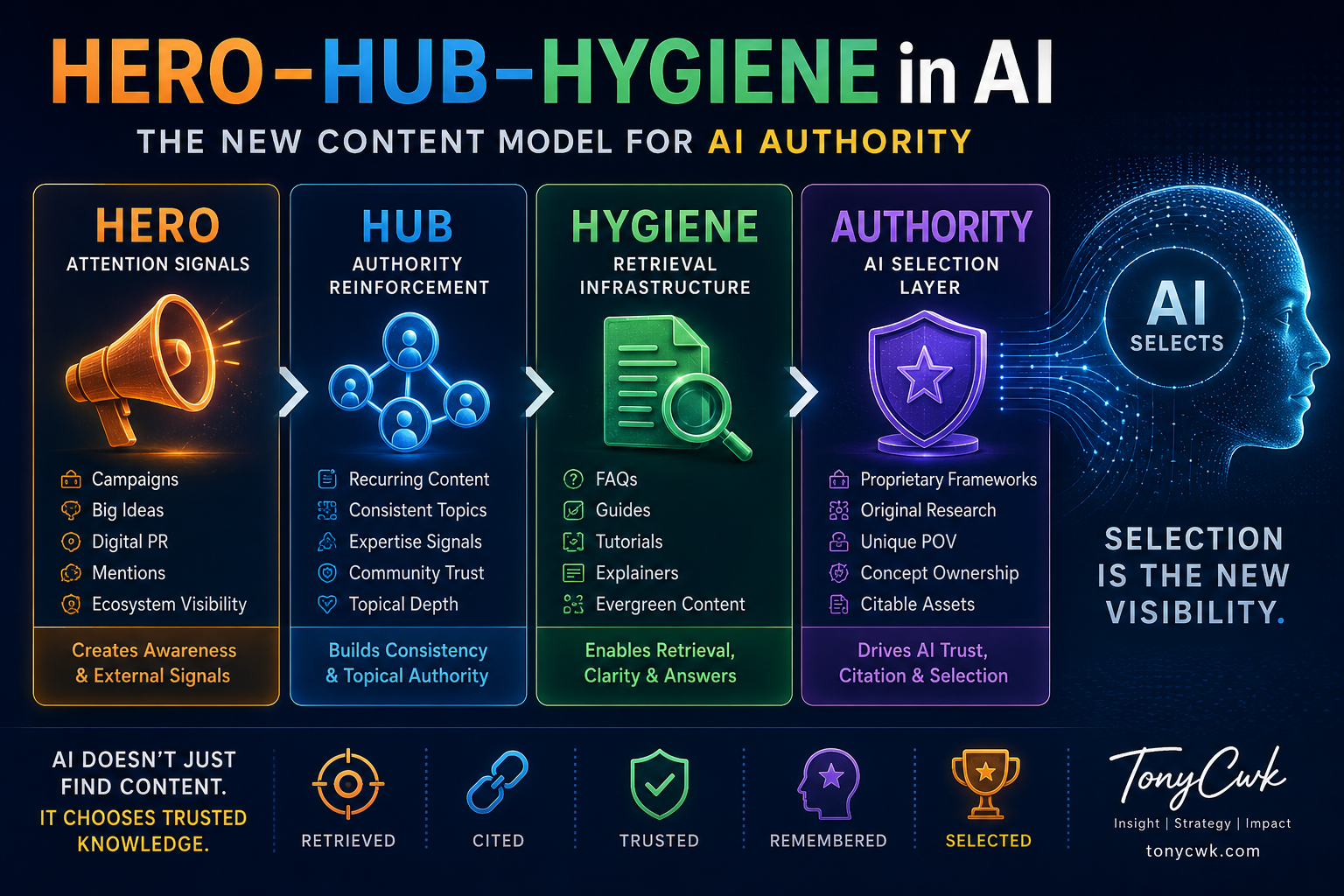
The Evolution: Hero–Hub–Hygiene → Hero–Hub–Hygiene–Authority
The traditional framework now requires a fourth layer:
Authority Content
Authority content exists primarily to improve:
- AI trust,
- retrieval reliability,
- thematic depth,
- semantic consistency,
- and entity recognition.
This is the missing layer most brands still ignore.
The Four-Layer AI Content Model
1. Hero = Attention Signals
Hero content still matters.
But its role changes.
In AI ecosystems, Hero content primarily generates:
- awareness signals,
- mentions,
- digital PR,
- citations,
- backlinks,
- and ecosystem recognition.
Hero content becomes:
- a credibility amplifier,
- not merely a traffic generator.
AI-Era Hero Objectives
- Generate entity mentions
- Increase ecosystem visibility
- Create external reinforcement signals
- Trigger authority associations
- Expand semantic footprint
2. Hub = Relationship Reinforcement
Hub content becomes the consistency engine.
AI systems increasingly evaluate:
- consistency,
- topical persistence,
- recurring expertise,
- and thematic continuity.
Frequent, high-quality Hub content helps establish:
- entity persistence,
- authority reinforcement,
- and topical specialization.
AI-Era Hub Objectives
- Reinforce thematic consistency
- Expand semantic coverage
- Build recurring expertise signals
- Improve AI confidence in topical association
3. Hygiene = Retrieval Infrastructure
Hygiene content becomes dramatically more important in AI search.
Why?
Because AI systems heavily rely on:
- structured explanations,
- clear definitions,
- FAQs,
- comparison pages,
- tutorials,
- and knowledge architecture.
This content is often the easiest for AI systems to:
- retrieve,
- parse,
- extract,
- and synthesize.
In many industries, Hygiene content may become the primary AI discovery layer.
AI-Era Hygiene Objectives
- Improve machine readability
- Increase retrieval probability
- Support AI summarization
- Enable answer extraction
- Create semantic clarity
4. Authority = Selection Systems
Authority content is the new strategic layer.
This includes:
- proprietary frameworks,
- original models,
- research-backed insights,
- terminology ownership,
- ecosystem reinforcement,
- and structured knowledge systems.
This is where brands become:
- citable,
- memorable,
- and AI-selectable.
Examples include proprietary systems like:
- AI Authority Pyramid™
- AI Discovery Flywheel™
- AI Authority Operating System™
These are not just content pieces.
They are:
- structured authority assets,
- semantic anchors,
- and selection reinforcement systems.
AI-Era Authority Objectives
- Become uniquely identifiable
- Increase citation probability
- Build conceptual ownership
- Reinforce entity recognition
- Improve recommendation likelihood
The Biggest Strategic Mistake Brands Make
Most brands still allocate resources like this:
- 70% Hero
- 20% Hub
- 10% Hygiene
Almost nothing toward Authority architecture.
This worked in the social-media-dominant era.
But AI discovery increasingly favors:
- structured expertise,
- semantic depth,
- retrieval quality,
- and ecosystem trust.
In AI systems:
- loud brands are not always selected,
- viral brands are not always trusted,
- and high-traffic brands are not always cited.
The brands that win are the ones with:
- consistent knowledge architecture,
- strong thematic clustering,
- semantic reinforcement,
- and ecosystem credibility.
AI Does Not Understand “Campaigns.”
AI Understands Knowledge Systems.
This is the critical shift.
Traditional marketing optimized for:
- campaigns,
- moments,
- and spikes.
AI systems optimize for:
- consistency,
- structure,
- persistence,
- and reliability.
This means the future belongs to brands that:
- continuously reinforce expertise,
- structure information clearly,
- create proprietary frameworks,
- and build AI-readable authority ecosystems.
The Future of Hero–Hub–Hygiene
The framework is not dead.
It is evolving.
The AI-era version becomes:
| Traditional | AI-Era Evolution |
|---|---|
| Hero | Attention + Ecosystem Signals |
| Hub | Authority Reinforcement |
| Hygiene | Retrieval Infrastructure |
| Authority | AI Selection Layer |
The future is not:
- content volume,
- traffic alone,
- or virality alone.
The future is:
- structured authority,
- retrieval optimization,
- semantic consistency,
- and AI selection readiness.
The New Competitive Reality
Brands are no longer competing only for:
- audience attention,
- rankings,
- or clicks.
They are competing to become:
- retrievable,
- trusted,
- cited,
- remembered,
- and selected by AI systems.
That changes everything.
Final Thought
The original Hero–Hub–Hygiene model helped brands win the search era.
But AI is reshaping discovery itself.
In the next generation of digital competition:
Hero creates awareness.
Hub creates continuity.
Hygiene creates retrievability.
Authority creates selection.
And in the age of AI,
selection is the new visibility.
FAQ Section
1. What is Hero–Hub–Hygiene in AI?
Hero–Hub–Hygiene in AI is the evolution of the classic content marketing framework for an AI-driven discovery environment. Instead of only organizing content for human attention, it structures content for retrieval, citation, trust, and AI selection.
2. What does Hero content mean in the AI era?
Hero content refers to major campaigns, flagship reports, thought leadership launches, or high-impact assets that create awareness and external credibility signals. In AI discovery, Hero content helps strengthen brand recognition, mentions, backlinks, and ecosystem authority.
3. What does Hub content mean in AI content strategy?
Hub content is recurring content that reinforces topical expertise over time. In AI, Hub content helps establish consistency, entity persistence, semantic depth, and ongoing authority signals around a brand’s core topics.
4. What does Hygiene content mean in AI search?
Hygiene content refers to evergreen, educational, searchable content such as FAQs, explainers, tutorials, glossary pages, and guides. In AI search, Hygiene content becomes retrieval infrastructure because it helps AI systems extract clear answers and understand topical relevance.
5. Why is the Hero–Hub–Hygiene model still relevant?
The model is still useful because it helps brands balance awareness, engagement, and evergreen discoverability. However, in the AI era, it needs to be expanded with an Authority layer to support AI trust, citation, and selection.
6. Why does Hero–Hub–Hygiene need an Authority layer?
It needs an Authority layer because AI systems do not only look for popular content. They look for credible, structured, consistent, and trustworthy sources. Authority content helps a brand become more recognizable, citable, and selection-worthy.
7. What is Authority content?
Authority content includes proprietary frameworks, original research, structured models, expert commentary, thought leadership systems, and category-defining ideas. Its purpose is to make a brand uniquely identifiable and trusted within AI-led discovery systems.
8. How does AI change content marketing strategy?
AI changes content marketing by shifting the goal from simply earning clicks to becoming retrievable, cited, recommended, and selected. Content must now be structured for both human usefulness and machine interpretation.
9. Is SEO still important in the AI era?
Yes. SEO remains important because search engines and AI systems still need clear, crawlable, structured, and relevant content. However, SEO alone is no longer enough; brands also need AI Authority, entity clarity, semantic consistency, and ecosystem credibility.
10. What is the difference between visibility and selection?
Visibility means being seen in search results or feeds. Selection means being chosen by AI systems as a trusted source, answer, citation, or recommendation. In AI discovery, selection becomes more valuable than visibility alone.
11. How does Hygiene content help AI systems?
Hygiene content helps AI systems by providing clear definitions, direct answers, structured explanations, FAQs, comparisons, and evergreen knowledge. This makes content easier to retrieve, parse, summarize, and cite.
12. How does Hub content build AI Authority?
Hub content builds AI Authority by reinforcing a brand’s expertise across recurring themes. Over time, this consistency helps AI systems associate the brand with specific topics, concepts, and expertise areas.
13. How does Hero content support AI discovery?
Hero content supports AI discovery by generating external signals such as mentions, backlinks, social amplification, media coverage, and brand recognition. These signals can strengthen perceived credibility across the wider digital ecosystem.
14. What are examples of AI-era Authority assets?
Examples include proprietary frameworks, original research reports, expert-led guides, structured knowledge hubs, comparison models, glossary systems, and named methodologies such as the AI Authority Pyramid™ or AI Discovery Flywheel™.
15. What is the biggest mistake brands make with Hero–Hub–Hygiene?
The biggest mistake is treating the framework as only a publishing calendar. In the AI era, content must function as a knowledge system that reinforces entity recognition, topical authority, retrieval confidence, and selection readiness.
16. Should every brand create proprietary frameworks?
Not every brand needs complex frameworks, but every brand should create clearly defined points of view, repeatable concepts, expert explanations, and structured knowledge assets. Proprietary frameworks are especially useful for category leadership and AI Authority.
17. How can small brands use Hero–Hub–Hygiene in AI?
Small brands can use the model by creating focused authority around a niche. Instead of trying to publish broadly, they should build deep topic clusters, clear explainers, recurring insights, and distinctive frameworks in one strategic area.
18. What is the future of Hero–Hub–Hygiene?
The future of Hero–Hub–Hygiene is a four-layer content model: Hero for attention signals, Hub for authority reinforcement, Hygiene for retrieval infrastructure, and Authority for AI selection.
Suggested Further Readings
- AI Authority Pyramid™ 👉 https://tonycwk.com/ai-authority-pyramid/
- AI Discovery Flywheel™ 👉 https://tonycwk.com/ai-discovery-flywheel/
- Why AI Doesn’t Trust Content — It Trusts Systems 👉https://tonycwk.com/why-ai-doesnt-trust-content-it-trusts-systems/
- AI Memory Architecture™ 👉 https://tonycwk.com/ai-memory-architecture/
- Selection Rate vs Click-Through Rate 👉https://tonycwk.com/selection-rate-vs-click-through-rate/
- Digital PR → AI Authority Mapping Framework 👉 https://tonycwk.com/digital-pr-ai-authority-mapping-framework/
Written by Tony Chan (TonyCWK)
AI Authority & Digital Strategy Researcher
Leave a Reply