
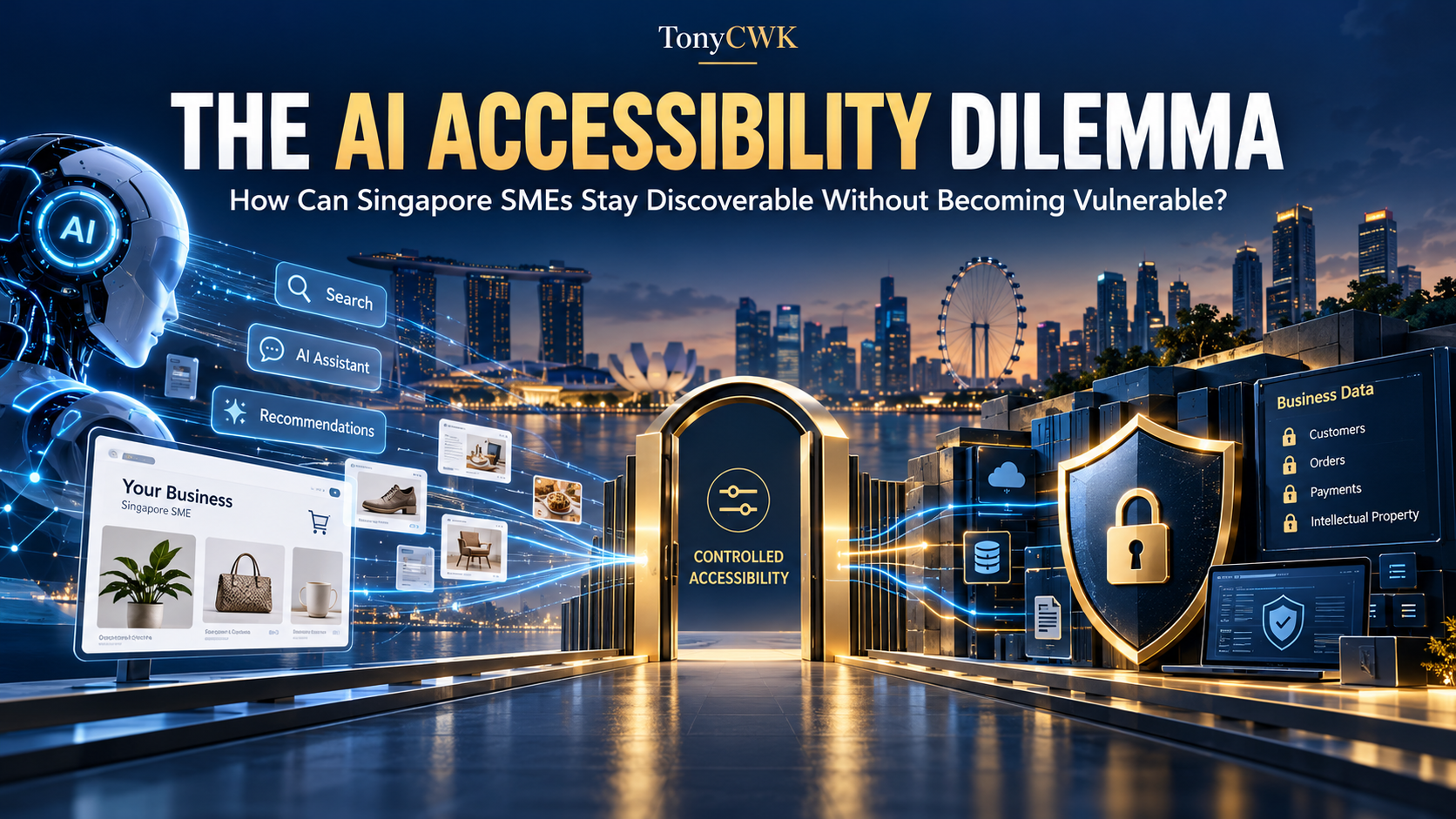
By Tony | TonyCWK
Your next customer may not visit your website personally.
An AI agent may visit on their behalf.
It could compare products, check availability, evaluate specifications or request a quotation.
Another automated visitor arrives the same day.
But this one is not looking for products.
It is looking for vulnerabilities.
For a Singapore SME without dedicated cybersecurity staff, the challenge is becoming more complicated.
Block too much, and legitimate machine-mediated opportunities may never reach your business.
Allow too much, and sensitive systems could become unnecessarily exposed.
This is the AI Accessibility Dilemma.
As AI becomes another gateway to customers, businesses may need to accommodate more machine interactions while dealing with increasingly capable automated cyber threats.
The question is no longer simply whether AI can discover your business.
It is whether your business can interact with AI agents safely.
And that requires a different understanding of accessibility.
In the Machine Decision Economy, accessibility without security is not readiness. It is exposure.
1. Why AI Accessibility Is Becoming a Business Issue
For years, businesses designed websites primarily for human visitors.
Search engines helped people discover information. Customers visited websites, compared offers and completed transactions themselves.
AI-assisted discovery introduces another possibility.
A customer may ask an AI assistant to identify suitable products, compare suppliers or investigate purchasing options.
Depending on its capabilities and the services available, that assistant may retrieve public information, interact with websites or call supported APIs.
Eventually, some authorized agents may also initiate transactions.
These activities are not equivalent.
Reading a public product description is fundamentally different from accessing an order-management system.
Yet both can involve machine-generated requests.
Consider a Singapore electronics distributor.
It wants AI-assisted customers to discover its networking products, understand technical specifications and request quotations.
That is a commercial opportunity.
But the distributor may also operate inventory software, customer databases, accounting systems and an ERP platform behind its website.
Should an external AI agent be allowed to interact with all of them?
Clearly not.
The business must distinguish information that should be discoverable from capabilities that require explicit authorization.
This is why AI accessibility cannot simply mean making more of the business available to machines.
It must mean making the right information and functions accessible under appropriate conditions.
That distinction will matter as agent-mediated shopping and procurement mature.
It does not mean every Singapore SME needs autonomous checkout today.
It means businesses should understand their digital boundaries before granting machines additional capabilities.
2. Singapore SMEs Already Face a Significant Cybersecurity Challenge
The concern is not theoretical, although the scale of malicious AI-agent activity against Singapore SMEs remains uncertain.
The Cyber Security Agency of Singapore (CSA), in its Singapore Cyber Landscape 2025/2026 report, identifies AI as one of the factors influencing the growing complexity, speed and sophistication of cyber threats.
According to CSA, Singapore recorded 165 reported ransomware incidents in 2025, compared with 159 in 2024.
SMEs in wholesale and retail trade, manufacturing and construction were among the organizations most affected.
CSA also cautions that reported figures may understate the actual threat.
These figures must be interpreted carefully.
They do not establish that AI agents caused those ransomware incidents.
Instead, they demonstrate that many businesses are already confronting significant cyber risks before agent-mediated commerce becomes widespread.
The emergence of AI-assisted attacks could add further pressure.
This is particularly relevant to smaller businesses with limited IT personnel, outsourced system maintenance or insufficient visibility into their digital infrastructure.
An SME may operate a WordPress website, ecommerce platform, payment gateway, cloud storage and accounting system without having a dedicated cybersecurity specialist.
The systems may work perfectly well for daily business.
But how securely are they connected?
Who monitors unauthorized access?
Who decides which applications can exchange data?
And who responds when an unfamiliar automated system begins requesting information?
These questions existed before AI agents.
AI makes it increasingly important that businesses can answer them.
3. Not Every AI Visitor Has the Same Purpose
One mistake businesses should avoid is treating all automated traffic as identical.
Machine-generated requests can serve very different purposes.
AI search crawlers
These retrieve public information that may help search or answer-generation services discover and understand web content.
For businesses pursuing AI visibility, unnecessarily blocking relevant crawlers could interfere with some discovery pathways.
However, being crawled does not guarantee that a business will be cited, recommended or selected.
AI training crawlers
These may collect information for training or improving AI models.
Their purpose differs from retrieving current information for a customer enquiry.
Businesses may wish to apply different content-access policies to these activities.
Customer-directed AI agents
These act on tasks initiated by people.
For example, a customer might ask an agent to compare three printers, check product availability or prepare an order.
Some actions involve only public information.
Others require authenticated access or transaction-specific authorization.
Business integration agents
These interact with APIs, databases, operational software or other connected services.
They may automate quotations, update inventory or process approved workflows.
Their permissions should be determined by the business functions they perform.
Malicious or compromised automation
These systems may probe vulnerabilities, misuse credentials, exploit software weaknesses or attempt unauthorized access.
Some use AI. Others rely on conventional automation.
A system identifying itself as an AI agent is not automatically legitimate.
Nor does unfamiliar automated traffic automatically indicate an attack.
Why these distinctions matter
In July 2026, Cloudflare introduced controls that distinguish AI traffic by Search, Agent and Training behavior.
This reflects a broader change.
Businesses increasingly need more nuanced decisions than simply allowing or blocking all AI-related traffic.
But traffic classification is not the same as secure authentication or authorization.
A bot label alone cannot establish that an agent is entitled to access confidential data.
Likewise, a robots.txt file communicates crawling preferences. It is not a security barrier against malicious actors.
The important question is not whether a visitor is a machine.
It is what that machine is trying to access, what it is authorized to do and what consequences could follow.
4. How AI Changes the Economics of Cyberattacks
AI does not need to invent new vulnerabilities to influence cybersecurity.
It can change the economics of discovering and exploiting existing weaknesses.
Consider several familiar security problems:
An outdated website plugin.
A misconfigured API.
An exposed administrative interface.
A stolen password.
An application account with excessive privileges.
None originated with agentic AI.
But automation can make certain tasks involved in identifying or exploiting such weaknesses faster and easier to repeat.
An attacker may use AI-assisted tools to analyze information, generate scripts, interpret technical responses or adapt portions of a workflow.
Instead of manually repeating every step, some activities can be automated or partly delegated to software.
That can reduce the effort required to investigate multiple targets.
It may also make smaller businesses attractive to attackers who previously considered individual targets not worth the time.
However, an important distinction must be maintained.
AI-assisted attacks are not necessarily fully autonomous, and AI does not make every attack more successful.
Effectiveness depends on the tools, the target, the vulnerability and the defensive controls.
The more defensible concern is that AI can lower the cost of attempting certain attacks at scale.
For SMEs, this reinforces an uncomfortable reality.
A weakness that appears minor when viewed in isolation may become more consequential when automated systems can repeatedly search for similar weaknesses across many websites.
The first defence against AI-assisted attacks is often still good conventional cybersecurity.
Patch vulnerable software.
Protect administrator accounts.
Secure exposed services.
Limit unnecessary permissions.
Monitor unusual activity.
Emerging threats do not make these fundamentals obsolete.
They make them more important.
5. The Real Security Question: Access Versus Authority
This is where the discussion moves beyond ordinary website protection.
Access is not the same as authority.
A machine reading a public product catalogue has limited capability.
A machine that can create orders, change prices, issue refunds or retrieve customer records has far more consequential capability.
The critical question becomes:
What is the machine technically capable of doing, regardless of what it was instructed to do?
An AI agent may be told to check product availability.
But if its connected application also provides access to supplier prices, customer information or administrative functions, the potential consequences of misuse are much greater.
Permissions should therefore be enforced by the underlying systems—not simply described in the AI agent’s instructions.
Four concepts become essential.
Identity
Who or what is making the request?
Can the business reliably establish the requesting system’s identity where authentication is required?
Authority
What is the requester entitled to do?
Does it represent an authenticated customer, approved partner or authorized internal workflow?
Boundaries
Which information and actions remain outside that authority?
Can the agent access one customer’s order without accessing another customer’s records?
Accountability
Can the business reconstruct what happened?
Are important actions logged?
Can access be revoked or suspicious transactions investigated?
In February 2026, the US National Institute of Standards and Technology (NIST) published a concept paper on software and AI agent identity and authorization.
The paper highlights questions involving agent identification, authorization, auditing and protection against prompt injection.
These issues matter because granting authority to software requires more than confirming that the software exists.
Machine identity helps establish who is asking.
Machine authorization determines what actions may be permitted.
Neither alone guarantees that the action is safe.
6. Even a Legitimate AI Agent Can Become a Security Risk
A common assumption is that verifying an AI agent solves the security problem.
It does not.
A legitimate agent could have compromised credentials.
It could receive excessive permissions.
It might misinterpret instructions.
A connected application could malfunction.
Or an attacker could manipulate the information the agent processes.
One particularly important risk is prompt injection.
How prompt injection can affect an SME
Imagine a Singapore distributor that uses an internal AI assistant to process quotation requests.
The assistant reads customer documents, extracts technical specifications and helps prepare quotations.
A malicious actor submits a quotation attachment containing instructions designed to redirect the assistant.
Instead of treating those instructions as untrusted document content, a poorly protected assistant might attempt to follow them.
If it also has excessive access to confidential supplier pricing or customer records, the attempted manipulation could lead to unauthorized disclosure.
The problem is not simply that a malicious document was received.
It is that untrusted content may influence an agent that possesses access to sensitive tools or information.
The OWASP Top 10 for Agentic Applications 2026 identifies agent-specific risks involving goal manipulation, tool misuse, privilege abuse and related failures.
OWASP’s October 2026 agentic AI exploit roundup also examines selected incidents and research demonstrations involving these risk categories.
These examples illustrate genuine weaknesses, although they do not establish how frequently such attacks affect SMEs.
The practical lesson is important.
Businesses must protect themselves from malicious external agents and protect their own AI agents from malicious external information.
For internally deployed agents, safeguards may include separating trusted instructions from untrusted content, restricting tool permissions, validating actions independently and requiring confirmation before consequential operations.
An AI assistant should never acquire broad access to financial or customer systems merely because it is convenient to connect them.
7. But Blocking Every AI Agent Can Also Have a Cost
Cybersecurity is only one side of the dilemma.
The other is commercial accessibility.
A blanket policy against automated traffic may reduce certain unwanted interactions.
But overly broad restrictions can also interfere with legitimate discovery, supported integrations or customer-directed agent tasks.
Consider two hypothetical suppliers selling similar networking equipment.
Supplier A makes public specifications easy to retrieve and provides an approved method for checking stock and requesting quotations.
Supplier B blocks almost every automated interaction.
In some agent-assisted procurement workflows, Supplier A may be easier for an authorized agent to investigate.
Supplier B may require a manual visit, human enquiry or alternative workflow.
That does not establish that AI systems universally rank Supplier A higher.
Machine selection depends on many factors, and there is no single verified rule connecting agent accessibility with recommendation rankings.
The narrower point is commercially meaningful.
If a legitimate agent cannot complete an approved interaction, an opportunity may be delayed, interrupted or lost.
Yet unrestricted access is not the answer.
This creates the central business question:
How can an SME make commercially useful information accessible without exposing systems that should remain protected?
My proposed answer is Controlled Agent Accessibility.
8. The Controlled Agent Accessibility Framework
An operating model proposed by TonyCWK for managing machine-mediated interactions.
Controlled Agent Accessibility is based on a straightforward principle:
The greater the potential consequence of an agent’s action, the stronger the authorization, verification and control required.
Instead of treating accessibility as one universal permission, businesses can assess machine interactions across four risk levels.
Level 1 — Public Discovery
Purpose: Allow machines to find and understand public business information.
Examples include product descriptions, technical specifications, public prices, service descriptions and business contact information.
These resources generally should not require access to private customer or administrative systems.
Appropriate protections include secure website configuration, software updates, sensible traffic management and monitoring for abuse.
The aim is to make useful information discoverable while preventing unrelated access to protected resources.
Level 2 — Controlled Interaction
Purpose: Support limited business interactions without granting unnecessary authority.
Examples include stock enquiries, public quotation requests and access to selected product information through supported interfaces.
Controls may include request limits, input validation, data minimization, restricted APIs and authentication where the information or function warrants it.
For example, an agent checking publicly available stock information should not gain access to purchasing costs or unrestricted inventory records.
The business should expose only the minimum information needed for the approved function.
Level 3 — Authorized Transactions
Purpose: Permit specific actions that change business or customer records.
Examples include creating an order, reserving inventory or modifying an authenticated customer account.
These actions require stronger assurance.
The system may need to verify the customer or organizational principal, establish delegated authority, check the exact action requested and maintain an audit record.
Authorization must be enforced by the application itself.
An AI agent claiming that a customer approved a transaction is not sufficient evidence of approval.
Level 4 — Protected Operations
Purpose: Protect highly sensitive or consequential capabilities.
Examples include issuing significant refunds, changing supplier bank details, accessing customer databases, modifying financial records or administering ERP systems.
These operations warrant strict permissions, strong authentication, independent validation and, where appropriate, separation of duties or human approval.
Some functions should remain unavailable to external agents entirely.
Others may be exposed only through carefully designed workflows with additional safeguards.
This is not an automatic progression ladder
An agent permitted to access Level 2 functions does not automatically acquire Level 3 permissions.
An agent authorized to prepare an order does not automatically gain permission to approve payment.
And an agent that successfully completes a purchase should not inherit access to administrative functions.
Each non-public capability requires appropriate, independently enforced authorization.
The framework can also be understood as three business zones:
Discoverability: What machines can find and understand.
Controlled Accessibility: What approved agents are permitted to access and do.
Secure Execution: What consequential actions may proceed under validated controls.
These zones separate commercial visibility from operational authority.
The objective is not maximum openness.
It is the minimum necessary access required to complete a legitimate business task safely.
9. A Practical Singapore SME Example
Consider a small Singapore electronics distributor selling switches, wireless access points, surveillance cameras and related equipment.
It maintains a product website connected to an inventory and order-management system.
The company wants AI-assisted procurement systems to help potential customers find suitable products and request quotations.
It does not have a dedicated cybersecurity department.
Four different machine interactions illustrate the challenge.
Scenario A: A legitimate shopping agent
A customer asks an AI agent to find a network switch with specific technical requirements.
The agent reads public product specifications, checks supported availability information and submits a quotation request.
This is an intended commercial interaction.
The distributor benefits because its products are discoverable and its enquiry process is machine-compatible.
Scenario B: Malicious automated reconnaissance
An unknown visitor probes an outdated website component and attempts to access an improperly secured endpoint.
The appropriate response involves patching, access restrictions, protective filtering, monitoring and other defensive controls.
The business should not rely on the visitor voluntarily obeying website crawling policies.
Scenario C: A compromised external agent
An agent presents valid-looking credentials but attempts to access information beyond its authorized scope.
For example, it tries to retrieve another customer’s quotation or alter order details it does not own.
The application’s server-side authorization checks should reject those actions, regardless of the agent’s identity claims or instructions.
Scenario D: A manipulated internal assistant
A quotation attachment contains malicious instructions attempting to make the distributor’s AI assistant reveal confidential supplier prices.
The assistant should treat the attachment as untrusted data.
It should not have unrestricted access to sensitive systems, and potentially harmful actions should be prevented by controls outside the model’s reasoning process.
These scenarios are illustrative, not reported incidents.
The same website can receive commercially useful agent interactions and malicious automated requests.
That is why simply dividing machines into “good agents” and “bad agents” is inadequate.
Security must be attached to the resources and actions being requested.
10. Can Singapore SMEs Afford This Level of Protection?
One concern deserves attention.
Many SMEs do not have large IT departments, dedicated security operations centres or enterprise-grade management information systems.
Does that mean controlled agent accessibility is beyond their reach?
Not necessarily.
The priority should be to establish a dependable security foundation before introducing more advanced agent capabilities.
First: Strengthen conventional cybersecurity
For many SMEs, the starting point is familiar:
- Keep websites, plugins, applications and devices updated.
- Use multi-factor authentication for administrative and sensitive accounts.
- Remove unused accounts and unnecessary privileges.
- Protect hosting and cloud configurations.
- Maintain tested backups.
- Monitor critical systems for suspicious activity.
- Document who manages each system and how incidents are handled.
Businesses using WordPress or other content-management systems should pay particular attention to plugin maintenance, administrator access, backups and exposed integrations.
These measures are valuable whether or not the business supports AI agents.
Second: Add agent-specific controls only where needed
If the business introduces an API for machine-generated quotations, that API should expose only the required functions and information.
If an agent can create orders, the system needs transaction-specific authorization and validation.
If an internal AI assistant processes documents, the business should restrict which tools, databases and external services it can access.
Advanced functionality should be introduced progressively.
A small business should not connect an AI agent directly to sensitive ERP or financial administration functions simply because the integration is technically possible.
Third: Use established providers and external expertise
SMEs can use reputable managed hosting, ecommerce platforms, security services and outsourced IT support.
But outsourcing must not mean losing visibility into responsibility.
Business owners should ask:
Who maintains website and plugin security?
Who configures API access?
Who monitors suspicious requests?
Who can revoke agent credentials?
Who responds if customer information is exposed?
These responsibilities should be established before an incident occurs.
Singapore support is available
Singapore’s Cyber Security Agency has expanded its Cyber Essentials and Cyber Trust programmes to address modern technology risks, including cloud and AI-related security considerations.
Its CISO-as-a-Service programme provides a route for organizations with limited internal expertise to seek professional cybersecurity guidance.
Eligible SMEs may qualify for funding support, subject to prevailing conditions.
CSA’s Internet Hygiene Portal is another useful starting point for reviewing internet-facing security practices.
SMEs do not need to replicate the cybersecurity budgets of large multinational companies.
They need protection proportionate to their exposure, systems and business risks.
11. Data Protection, Accountability and Recovery
Security failures can create more than technical disruption.
Where personal data is involved, they can also create legal and regulatory responsibilities.
Under Singapore’s Personal Data Protection Act (PDPA), organizations must make reasonable security arrangements to protect personal data in their possession or under their control.
The legislation does not prescribe one universal cybersecurity product or system architecture.
Instead, organizations must implement arrangements appropriate to their circumstances.
The Personal Data Protection Commission’s January 2026 advisory on common data protection lapses highlights problems such as insufficient monitoring and the inability to detect unusual access or large-scale data downloads.
These are not exclusively AI-agent problems.
They are established weaknesses that additional automated interfaces could make more consequential.
For SMEs considering agent integration, four questions matter.
Where is sensitive information stored?
Customer databases, cloud storage, payment services and outsourced processing systems should be identified.
Which applications and agents can access it?
Access should be limited to legitimate operational requirements.
Who is accountable for each integration?
An external IT vendor may manage a system, but the business still needs to understand its responsibilities.
What happens if something goes wrong?
The organization should know how to disable access, preserve records, assess the incident, recover operations and determine whether notifications are required.
Under Singapore’s data breach notification rules, not every incident is automatically reportable. Organizations must assess whether a breach meets the applicable notification criteria.
For a notifiable breach, the PDPC generally must be notified as soon as practicable and no later than three calendar days after the organization determines it is notifiable.
The PDPC’s Guide on Managing and Notifying Data Breaches explains the requirements.
This is why monitoring, audit trails and incident response should be considered part of agent readiness.
A business that cannot detect or reconstruct an unauthorized machine action cannot confidently govern that action.
12. A Practical 30-Day Starting Roadmap
SMEs do not need to solve every aspect of agentic commerce immediately.
A phased assessment is more realistic.
The following is an illustrative starting plan. Actual implementation timelines will depend on existing systems and risk.
Days 1–7: Understand Your Exposure
Identify public websites, plugins, APIs, cloud services and connected business applications.
Determine which systems store sensitive customer, financial or operational information.
Assign responsibility for each system, including external providers.
Days 8–14: Fix the Most Important Weaknesses
Apply security updates.
Enable multi-factor authentication.
Remove unused accounts.
Review administrator privileges.
Confirm backup reliability.
Check whether sensitive services are unnecessarily exposed to the internet.
Existing critical vulnerabilities should take priority over speculative future agent threats.
Days 15–21: Define Machine Access Boundaries
Separate public information from authenticated functions.
Determine which machine interactions genuinely support business operations.
Identify functions that should remain restricted.
Where agent-based functions are planned, specify how identity, authorization, validation and audit records will be handled.
Days 22–30: Test, Monitor and Prepare
Confirm that unauthorized requests are rejected.
Review whether sensitive information can be accessed through unnecessary integrations.
Test how credentials and permissions can be revoked.
Establish an incident-response contact and recovery procedure.
Ask external IT providers to explain the controls they manage and the responsibilities the SME retains.
The priority is not to complete a sophisticated autonomous-commerce platform in 30 days.
It is to understand the current risk and make informed decisions about what comes next.
13. Security Should Enable AI-Ready Commerce, Not Prevent It
Traditional ecommerce readiness involved presenting products, accepting orders, processing payments and fulfilling purchases.
Emerging agentic commerce introduces additional questions.
Can machines understand the business?
Can authorized agents interact with its systems?
Can the organization verify delegated authority?
Can consequential actions be validated, monitored and audited?
These questions connect directly to the wider Machine Decision Economy.
AI Authority concerns whether a business can become discoverable, understandable, credible and selectable in machine-mediated discovery.
Controlled Agent Accessibility concerns whether approved machine interactions can proceed without exposing unnecessary data or authority.
The two capabilities are complementary.
An SME might be selected by an AI assistant but lack the supported interfaces needed for the requested action.
Another might build technically sophisticated agent integrations but struggle to become visible or relevant within AI-assisted discovery.
Neither outcome is ideal.
And security is not something to introduce only after agentic commerce becomes common.
It should shape which capabilities the business chooses to expose in the first place.
The objective is to support new commercial opportunities without creating uncontrolled operational exposure.
Frequently Asked Questions
Can AI agents hack small business websites?
AI-assisted tools can be used in malicious cyber operations, including activities that probe or exploit vulnerabilities. However, not every AI agent is malicious, and website compromises often exploit conventional weaknesses such as outdated software, stolen credentials or insecure configurations.
Should Singapore SMEs block all AI agents?
Not necessarily. Businesses should distinguish public discovery from authenticated interactions and sensitive operations. Blocking policies should reflect commercial needs and security risks rather than treating all automated visitors identically.
How can an SME identify a legitimate AI agent?
Identification methods vary by platform and integration. Where an action requires authentication, businesses should use supported verification methods, authenticated accounts or approved integrations. A claimed agent name or user-agent string alone is not sufficient proof of identity or delegated authority.
What is the biggest risk when connecting AI agents to business software?
One major risk is granting agents more capability than they require. Compromised credentials, excessive permissions, insecure integrations or manipulated instructions can then lead to unintended or unauthorized actions.
Can SMEs secure agent interactions without dedicated cybersecurity teams?
Yes, they can begin with conventional cyber hygiene, managed security services, clear access restrictions and external professional support. More consequential agent capabilities may require additional technical controls and expertise.
Is AI discoverability the same as agent accessibility?
No. Discoverability concerns whether AI systems can find and understand relevant information. Agent accessibility concerns whether a machine can interact with a website or business function. Some interactions are public, while others require authentication, authorization and additional safeguards.
Conclusion: The Next Competitive Advantage Is Controlled Accessibility
The internet was largely designed around people and conventional software clients accessing digital services.
AI agents are adding another category of participant.
Some will help customers discover products and complete useful tasks.
Others may be misconfigured, compromised or deliberately malicious.
For Singapore SMEs, the response should be neither unrestricted openness nor indiscriminate blocking.
It should be deliberate control over information, access and authority.
Make public information discoverable.
Make sensitive capabilities permissioned.
Make consequential actions verifiable and accountable.
This approach allows businesses to pursue AI-mediated opportunities while reducing unnecessary exposure.
The businesses best prepared for an AI-driven economy will not necessarily be those offering the widest access.
They will be those that understand which access creates value, which access creates risk and how to manage the boundary between them.
In the Machine Decision Economy, accessibility without security is not readiness. It is exposure.
References and Further Reading
- Cyber Security Agency of Singapore — Singapore Cyber Landscape 2025/2026
- CSA — Ransomware Portal
- Cloudflare — New Options to Manage AI Traffic, July 2026
- OWASP — Top 10 for Agentic Applications 2026
- OWASP — GenAI and Agentic AI Exploit Roundup, Q3 2026
- NIST — Identity and Authority of Software Agents, February 2026
- PDPC — Advisory on Common Data Protection Lapses, January 2026
- CSA — Cybersecurity Certification for Organizations
- CSA — CISO-as-a-Service Cybersecurity Health Plan
- PDPC — Guide on Managing and Notifying Data Breaches
Editor’s note: Controlled Agent Accessibility is a proposed TonyCWK conceptual framework for business planning, not an official cybersecurity standard or certification. Technical controls should be assessed against applicable requirements and the risks of the specific system.
© TonyCWK | AI Authority, Digital Strategy and the Machine Decision Economy
Leave a Reply