The End of the Click-Centric Internet
For more than two decades, digital advertising operated on a relatively stable model:
- Users searched
- Platforms displayed ads
- Users clicked
- Brands paid for visibility
The entire system was built around interruption and navigation.
But AI interfaces are fundamentally changing how people discover information.
Instead of browsing through pages of links, users now interact with AI systems that synthesize answers directly.
This transition changes one critical economic reality:
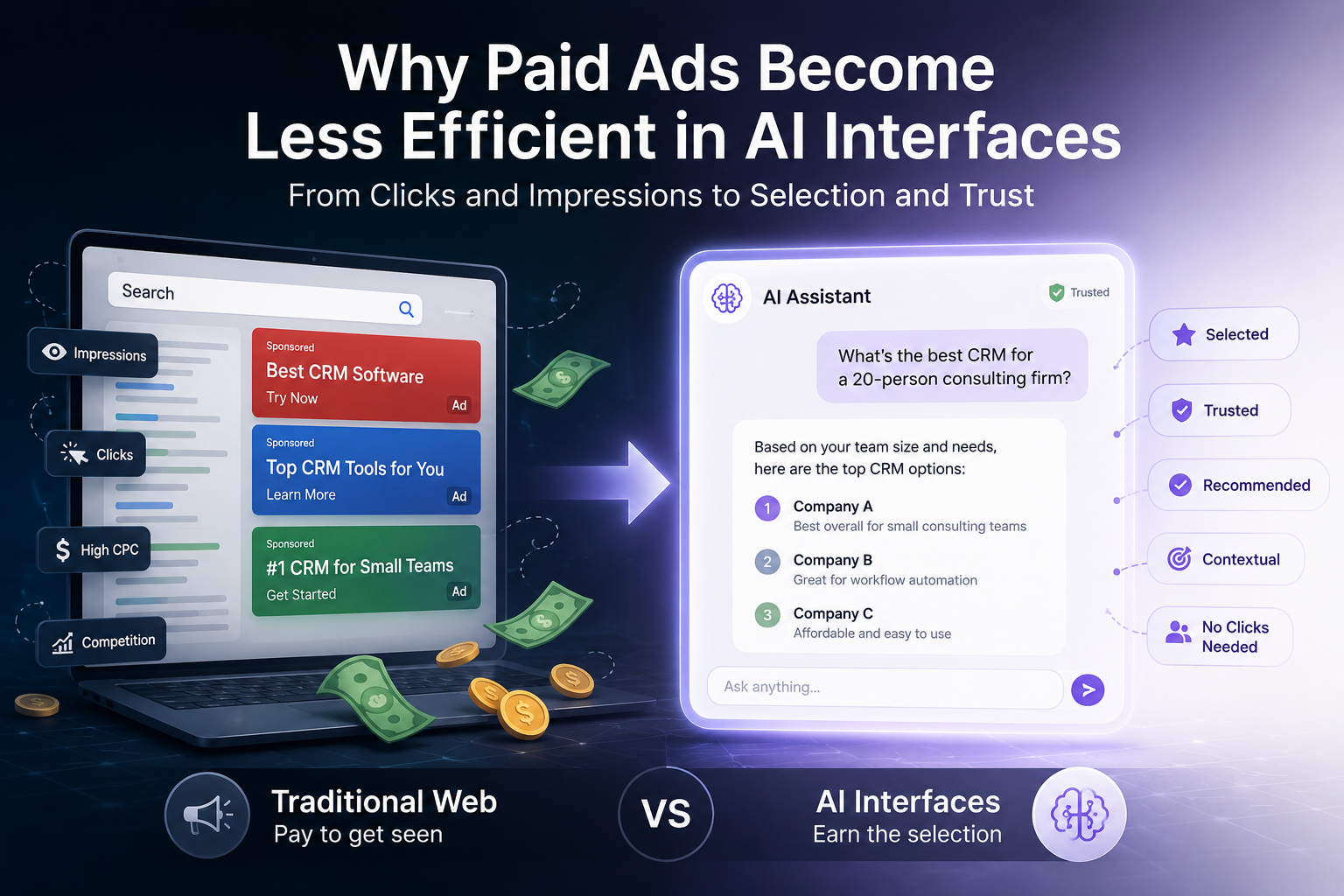
The value of visibility is shifting from “being seen” to “being selected.”
And that shift is making traditional paid advertising progressively less efficient.
AI Interfaces Compress Attention
Traditional search engines create multiple opportunities for advertisers:
- Sponsored results
- Display ads
- Retargeting
- Banner placements
- Affiliate visibility
- Suggested content
But AI interfaces compress the user journey into a single conversational response.
Users increasingly receive:
- Direct answers
- Summarized recommendations
- Curated comparisons
- Suggested actions
- Condensed insights
Without needing to click multiple websites.
This creates a major structural problem for advertising.
There are fewer surfaces to monetize.
In traditional search:
- 10 blue links competed
- 4 paid ads appeared
- Users browsed options
In AI interfaces:
- One synthesized answer may dominate attention.
That dramatically reduces:
- Click opportunities
- Impression inventory
- Ad exposure duration
- Comparative browsing behavior
The economics of advertising weaken when navigation disappears.
AI Prioritizes Utility, Not Bid Size
Traditional advertising systems reward:
- Budget scale
- Bid competitiveness
- Keyword dominance
- Audience targeting
But AI systems prioritize something very different:
- Relevance
- Credibility
- Utility
- Trustworthiness
- Retrieval confidence
- Contextual fit
An AI assistant does not “prefer” the brand spending the most.
It prefers the source most likely to:
- Solve the user’s problem
- Reduce uncertainty
- Provide trusted information
- Match contextual intent
This is a profound shift.
In AI interfaces:
- Paid prominence does not automatically equal recommendation prominence.
The highest bidder is no longer guaranteed the highest influence.
AI Reduces Click Dependency
Paid advertising thrives in environments where users must click to continue their journey.
But AI systems increasingly eliminate the need for clicks.
Examples:
- Product comparisons summarized instantly
- Technical explanations generated directly
- Recommendations synthesized conversationally
- Reviews aggregated automatically
- Tutorials condensed into actionable steps
As AI answers become more complete:
- Fewer users leave the interface
- Fewer users visit external websites
- Fewer ad-supported journeys occur
This creates a structural decline in traditional ad efficiency metrics such as:
- CTR
- CPC performance
- Landing page conversions
- Session duration
- Multi-page funnel navigation
The interface itself becomes the destination.
AI Interfaces Shift Competition From Reach to Selection
Traditional advertising is optimized for exposure.
AI discovery is optimized for selection.
That means the core competitive question changes from:
“Can I reach the audience?”
to:
“Will the AI choose me?”
These are not the same thing.
A brand may:
- Run massive ad campaigns
- Buy impressions everywhere
- Dominate paid search auctions
Yet still fail to become:
- Referenced
- Retrieved
- Recommended
- Synthesized
- Trusted by AI systems
This is why many traditional performance strategies may gradually lose efficiency in AI-driven environments.
The Hidden Problem: Ads Create Temporary Visibility
Paid ads are transactional visibility.
Once spending stops:
- Visibility declines
- Traffic drops
- Exposure disappears
But AI systems increasingly reward accumulated authority signals such as:
- Expert consistency
- Topical depth
- Cross-platform mentions
- Knowledge structure
- Brand citations
- Community validation
- Ecosystem trust
This creates a widening gap between:
| Paid Visibility | AI Authority |
|---|---|
| Temporary | Compounding |
| Budget-driven | Trust-driven |
| Interruptive | Selected |
| Impression-based | Retrieval-based |
| Campaign-centric | Knowledge-centric |
| Click-focused | Recommendation-focused |
As AI interfaces mature, compounding authority becomes more economically powerful than temporary exposure.
AI Interfaces Compress the Funnel
Traditional marketing funnels assumed multiple stages:
- Awareness
- Consideration
- Comparison
- Evaluation
- Conversion
Paid ads played a role at almost every stage.
But AI systems increasingly collapse these stages into a single interaction.
For example:
A user may ask:
“What’s the best CRM for a 20-person consulting firm?”
The AI may instantly:
- Compare products
- Evaluate suitability
- Summarize pros and cons
- Recommend a preferred option
The user may never:
- Visit multiple websites
- See display ads
- Click comparison pages
- Browse traditional search results
This dramatically reduces traditional advertising touchpoints.
AI Recommendation Economics Favor Trusted Entities
AI systems are designed to minimize risk.
That means they naturally favor:
- Recognized authorities
- Consistent expertise
- Strong reputation signals
- High-confidence sources
This creates “selection concentration.”
Over time:
- A smaller number of trusted entities receive disproportionate recommendation visibility.
This resembles a “default authority economy.”
In such environments:
- Spending more on ads may produce diminishing returns
- Becoming structurally trusted becomes more valuable
The competitive moat shifts from:
- Media buying power
to - Algorithmic trustworthiness
Why Performance Marketing Metrics Become Misleading
Many current marketing dashboards still emphasize:
- Impressions
- Click-through rate
- Cost per acquisition
- Bounce rate
- Session duration
But AI interfaces change the meaning of visibility itself.
A brand may:
- Influence AI-generated answers
- Shape recommendations
- Become part of synthesis layers
- Affect decision-making invisibly
Without generating measurable clicks.
This creates a growing analytics blind spot.
The future of marketing measurement may require new metrics such as:
- Selection rate
- Citation frequency
- AI recommendation share
- Retrieval visibility
- Conversational mention rate
- Authority velocity
- Recommendation persistence
Traditional ad metrics alone will become increasingly incomplete.
Paid Ads Will Not Disappear — But Their Role Will Change
Paid advertising is not dying.
But its role is evolving.
Ads may become more useful for:
- Short-term amplification
- Launch acceleration
- Retargeting ecosystems
- Demand capture
- Event-based visibility
- Commercial intent moments
However, ads alone are becoming less capable of building durable discoverability.
In AI interfaces:
- authority compounds,
- trust scales,
- and recommendation power persists longer than campaign exposure.
The Future Belongs to AI Authority
The next era of digital competition is not merely about traffic acquisition.
It is about becoming:
- retrievable,
- understandable,
- trustworthy,
- and recommendable by AI systems.
That requires more than advertising.
It requires:
- structured knowledge ecosystems,
- topical authority,
- ecosystem credibility,
- and algorithmic trust signals.
This is the transition from:
“Buying visibility”
to
“Earning selection.”
And that may become the defining competitive shift of the AI era.
In Summary
AI interfaces reduce the effectiveness of traditional paid advertising because they compress attention, reduce click dependency, and prioritize trusted recommendations over bid-based visibility. As users increasingly interact with AI-generated answers instead of browsing websites, traditional ad surfaces shrink. AI systems optimize for utility, credibility, contextual relevance, and trust rather than advertising spend alone. This shifts competition from exposure to selection. Brands that build AI Authority through structured knowledge, topical depth, ecosystem credibility, and trust signals may outperform brands relying solely on paid visibility.
Frequently Asked Questions (FAQ)
Is paid advertising becoming obsolete because of AI?
No. Paid advertising still plays an important role for amplification, launches, retargeting, and demand capture. However, AI interfaces may reduce the long-term efficiency of ads alone because recommendation systems increasingly prioritize trusted authority over pure visibility.
Why do AI interfaces reduce ad efficiency?
AI interfaces compress the user journey into direct answers and recommendations. Users increasingly receive synthesized responses without clicking multiple websites, reducing ad impressions, click opportunities, and browsing behavior.
What do AI systems prioritize instead of advertising spend?
AI systems prioritize:
- Relevance
- Trustworthiness
- Utility
- Credibility
- Contextual fit
- Retrieval confidence
This changes competition from “who spends the most” to “who is most trusted and useful.”
What replaces traditional visibility in AI environments?
Selection becomes more important than exposure. Brands increasingly compete to become the source AI systems retrieve, reference, recommend, and synthesize.
Will SEO still matter in AI interfaces?
Yes, but SEO evolves. Traditional ranking signals remain useful, but AI environments increasingly reward structured knowledge, topical authority, semantic clarity, and ecosystem trust signals beyond keyword optimization alone.
What metrics may become more important in AI-driven discovery?
Emerging AI-era metrics may include:
- Selection rate
- Citation frequency
- Conversational visibility
- Recommendation share
- Authority velocity
- Retrieval presence
- AI mention persistence
Continue Reading
If paid ads become less efficient in AI interfaces, what replaces them?
Read next:
- “Selection Rate vs Click-Through Rate” 👉 https://tonycwk.com/selection-rate-vs-click-through-rate/election Rate vs Click-Through Rate
- “How AI Systems Build Trust” 👉https://tonycwk.com/ai-selection-psychology/
- “AI Authority Metrics: How to Measure Selection, Not Just Traffic” 👉https://tonycwk.com/ai-authority-metrics/
- “Ads vs AI Authority: Why Paid Visibility Alone Is No Longer Enough” 👉https://tonycwk.com/ads-vs-ai-authority/
- “Why AI Doesn’t Trust Content — It Trusts Systems” 👉https://tonycwk.com/why-ai-doesnt-trust-content-it-trusts-systems/
Written by Tony Chan (TonyCWK)
AI Authority & Digital Strategy Researcher
Leave a Reply