
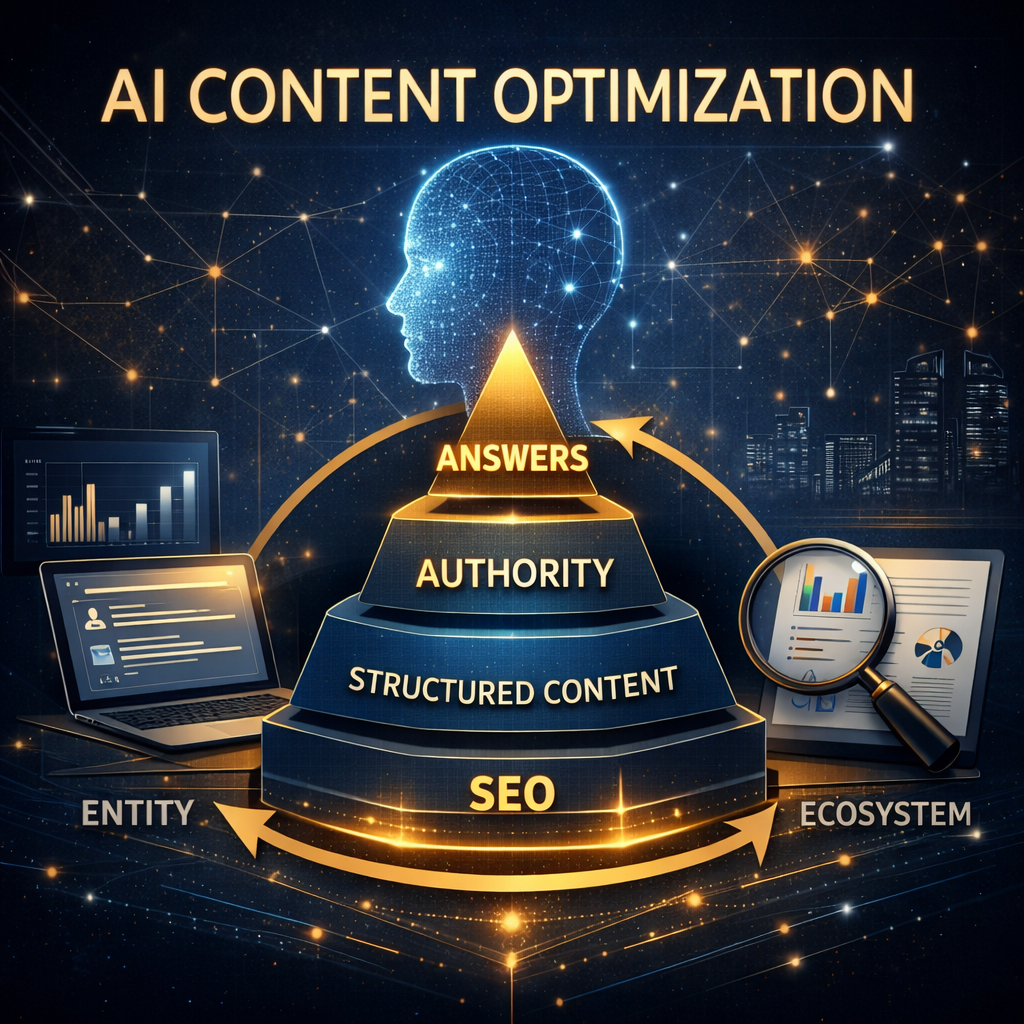
From Writing for Rankings to Designing for Selection
🔷 Introduction: A New Era of Visibility
Digital visibility is undergoing a fundamental transformation.
For years, success in search was defined by:
- Rankings
- Traffic
- Click-through rates
But today, AI systems are reshaping how information is discovered, interpreted, and delivered.
Users are no longer browsing pages.
They are receiving answers.
And increasingly, those answers are:
- Selected
- Synthesized
- Delivered directly by AI
💡 The Core Shift
Visibility is no longer determined by where you rank.
It is determined by whether you are selected.
This marks the rise of a new discipline:
🔷 AI Content Optimization
🔍 Section 1: What Is AI Content Optimization?
AI Content Optimization is the process of designing content so that it can be:
- Understood by AI systems
- Extracted accurately
- Selected as part of an answer
- Referenced across multiple contexts
Unlike traditional SEO, which focuses on:
“How do I rank higher?”
AI Content Optimization focuses on:
“How do I become the answer?”
Section 2: The Foundations of AI-Optimized Content
1. Structured Knowledge Design
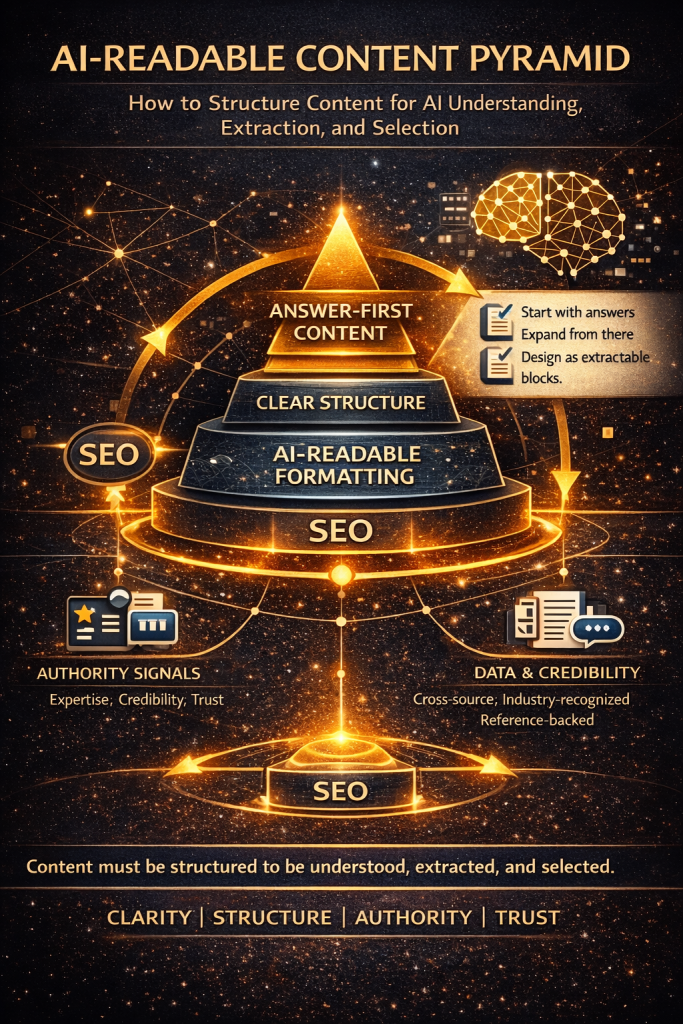
AI systems do not read content like humans.
They process:
- Sections
- Headings
- Semantic relationships
Key Principles:
- Use clear headings (H2, H3)
- Break content into logical blocks
- Organize ideas hierarchically
👉 Structure transforms content into machine-readable knowledge
2. Answer-First Content Architecture
AI systems prioritize content that:
- Delivers immediate value
- Answers questions directly
- Reduces ambiguity
Best Practice:
- Start with the answer
- Expand with explanation
- Support with examples
👉 The winning structure:
Question → Answer → Context → Expansion
3. Clarity Over Complexity
AI systems prefer content that is:
- Concise
- Precise
- Unambiguous
This means:
- Avoid overly long introductions
- Use simple, direct language
- Eliminate unnecessary filler
👉 Clarity improves:
- Extraction accuracy
- Citation likelihood
4. Authority-Driven Content Signals
AI systems evaluate trust.
Content is more likely to be selected when it includes:
- Data-backed insights
- Clear reasoning
- Consistent terminology
- Domain expertise
👉 This forms what can be defined as:
Algorithmic Trust
🌐 Section 3: Beyond Content — The System Behind Selection
AI does not evaluate content in isolation.
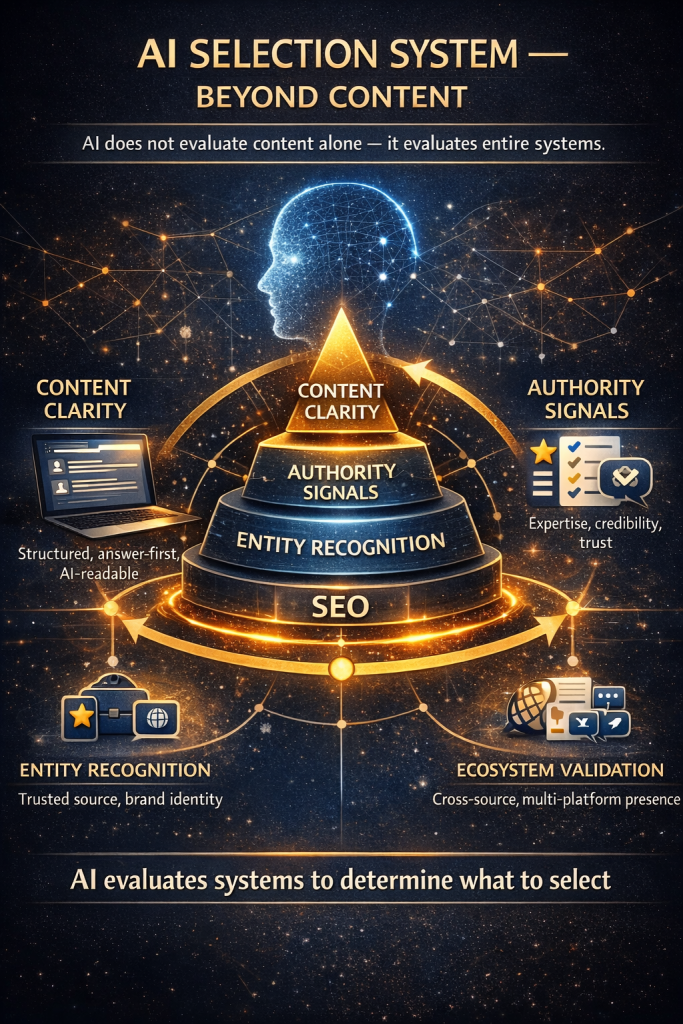
It evaluates:
- The source
- The consistency of information
- The presence across the ecosystem
🔷 The AI Selection Model
1. Crawlability (Foundation)
Content must be:
- Indexed
- Accessible
- Technically sound
2. Content Clarity (Extractability)
Content must be:
- Structured
- Understandable
- Segmentable
3. Authority Signals (Trust)
Content must demonstrate:
- Expertise
- Credibility
- Reliability
4. Entity Recognition (Identity)
AI systems favor:
- Recognized brands
- Consistent authors
- Clear positioning
5. Ecosystem Presence (Validation)
Visibility is reinforced when:
- Content exists across platforms
- Messaging is consistent
- Signals align
6. Contextual Relevance (Selection Fit)
Content must match:
- User intent
- Query context
- Answer requirements
📊 Section 4: From SEO to AI Optimization
The Evolution of Digital Visibility
| Dimension | SEO Era | AI Optimization Era |
|---|---|---|
| Goal | Rank pages | Be selected as answer |
| Output | Website | Response |
| Focus | Keywords | Context & meaning |
| Strategy | Optimization | Knowledge design |
| Metric | Traffic | Citations & inclusion |
🔷 The New Reality
- Users trust answers more than links
- AI filters what gets seen
- Visibility compounds through selection
⚙️ Section 5: How to Design AI-Optimized Content
🔹 1. Build in Answer Blocks
- Use Q&A formats
- Create extractable sections
- Design for direct retrieval
🔹 2. Structure for Machines
- Logical flow
- Clean formatting
- Hierarchical organization
🔹 3. Reinforce Authority
- Provide clear explanations
- Use consistent terminology
- Demonstrate expertise
🔹 4. Think in Systems, Not Pages
- Interlink related content
- Build topic clusters
- Create knowledge ecosystems
🔹 5. Align Across Channels
- Website
- Articles
- Mentions
👉 Consistency strengthens selection probability
🧠 Section 6: The Future of Content Strategy
AI Content Optimization is not a trend.
It is a structural shift in how visibility is created.
🔷 The New Competitive Advantage
Not:
- Who writes the most content
- Who ranks the highest
But:
Who builds the most trusted, structured, and connected knowledge system
💡 Final Strategic Insight
Content alone no longer defines visibility.
Selection is determined by clarity, trust, and system alignment.
📌 Executive Summary
- AI Content Optimization focuses on selection, not ranking
- Structured, answer-first content improves extractability
- Authority signals increase trust and citation likelihood
- AI evaluates:
- Content
- Entity
- Ecosystem
- The winning model is:
Structured Content + Authority + Ecosystem = AI Visibility
🧠 AI Content Optimization — FAQ
❓1. What is AI content optimization?
AI content optimization is the process of structuring and writing content so that AI systems can easily understand, extract, and select it as part of an answer. It focuses on clarity, structure, and authority rather than just keywords and rankings.
❓2. How is AI content optimization different from SEO?
SEO focuses on ranking pages in search results, while AI content optimization focuses on being selected as the answer by AI systems. SEO drives traffic; AI optimization drives citations and inclusion.
❓3. Why is AI content optimization important today?
AI systems are increasingly delivering direct answers instead of links, reducing the importance of traditional click-based traffic. Optimizing for AI ensures your content remains visible in this new environment.
❓4. What does “answer-first content” mean?
Answer-first content delivers the main answer immediately before providing explanation or context. This improves the likelihood of being extracted and cited by AI systems.
❓5. How do AI systems read content?
AI systems process content in structured segments such as headings, paragraphs, and lists. They rely on clear organization and semantic relationships to interpret meaning.
❓6. What makes content AI-readable?
AI-readable content is structured, clear, and logically organized with headings, concise explanations, and minimal ambiguity. It is easy for machines to interpret and extract.
❓7. Does content structure affect AI selection?
Yes, well-structured content significantly improves extraction and selection by AI systems. Clear formatting increases interpretability and retrieval accuracy.
❓8. What role do headings play in AI optimization?
Headings help AI systems understand content hierarchy and context. They improve segmentation and allow specific sections to be extracted as answers.
❓9. Is long-form content better for AI optimization?
Length alone does not determine effectiveness; clarity and structure are more important. Well-organized short content can outperform long, unstructured content.
❓10. What are authority signals in AI content?
Authority signals include expertise, data-backed insights, consistency, and credibility indicators. These help AI systems assess whether content is trustworthy.
❓11. Does schema markup help AI content optimization?
Schema markup can provide additional context, but it is a supporting signal rather than a primary driver. Content clarity and authority remain more important.
❓12. How important is freshness in AI content?
Freshness matters for time-sensitive topics, but relevance and clarity are often more important for evergreen content. AI prioritizes usefulness over recency in many cases.
❓13. What is entity recognition in AI systems?
Entity recognition refers to how AI identifies and understands brands, authors, or concepts as distinct and credible sources. Strong entity presence improves selection probability.
❓14. Why does ecosystem presence matter for AI visibility?
AI systems validate information across multiple sources, so consistent presence across platforms strengthens credibility and trust.
❓15. Can content be optimized for both SEO and AI?
Yes, SEO provides the foundation for discoverability, while AI optimization enhances selection. Both should be integrated for maximum visibility.
❓16. What is the role of internal linking in AI optimization?
Internal linking helps build topic relationships and strengthens knowledge structure, making content easier for AI to interpret and connect.
❓17. How do AI systems decide which content to cite?
AI systems evaluate clarity, relevance, authority, and consistency across sources before selecting content for inclusion in answers.
❓18. What is the biggest mistake in AI content strategy?
Focusing only on content formatting without building authority and ecosystem presence limits selection potential. Optimization must go beyond structure.
❓19. What is the future of content optimization?
The future lies in building structured knowledge systems supported by authority and ecosystem signals, rather than optimizing individual pages alone.
❓20. What is the key formula for AI visibility?
The most effective approach is: Structured Content + Authority + Ecosystem Presence = AI Selection.
Further Reading: AI Authority Framework Series
Explore the full system behind AI-driven visibility:
The New Visibility Model — Why Being Found Is No Longer Enough
https://tonycwk.com/the-new-visibility-model
AI Discovery Flywheel — How Selection Creates Compounding Visibility
https://tonycwk.com/ai-discovery-flywheel/
AI Authority Pyramid — The Foundation of AI Selection
https://tonycwk.com/ai-authority-pyramid/
AI Search Visibility Framework
https://tonycwk.com/ai-search-visibility-framework
Written by Tony Chan (TonyCWK)
AI Authority & Digital Strategy Researcher
Leave a Reply