
By TonyCWK
Over the past two decades, website owners have become accustomed to welcoming search engine crawlers. Googlebot and Bingbot index websites so they can appear in search results, bringing visitors and potential customers.
Today, a new generation of crawlers is emerging.
AI platforms such as ChatGPT, Gemini, Claude, Perplexity and other AI discovery systems increasingly rely on web crawlers to discover, understand and evaluate online information. This has sparked a new debate among publishers and businesses:
Should AI crawlers be blocked?
The answer is more nuanced than a simple yes or no.
For organizations that want to build long-term AI Authority™, blocking every AI crawler may unintentionally remove themselves from the recommendation ecosystem they hope to participate in.
AI Crawlers Are Different from Traditional Search Crawlers
Traditional search engines primarily crawl pages to index them for retrieval. Users search, browse a list of links, and decide which websites to visit.
AI systems work differently.
They increasingly synthesize information, compare multiple sources, recognize entities, evaluate expertise, and recommend answers rather than simply retrieving pages.
This changes the purpose of crawling.
Crawling is no longer only about indexing pages. It is also about enabling AI systems to understand who you are, what you know, and whether your information deserves future recommendations.
Can AI Crawlers Be Blocked?
Yes.
Organizations can restrict AI crawlers through methods such as:
- robots.txt directives
- Web Application Firewalls (WAF)
- Server-level access rules
- IP blocking
- Authentication and gated content
Many publishers already do this to protect proprietary content or reduce unwanted scraping.
The technical capability exists.
The more important question is whether doing so supports your long-term business objectives.
Why Some Organizations Block AI Crawlers
Businesses often choose to restrict AI crawlers because they worry about:
- Unauthorized use of proprietary content
- AI model training without compensation
- Loss of website traffic
- Increased server resource consumption
- Copyright and licensing concerns
These are legitimate considerations, particularly for premium publishers and subscription-based businesses.
However, protecting content and building AI visibility are not always the same objective.
The Hidden Cost of Blocking AI Crawlers
Every AI recommendation begins with discovery.
If reputable AI systems cannot access your website, they have fewer opportunities to:
- Discover your expertise
- Understand your products and services
- Recognize your entity relationships
- Associate your brand with relevant topics
- Evaluate your authority over time
Blocking every AI crawler may reduce the amount of information available for AI systems to evaluate your organization.
In the emerging recommendation economy, limited understanding often leads to limited recommendations.
Crawlability Is the First Step Toward AI Authority™
One of the core principles behind AI Authority™ is:
Visibility helps AI find you. AI Authority™ helps AI recommend you.
But before visibility comes something even more fundamental.
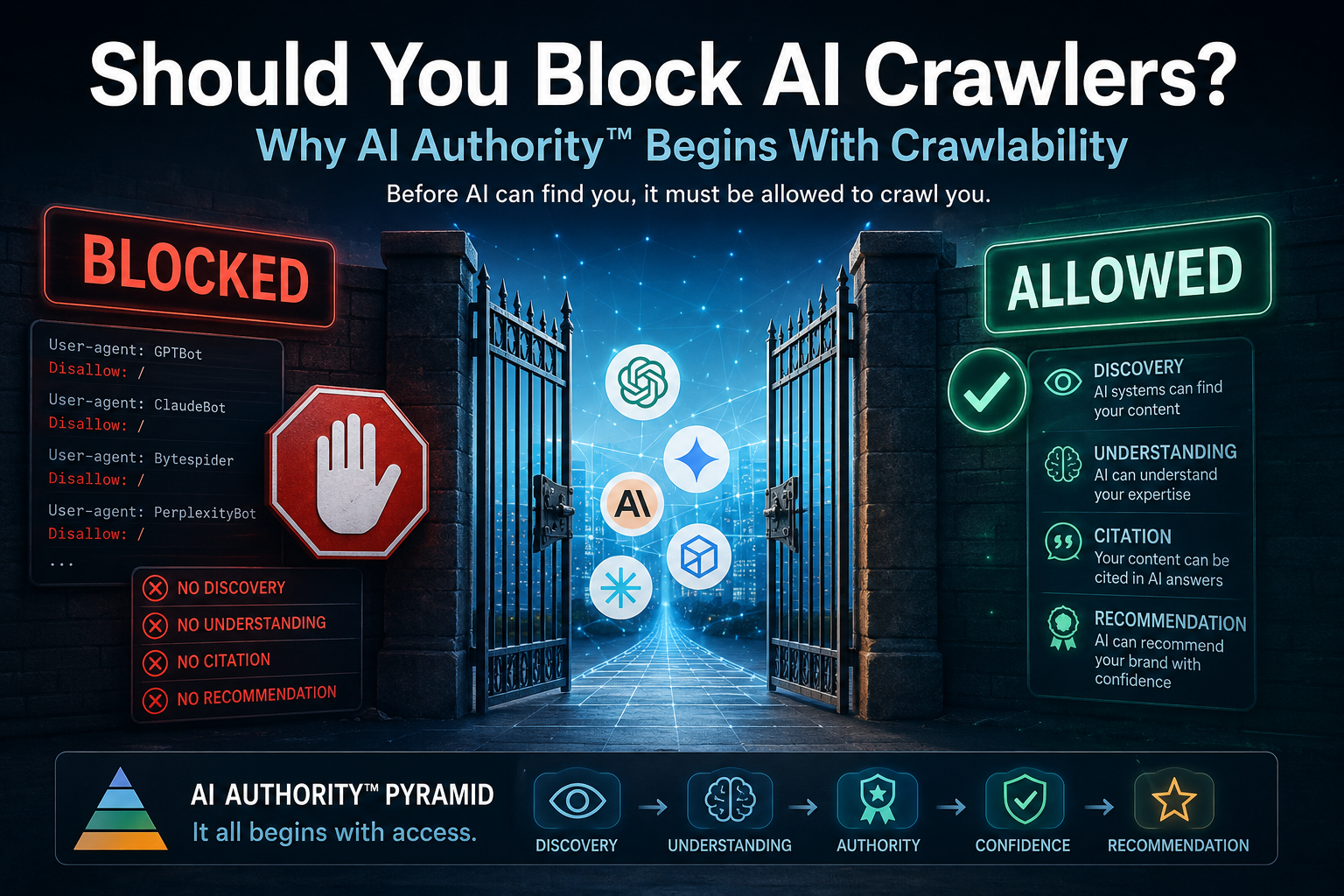
AI must first be allowed to crawl your content.
Without crawlability:
- There is no discovery.
- There is no understanding.
- There is no confidence accumulation.
- There is no recommendation.
Crawlability is not the destination.
It is the gateway.
Not Every AI Crawler Should Be Treated Equally
Rather than making an all-or-nothing decision, organizations should evaluate different categories of AI crawlers.
Some crawlers primarily support AI search, retrieval, citations and answer generation.
Others may focus on large-scale model training, commercial scraping or unknown data collection activities.
Instead of blocking every crawler, organizations should consider:
- Which AI systems contribute meaningful business visibility?
- Which platforms generate referrals or citations?
- Which crawlers align with your content licensing policies?
- Which bots consume resources without providing measurable value?
Treating every crawler identically may overlook important strategic differences.
Measure Before You Block
Many businesses continue making AI crawler decisions based on assumptions rather than evidence.
Instead, monitor indicators such as:
- AI referral traffic
- Citation frequency
- Brand mentions in AI-generated answers
- Recommendation visibility
- Conversion quality from AI-assisted journeys
- Crawl activity in server logs
These signals provide a clearer understanding of whether AI platforms are contributing meaningful business value.
Not fear.
AI Authority™ Is Built on Participation
The future of digital visibility is gradually shifting from retrieval to recommendation.
Organizations cannot assume AI systems will recommend information they have never been able to discover or understand.
That does not mean allowing unrestricted access to every crawler.
It means making intentional, evidence-based decisions that balance content protection with long-term discoverability.
Organizations that understand this distinction will be better positioned to participate in the next generation of AI-powered discovery.
Final Thoughts
Blocking AI crawlers is a technical decision.
Building AI Authority™ is a strategic decision.
The organizations that succeed will not simply ask, “How do we protect our content?”
They will also ask:
“How do we ensure AI systems know enough about us to recommend us with confidence?”
Because in the age of AI, authority begins long before recommendation.
It begins with being discoverable.
FAQ
1. Can AI crawlers be blocked?
Yes. AI crawlers can be restricted through robots.txt, web application firewalls, server rules, IP blocking and authentication. However, blocking reputable AI crawlers may reduce opportunities for AI discovery and recommendation.
2. Will blocking AI crawlers stop my website from appearing in AI answers?
Not necessarily. AI systems use multiple information sources, including licensed content, search indexes and previously acquired knowledge. However, blocking crawlers may reduce future opportunities for your latest content to be discovered and evaluated.
3. Should every AI crawler be allowed?
No. Organizations should distinguish between reputable AI search and retrieval crawlers, model-training crawlers, and abusive scraping bots. Access policies should reflect business goals, licensing preferences and measurable value.
4. How does crawlability relate to AI Authority™?
Crawlability is the technical prerequisite for AI discovery. AI Authority™ develops after AI systems can access, understand, validate and accumulate confidence in your expertise.
5. What metrics should businesses monitor before blocking AI crawlers?
Useful metrics include AI referral traffic, citation frequency, recommendation visibility, server logs, brand mentions in AI-generated responses, engagement quality and conversions.
Leave a Reply