
By TonyCWK
Introduction
Most businesses do not suffer from a lack of information.
They suffer from a lack of consistency.
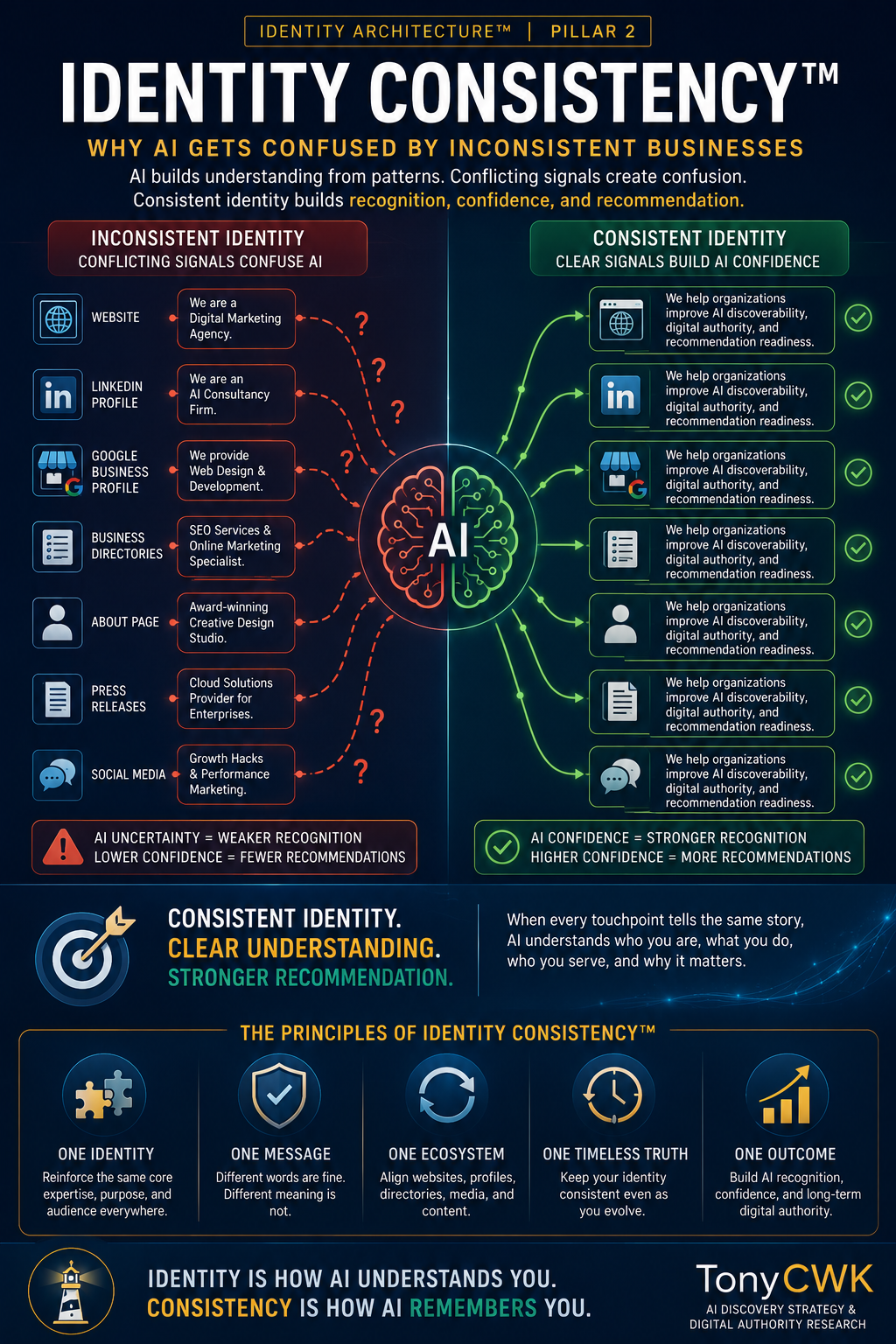
Their website describes one business.
Their LinkedIn profile describes another.
Their Google Business Profile emphasizes different services.
Their author biographies introduce different expertise.
Their press releases use different positioning.
Their directory listings contain outdated descriptions.
To people, these differences may seem insignificant.
To artificial intelligence, they create uncertainty.
AI systems attempt to build a coherent understanding of every organization they encounter. When multiple sources describe the same business differently, AI has to determine which version is the most reliable.
The greater the inconsistency, the greater the uncertainty.
That is why Identity Consistency™ is the second pillar of Identity Architecture™.
What Is Identity Consistency™?
Identity Consistency™ is the deliberate practice of ensuring that every digital touchpoint reinforces the same business identity, expertise, audience, and purpose across the entire digital ecosystem.
It does not mean using identical wording everywhere.
Instead, it means that every platform tells the same story.
Whether AI encounters your business through your website, social profiles, industry publications, business directories, customer reviews, podcasts, or media coverage, it should arrive at the same conclusion about who you are.
Consistency builds recognition.
Recognition builds confidence.
Confidence supports recommendation.
AI Learns Through Repetition
Humans can easily understand that slightly different descriptions may refer to the same business.
AI systems rely more heavily on recurring patterns.
Every consistent signal strengthens AI’s confidence.
For example, if multiple trusted sources consistently associate your organization with AI discovery strategy, AI Authority™, and digital authority research, AI is more likely to recognize these as defining characteristics of your expertise.
However, if some sources describe you as an SEO agency, others as a web design company, others as an AI consultancy, and others as a digital marketing freelancer, AI receives mixed identity signals.
The result is a weaker understanding of your core identity.
Where Inconsistency Commonly Appears
Identity inconsistency often develops gradually as businesses evolve.
Common examples include:
Website
Different pages describe different primary services.
About Page
The company mission differs from the homepage.
LinkedIn Profile
Professional expertise differs from the website.
Google Business Profile
Business categories emphasize unrelated services.
Author Biography
Different credentials appear on different websites.
Business Directories
Older descriptions remain online for years.
Press Releases
Each announcement introduces a different positioning statement.
Social Media
Content shifts constantly without reinforcing a core expertise.
Individually, these inconsistencies may seem harmless.
Collectively, they weaken AI’s understanding.
Consistency Does Not Mean Repetition
Many organizations misunderstand consistency.
Consistency does not require copying the same paragraph onto every platform.
Instead, it requires reinforcing the same identity from different perspectives.
For example:
Homepage:
“We help organizations improve AI discoverability and digital authority.”
About Page:
“Our expertise focuses on helping businesses become more understandable, credible, and recommendable in AI-driven search.”
LinkedIn:
“Researching AI discovery strategy, Identity Architecture™, and AI Authority™.”
The wording differs.
The identity remains consistent.
Identity Is An Ecosystem, Not A Website
One of the biggest misconceptions in digital marketing is that identity lives on a website.
AI rarely forms opinions from a single source.
Instead, it combines information from an ecosystem that may include:
- Websites
- Business directories
- Professional profiles
- Industry publications
- Research papers
- Videos
- Podcasts
- Interviews
- Reviews
- Case studies
- Citations
- Conference presentations
- Social platforms
Each source contributes another piece of the identity puzzle.
Identity Consistency™ ensures those pieces fit together.
The Cost Of Identity Inconsistency
When identity becomes fragmented, AI may struggle to:
- Categorize expertise accurately.
- Associate the organization with the correct topics.
- Connect related content.
- Recognize subject matter expertise.
- Develop recommendation confidence.
- Reinforce authority over time.
This does not necessarily prevent visibility.
It reduces confidence.
In AI-driven recommendation systems, confidence often determines which organizations are surfaced.
Building Identity Consistency™
Organizations should periodically review every major digital touchpoint and ask:
- Does this accurately describe who we are today?
- Does it reinforce our primary expertise?
- Does it align with our website?
- Would AI reach the same conclusion regardless of where it encountered us?
- Have outdated descriptions been removed or updated?
- Are our products, services, and content reinforcing one coherent identity?
Identity consistency is not achieved through a single project.
It becomes an ongoing governance process.
Identity Consistency™ Within Identity Architecture™
Identity Definition™ establishes who you are.
Identity Consistency™ ensures that definition is reinforced everywhere.
Without consistency, even a well-defined identity becomes diluted.
Without definition, consistency simply repeats ambiguity.
The two pillars depend on one another.
Together, they create a stable foundation before Identity Relationships™, Identity Representation™, Identity Reinforcement™, and Identity Persistence™ further strengthen AI recognition.
Looking Ahead
Once identity has been clearly defined and consistently reinforced, the next challenge is helping AI understand how your people, expertise, products, services, and organizations relate to one another.
The next article explores the third pillar of Identity Architecture™:
Identity Relationships™: Why AI Understands Connections Better Than Isolated Content.
Conclusion
AI systems do not simply collect information.
They build understanding through repeated patterns.
Every consistent signal strengthens recognition.
Every conflicting signal introduces uncertainty.
Identity Consistency™ transforms a collection of disconnected digital assets into a coherent identity that AI can recognize with greater confidence.
In the age of AI recommendations, consistency is no longer just a branding principle.
It is an architectural requirement for digital recognition.
FAQ
1. What is Identity Consistency™?
Identity Consistency™ is the second pillar of Identity Architecture™. It is the practice of ensuring that every digital touchpoint consistently communicates the same business identity, expertise, audience, and purpose so AI systems can accurately recognize and understand an organization.
2. Why is Identity Consistency™ important for AI?
AI systems build an understanding of businesses by combining information from many sources. When those sources consistently reinforce the same identity, AI develops greater confidence. When they conflict, AI becomes less certain about how the business should be categorized or recommended.
3. Does Identity Consistency™ mean using identical wording everywhere?
No. Identity Consistency™ is about maintaining the same meaning rather than repeating the exact same text. Different platforms can use different wording while still reinforcing the same business identity.
4. What causes identity inconsistency?
Identity inconsistency often occurs when websites, social media profiles, business directories, author biographies, press releases, and other digital assets describe a business differently or contain outdated information that no longer reflects its primary expertise.
5. Can inconsistent identity affect AI recommendations?
Yes. While inconsistent identity may not prevent AI from discovering a business, it can reduce AI’s confidence in understanding what the business represents, making recommendations less likely or less accurate.
6. How is Identity Consistency™ different from branding?
Branding focuses on how people perceive a business through design, messaging, and customer experience. Identity Consistency™ focuses on ensuring AI systems receive consistent signals about the organization’s expertise, purpose, and relationships across the digital ecosystem.
7. What digital assets should maintain identity consistency?
Identity consistency should extend across websites, About pages, Google Business Profiles, LinkedIn profiles, business directories, author biographies, press releases, podcasts, videos, case studies, reviews, and social media platforms.
8. How does Identity Consistency™ support AI Authority™?
Identity Consistency™ strengthens the foundation upon which AI Authority™ is built. When AI consistently recognizes an organization’s expertise and purpose, it becomes easier to associate that organization with authority within its area of specialization.
9. Is Identity Consistency™ a one-time project?
No. As businesses evolve, new products, services, partnerships, and content should continue reinforcing the same core identity. Identity Consistency™ is an ongoing governance process rather than a one-time optimization task.
10. What is the main objective of Identity Consistency™?
The goal is to reduce ambiguity by ensuring AI systems consistently reach the same understanding of an organization regardless of which digital source they encounter first.
Leave a Reply