
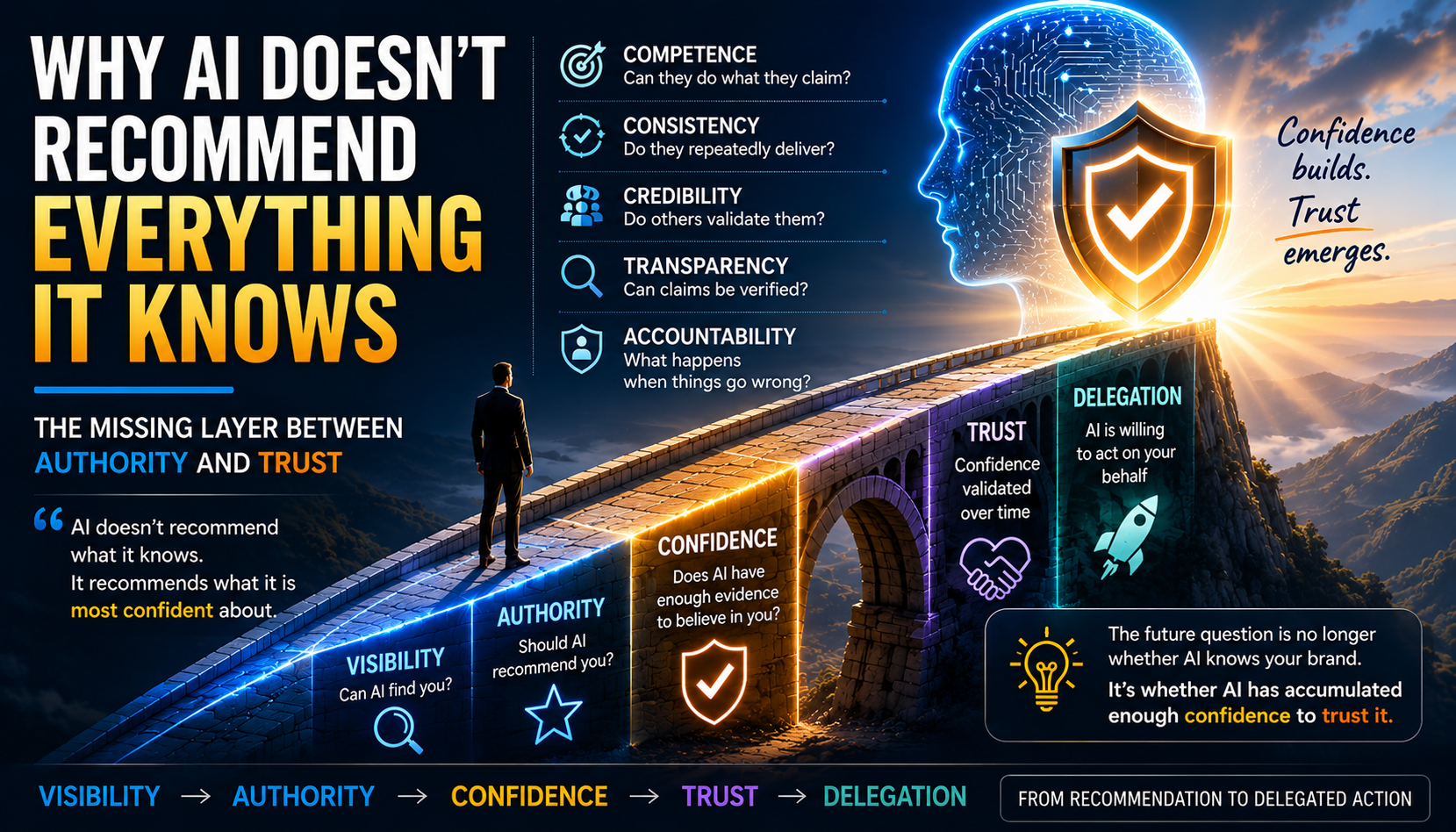
The Missing Layer Between Authority And Trust
Artificial intelligence knows far more than it recommends.
Every day, AI systems process vast amounts of information about companies, products, services, experts, and brands. Yet when asked for recommendations, they consistently surface only a small subset of what they know.
Why?
Most discussions about AI visibility focus on being found.
Can AI discover your website?
Can AI understand your content?
Can AI recognize your brand?
These are important questions.
In fact, they sit at the foundation of the AI Authority™ thesis.
Visibility helps AI find you.
Authority helps AI recommend you.
But recently, while exploring trust, delegation, and agentic commerce, I found myself asking a different question.
Why does AI repeatedly recommend some brands while others receive little or no visibility?
The answer may not be explained by authority alone.
There may be another layer emerging between authority and trust.
Confidence.
Visibility Explains Discovery
The first challenge for any brand is visibility.
If AI cannot find, crawl, understand, or associate your content with a topic, you are effectively invisible.
This is why technical SEO, structured data, entity development, semantic relationships, and content architecture remain important.
Visibility answers a simple question:
Can AI find you?
Without visibility, nothing else matters.
Authority Explains Recommendation
Once a brand becomes visible, the next challenge is authority.
Authority is what helps AI determine whether a source deserves consideration.
This is where signals such as:
begin to matter.
Authority answers another important question:
Should AI recommend you?
This is the foundation of AI Authority™.
Not every visible brand becomes a recommended brand.
Authority influences which brands AI surfaces when users ask for guidance, comparisons, and recommendations.
The Question Authority Doesn’t Fully Answer
Yet something interesting happens.
Two brands can operate in the same category.
They can have similar visibility.
They can have similar authority signals.
They may even have comparable expertise.
And yet AI seems to recommend one more frequently than the other.
Why?
Traditional explanations often stop at authority.
But authority alone may not fully explain repeated recommendation patterns.
There appears to be something else happening.
AI Doesn’t Recommend Everything It Knows
AI systems know far more than they recommend.
This distinction matters.
Knowing that a brand exists is different from being confident enough to surface that brand as a recommendation.
In other words:
AI does not recommend everything it knows.
It recommends what it is most confident about.
That confidence may be influenced by many factors.
Repeated evidence.
Consistency.
Validation.
Proven outcomes.
Reliability over time.
The important point is that confidence appears to reduce uncertainty.
And when uncertainty decreases, recommendations become easier.
How Confidence May Be Formed
Confidence is not a single signal.
It is not a metric that can be optimized overnight.
Instead, confidence appears to emerge from accumulated evidence.
While this area is still evolving, several factors seem likely to contribute.
Competence
Can the brand do what it claims?
Does it demonstrate expertise, knowledge, and capability?
Consistency
Does it repeatedly deliver the same quality and outcomes over time?
Credibility
Do other trusted sources validate the brand’s claims?
Transparency
Can information be verified?
Are claims supported by evidence?
Accountability
What happens when things go wrong?
Does the organization stand behind its commitments?
None of these factors create trust instantly.
But together, they may contribute to confidence.
Confidence Accumulation
This is where the idea becomes particularly interesting.
Trust rarely appears overnight.
Think about how we trust:
- Banks
- Airlines
- Doctors
- Established brands
Trust is usually not created through a single interaction.
Instead, confidence accumulates.
Repeated validation reinforces that confidence.
Over time, trust emerges.
The same principle may eventually apply to AI systems.
Confidence is built through evidence.
Evidence is validated through repeated interactions.
Trust becomes the outcome.
Why This Matters For Agentic Commerce
Today’s AI systems primarily recommend.
Tomorrow’s AI systems may act.
They may:
- Book appointments
- Purchase products
- Select vendors
- Execute transactions
- Make decisions on behalf of users
This is the promise of delegated commerce.
But delegation introduces a higher standard.
A system may recommend a brand.
That does not automatically mean it will act on behalf of a user.
Delegation requires greater certainty.
Greater certainty may require greater confidence.
And over time, trust may emerge from accumulated confidence.
If trust enables delegation, confidence may be the bridge that makes trust possible.
A New Question For Brands
For years, digital marketing focused on visibility.
More recently, AI visibility discussions have focused on authority.
Both remain important.
But the next question may be different.
Not:
Can AI find my brand?
Not even:
Can AI recommend my brand?
But:
Has AI accumulated enough confidence to trust my brand?
That question may become increasingly important as AI moves from recommendation toward delegation.
And it may represent the next stage in the evolution of AI visibility.
Because the future may not belong to the brands AI merely knows.
It may belong to the brands AI becomes increasingly confident in recommending.
And eventually, confident enough to trust.
FAQ
1. Why doesn’t AI recommend everything it knows?
Because knowing a brand exists is not the same as being confident enough to recommend it. AI tends to surface brands supported by clearer, stronger, and more consistent signals.
2. What is the missing layer between authority and trust?
The missing layer is confidence. Authority helps AI consider a brand, but confidence helps AI become more certain that the brand is reliable enough to recommend.
3. How is AI confidence built?
AI confidence may be built through competence, consistency, credibility, transparency, accountability, and repeated validation across multiple trusted sources.
4. Is confidence the same as trust?
No. Confidence is the evidence-based certainty that grows over time. Trust is the outcome when that confidence survives repeated validation.
5. Why does this matter for agentic commerce?
In agentic commerce, AI may eventually act on behalf of users. That requires a higher level of certainty than simple recommendation. Confidence may become the bridge between AI authority, trust, and delegation.
6. What should brands focus on now?
Brands should focus on becoming easier to verify, consistently credible, and supported by evidence across their website, third-party platforms, reviews, citations, and real-world outcomes.
Leave a Reply