
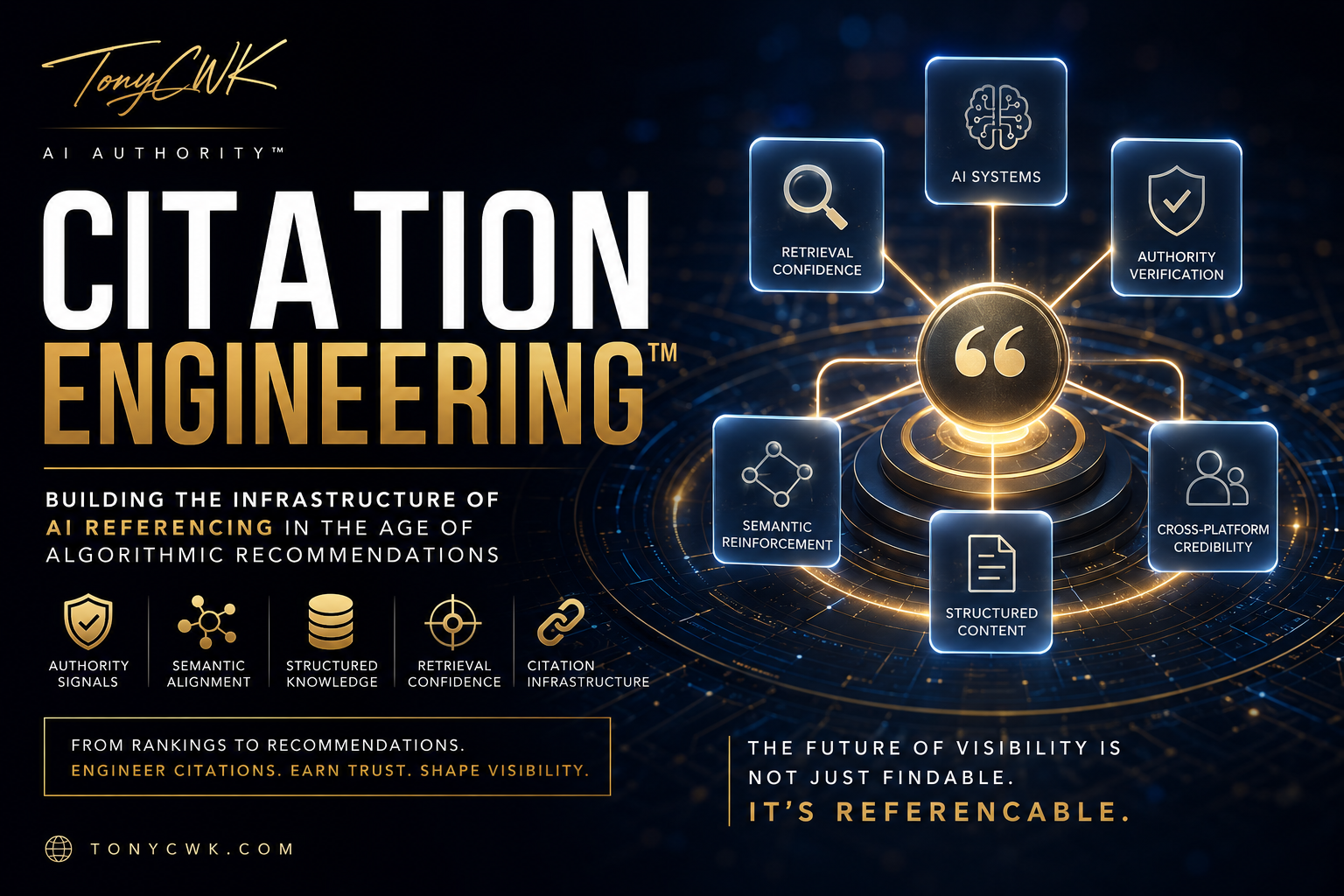
Building the Infrastructure of AI Referencing in the Age of Algorithmic Recommendations
The digital visibility economy is undergoing a structural transformation.
For two decades, brands optimized for rankings.
Today, they must optimize for references.
Modern AI systems no longer behave like traditional search engines that simply retrieve indexed pages. Increasingly, systems such as Google AI Overviews, OpenAI ChatGPT, Anthropic Claude, and Perplexity AI Perplexity operate as synthesis engines — selecting, recombining, validating, and recommending information across fragmented ecosystems.
In this environment, visibility is no longer determined solely by where content ranks.
It is determined by whether AI systems trust a source enough to cite it.
This creates the emergence of a new strategic discipline:
What Is Citation Engineering™?
Citation Engineering™ is the systematic design of digital ecosystems, structured knowledge, credibility signals, and semantic reinforcement mechanisms to maximize the probability that AI systems reference, retrieve, recommend, and cite a brand across generative interfaces.
It is not merely about earning backlinks.
It is about engineering machine-recognizable authority pathways.
Traditional SEO focused on:
- Rankings
- Crawling
- Keywords
- Links
- Click acquisition
Citation Engineering™ focuses on:
- AI citation probability
- Retrieval confidence
- Semantic consistency
- Cross-platform entity validation
- Structured knowledge architecture
- Algorithmic trust reinforcement
- Recommendation eligibility
In the AI era, discoverability alone is insufficient.
A brand must become:
Because AI systems increasingly select sources, not merely pages.
Why Citation Engineering™ Matters
AI systems operate under uncertainty.
When generating responses, recommendation engines attempt to minimize:
- Hallucination risk
- Contradictory information
- Weak authority signals
- Inconsistent entity relationships
- Low-confidence retrievals
As a result, modern AI systems favor sources with:
- High semantic coherence
- Cross-platform consistency
- Structured topical authority
- Strong citation repetition
- Reliable contextual reinforcement
- Ecosystem-wide credibility signals
This means the future competitive advantage belongs not merely to brands with traffic —
but brands with citation infrastructure.
The emerging visibility economy is transitioning from:
| Old Visibility Model | Emerging AI Visibility Model |
|---|---|
| Rankability | Citeability |
| Click acquisition | Recommendation eligibility |
| SERP positioning | Retrieval confidence |
| Keyword optimization | Semantic authority engineering |
| Backlinks | Cross-ecosystem reinforcement |
| Page-level relevance | Entity-level trust |
| Content publishing | Knowledge architecture |
This is why many high-traffic websites may gradually lose influence inside AI-generated answers while smaller but highly coherent brands gain disproportionate recommendation visibility.
The Rise of AI Citation Systems
Modern AI systems increasingly rely on:
- Retrieval-Augmented Generation (RAG)
- Hybrid semantic search
- Entity resolution
- Confidence scoring
- Citation verification
- Multi-source corroboration
- Knowledge graph alignment
This means AI systems are constantly evaluating:
- Which source appears repeatedly?
- Which entity relationships remain consistent?
- Which domains reinforce the same expertise?
- Which brands demonstrate semantic stability?
- Which information clusters reduce uncertainty?
The result is an emerging AI citation layer across the internet.
This layer determines:
- Which brands are surfaced
- Which sources are trusted
- Which entities are referenced
- Which companies become recommendation candidates
Citation Engineering™ is the discipline of intentionally optimizing for this layer.
The 7 Pillars of Citation Engineering™
1. Entity Consistency
AI systems require stable entity recognition.
Brands with inconsistent:
- Names
- Messaging
- Expertise positioning
- Author structures
- Service descriptions
create lower retrieval confidence.
Strong Citation Engineering™ requires:
- Consistent naming conventions
- Stable expertise themes
- Repeated semantic positioning
- Unified author identity
- Cross-platform entity alignment
Entity ambiguity reduces citation probability.
Entity coherence increases recommendation confidence.
2. Structured Knowledge Architecture
AI systems process structured information more efficiently than fragmented content.
This includes:
- Schema markup
- FAQ structures
- Hierarchical topical clusters
- Internal semantic linking
- AI-readable content organization
- Knowledge graph compatibility
Brands that structure knowledge clearly become easier for AI systems to:
- Parse
- Retrieve
- Recombine
- Validate
- Cite
This is why AI-readable architecture is becoming a competitive moat.
3. Thematic Reinforcement
AI systems trust repeated expertise patterns.
One isolated article rarely creates strong citation confidence.
Instead, AI systems evaluate:
- Topic depth
- Coverage breadth
- Semantic continuity
- Repeated conceptual alignment
A brand publishing consistently around:
- AI Authority
- AI Discovery
- Recommendation Systems
- Citation Infrastructure
- Retrieval Confidence
builds stronger thematic legitimacy.
This increases the probability of future citations.
4. Cross-Platform Credibility Signals
AI systems increasingly synthesize information across:
- Websites
- Social platforms
- News mentions
- Professional profiles
- Community discussions
- Structured databases
Authority is no longer isolated to one domain.
It is ecosystem-based.
Brands with aligned reinforcement across:
- Company websites
- Podcasts
- Interviews
- Research publications
- Industry commentary
develop stronger citation resilience.
5. Retrieval Confidence Optimization
AI systems prioritize sources that reduce uncertainty.
This involves:
- Accurate claims
- Clear authorship
- Semantic clarity
- Contextual consistency
- Reliable supporting evidence
- Structured explanations
The clearer and more trustworthy the information structure,
the higher the retrieval confidence.
Retrieval confidence increasingly influences:
- AI recommendations
- Citation inclusion
- Answer visibility
- Delegated decision-making
6. Citation Surface Expansion
Brands that exist across multiple trusted surfaces become easier to reference.
This includes:
- Industry publications
- Interviews
- Guest articles
- Community discussions
- Research citations
- Structured directories
- Knowledge panels
- Digital PR coverage
AI systems trust corroborated presence.
Repeated appearance across credible surfaces strengthens:
- Entity validation
- Semantic trust
- Recommendation likelihood
7. Algorithmic Trust Reinforcement
Ultimately, Citation Engineering™ is about trust engineering.
AI systems continuously evaluate:
- Signal consistency
- Context alignment
- Source quality
- Citation overlap
- Semantic reinforcement
- Historical reliability
Over time, repeated positive reinforcement creates:
- Stronger retrieval eligibility
- Higher citation frequency
- Recommendation momentum
- AI visibility durability
This is the foundation of long-term AI Authority™.
Citation Engineering™ vs Traditional Link Building
Traditional link building aimed to influence rankings.
Citation Engineering™ aims to influence machine trust systems.
| Traditional Link Building | Citation Engineering™ |
|---|---|
| Link quantity | Semantic validation |
| Domain authority | Entity authority |
| Anchor text | Retrieval confidence |
| PageRank flow | Citation eligibility |
| Search ranking | AI recommendation probability |
| SEO signals | AI trust signals |
| Traffic acquisition | Algorithmic recognition |
Backlinks still matter.
But their role is evolving.
In the AI era, links increasingly function as:
- credibility reinforcement,
- entity corroboration,
- contextual validation,
- and citation trust signals.
The Future of Visibility Is Citation-Based
The internet is shifting from a retrieval ecosystem to a recommendation ecosystem.
In traditional search:
users searched, evaluated, and clicked.
In AI interfaces:
systems increasingly:
- summarize,
- compare,
- filter,
- recommend,
- and eventually transact on behalf of users.
This changes the visibility equation entirely.
The future winners will not necessarily be brands with:
- the most traffic,
- the most ads,
- or the most pages.
They will be brands with:
- the strongest citation infrastructure,
- the clearest semantic authority,
- the most trusted knowledge architecture,
- and the highest algorithmic confidence.
Because in the AI era:
Visibility is no longer merely earned through rankings.
It is engineered through citations.
And Citation Engineering™ may become one of the defining competitive disciplines of the next digital decade.
Final Thought
SEO helped brands become findable.
Citation Engineering™ helps brands become recommendable.
The next era of digital competition will not be fought solely on:
- rankings,
- impressions,
- or clicks.
It will be fought on:
- retrieval confidence,
- recommendation eligibility,
- semantic trust,
- and citation persistence across AI ecosystems.
The brands that understand this shift early will not merely adapt to AI-driven discovery.
They will shape the citation layer that powers it.
Frequently Asked Questions (FAQ)
What is Citation Engineering™?
Citation Engineering™ is the systematic optimization of digital ecosystems, structured knowledge, semantic authority, and credibility signals to increase the likelihood that AI systems reference, retrieve, recommend, and cite a brand.
How is Citation Engineering™ different from SEO?
Traditional SEO primarily focuses on rankings, keywords, backlinks, and clicks. Citation Engineering™ focuses on AI citation probability, retrieval confidence, semantic trust, and recommendation eligibility across AI systems.
Why are AI citations becoming important?
AI interfaces increasingly summarize and recommend information directly to users. Brands cited by AI systems gain visibility, trust, and recommendation advantage even without traditional clicks.
What is AI retrieval confidence?
Retrieval confidence refers to how strongly an AI system trusts a source based on consistency, semantic clarity, corroboration, and authority signals.
Does backlink building still matter?
Yes. However, backlinks increasingly function as trust and validation signals rather than purely ranking signals. Their contextual quality and semantic relevance matter more in AI systems.
What role does schema markup play in Citation Engineering™?
Schema markup helps AI systems understand entities, relationships, expertise areas, FAQs, authorship, and structured knowledge, improving machine readability and citation likelihood.
Why is entity consistency important?
AI systems prefer stable and consistent entities because ambiguity lowers confidence. Consistent naming, expertise positioning, and messaging improve recommendation probability.
What are citation surfaces?
Citation surfaces are platforms or environments where a brand is referenced or reinforced, such as websites, LinkedIn posts, interviews, directories, podcasts, news articles, and community discussions.
How do AI systems determine which brands to cite?
AI systems evaluate semantic relevance, topical authority, cross-platform consistency, retrieval confidence, corroborated signals, and contextual trustworthiness.
What is thematic reinforcement?
Thematic reinforcement occurs when a brand repeatedly publishes semantically aligned content around a core expertise area, strengthening AI perception of authority.
Is Citation Engineering™ relevant only for large companies?
No. Smaller brands with strong semantic coherence and structured authority systems can outperform larger brands with fragmented messaging in AI-driven environments.
How does Citation Engineering™ relate to AI Authority™?
Citation Engineering™ is a foundational operational layer within AI Authority™ because citations reinforce algorithmic trust, recommendation confidence, and entity legitimacy.
What industries benefit most from Citation Engineering™?
Any industry affected by AI discovery and AI-assisted recommendations can benefit, including:
- Digital marketing
- SaaS
- Healthcare
- Education
- Finance
- Consulting
- E-commerce
- Professional services
What is citation persistence?
Citation persistence refers to how consistently a brand continues to appear in AI-generated references over time due to reinforced authority and semantic stability.
How can businesses start implementing Citation Engineering™?
Businesses can begin by:
- improving entity consistency,
- building topical authority clusters,
- implementing schema markup,
- strengthening internal linking,
- enhancing cross-platform consistency,
- and creating AI-readable structured content ecosystems.
Will Citation Engineering™ replace SEO?
No. SEO remains important. Citation Engineering™ expands beyond traditional SEO by optimizing for AI recommendation systems and generative discovery environments.
Why is cross-platform consistency important for AI systems?
AI systems synthesize information from multiple sources. Consistent messaging and positioning across platforms strengthen entity validation and trust.
How does Citation Engineering™ affect AI recommendations?
Brands with stronger citation infrastructure and retrieval confidence are more likely to be surfaced, referenced, and recommended by AI systems.
What is the future of digital visibility?
The future of digital visibility is increasingly recommendation-driven, where AI systems determine which brands users see, trust, and engage with.
Why is Citation Engineering™ strategically important now?
As AI systems become primary discovery interfaces, brands that engineer citation trust early may gain durable competitive advantages in recommendation visibility and algorithmic authority.
Suggested Reading
To strengthen topical authority and internal semantic reinforcement for this article, these TonyCWK articles would make excellent suggested reading:
- “The AI Citation Layer™”
Explores how AI systems build citation pathways and determine which brands become reference-worthy across generative interfaces. - “Retrieval Confidence™”
Deep dive into how AI systems evaluate trust, semantic consistency, and recommendation confidence. - “Algorithmic Authority Recognition”
Explains how AI systems increasingly recognize and reinforce authority through semantic and ecosystem-wide signals. - “Selection Intelligence™”
Examines how AI systems move beyond retrieval into recommendation and delegated decision-making. - “The Future of Search Is Recommendation, Not Retrieval”
Provides the macro-level visibility shift that makes Citation Engineering™ strategically important. - “SEO Alone Is No Longer Enough”
Foundational article explaining why traditional ranking strategies must evolve in the AI discovery era. - “The Evolution of SEO in the Age of AI Authority”
Balanced perspective on how SEO evolves into semantic trust and AI recommendation optimization. - “What Is AI Authority™?”
Core foundational framework for understanding long-term algorithmic trust and machine-recognized expertise. - “The AI Discovery Flywheel™”
Shows how repeated authority reinforcement compounds AI visibility and recommendation momentum. - “The AI Authority Pyramid™”
Strategic framework explaining the layered architecture required for durable AI visibility. - “The New Visibility Model: Why Being Found Is No Longer Enough in the Age of AI”
Reinforces the transition from discoverability to recommendation eligibility. - “Why AI Doesn’t Trust Content — It Trusts Systems”
Strong conceptual complement to Citation Engineering™, especially around infrastructure and semantic coherence. - “Entity Persistence in the Age of LLMs”
Explains how stable entity recognition influences long-term AI memory and citation durability. - “The Rise of AI Selectability™ in Delegated Commerce”
Connects citation infrastructure with future AI-driven transaction and recommendation systems. - “How AI Systems Build Trust”
Important supporting article on the mechanics of algorithmic trust formation and confidence scoring.
Written by Tony Chan (TonyCWK)
AI Authority & Digital Strategy Researcher
Leave a Reply