
Why Campaign Optimisation Is No Longer Enough
Executive Summary
Artificial Intelligence is transforming digital marketing at an unprecedented pace.
Most discussions focus on how AI improves campaigns—through automation, targeting, and optimisation.
While this is true, it represents only the surface.
The real shift is not that AI is improving marketing.
It is that AI is becoming the system that decides marketing outcomes.
This creates a critical illusion:
- Marketers believe success comes from better tools
- But in reality, success comes from being selected by AI systems
The future of marketing is no longer campaign-driven.
It is selection-driven.
1. The Rise of AI-Powered Marketing
AI has already reshaped how marketing operates.
Today, platforms like Google and Meta use AI to:
- Automate ad delivery
- Optimise targeting in real time
- Adjust bids and budgets dynamically
- Generate and test creative variations
At the execution level, this creates:
- Higher efficiency
- Faster experimentation
- Improved campaign performance
This is the visible layer of AI in marketing.
But this is where the illusion begins.
2. The Illusion: AI as a Performance Tool
Most marketers interpret AI as:
- A way to improve campaigns
- A tool to drive more traffic
- A system to increase ROI
This leads to a dominant belief:
“If I use better AI tools, I will achieve better marketing results.”
Why this is incomplete
Because:
- AI tools are becoming standardised
- Platforms are automating optimisation
- Competitive advantage from execution is shrinking
When everyone uses the same AI, no one wins through tools alone.
3. The Real Shift: AI as the Decision System
AI is no longer just supporting marketing.
It is now intervening between brands and users.
Platforms such as:
- ChatGPT
- Perplexity AI
- Google Gemini
are changing how discovery happens.
What these systems do differently
They:
- Answer instead of listing results
- Recommend instead of ranking options
- Summarise instead of sending traffic
The implication
Users no longer choose from options.
AI chooses on their behalf.
4. From Traffic to Selection
This creates a fundamental shift:
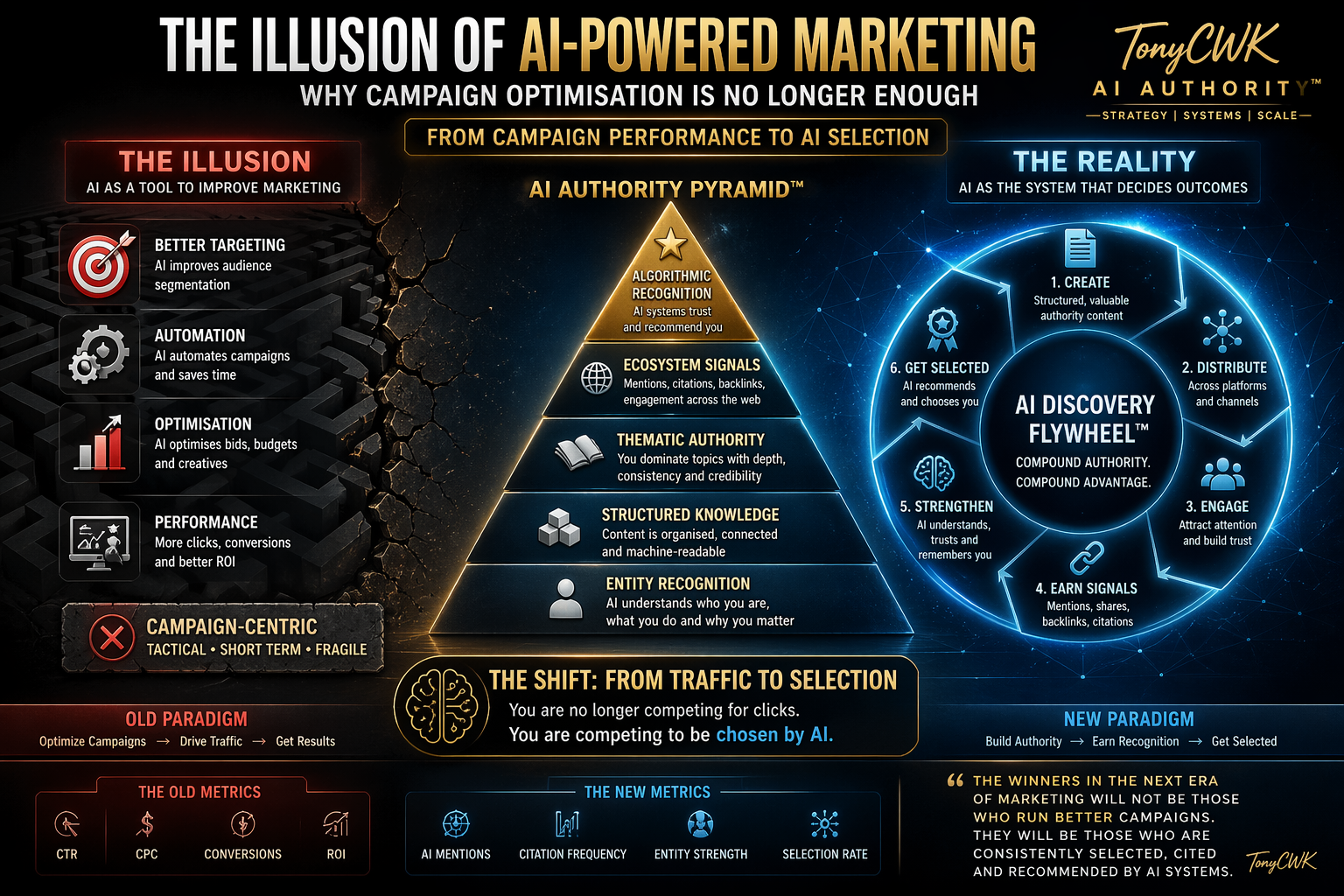
| Traditional Marketing | AI-Driven Reality |
|---|---|
| Drive traffic | Be selected |
| Optimise clicks | Influence decisions |
| Compete for rankings | Compete for recommendations |
The new objective
Visibility is no longer about being found.
It is about being chosen.
5. The Emergence of AI Authority
To operate in this new environment, brands must evolve.
The new requirement is:
AI Authority — the probability of being selected, cited, and recommended by AI systems
AI Authority is built through:
🔺 1. Entity Recognition
AI understands who you are and what you represent
🧱 2. Structured Knowledge
Your content is machine-readable and extractable
📚 3. Thematic Depth
You demonstrate consistent expertise across a topic
🌐 4. Ecosystem Signals
Mentions, citations, and external validation reinforce credibility
🤖 5. Algorithmic Trust
AI systems recognise and reuse your content
These are not campaign metrics.
These are selection signals.
6. The AI Discovery Flywheel
Visibility in the AI era is not linear.
It compounds.
The cycle:
- Create structured, authoritative content
- Distribute across platforms
- Generate engagement
- Earn signals (mentions, backlinks, citations)
- Strengthen recognition
- Increase selection probability
The outcome
The more you are selected, the more you will be selected again.
This creates a compounding advantage.
7. The Metrics Shift
Traditional marketing measures:
- CTR
- CPC
- Conversions
These reflect campaign performance.
New metrics for the AI era
- AI mentions
- Citation frequency
- Entity strength
- Selection rate
You are no longer measuring traffic.
You are measuring whether AI systems choose you.
8. The New Marketing Paradigm
The shift can be summarised simply:
Old Paradigm
- Run campaigns
- Drive traffic
- Optimise performance
New Paradigm
- Build authority
- Earn recognition
- Become the default recommendation
Marketing is no longer about exposure.
It is about becoming the answer.
9. Strategic Reframe
The most important question is no longer:
“How do I use AI in my marketing?”
The real question is:
“How do I become part of the AI’s decision system?”
🔥 Final Insight
The next era of marketing will not be won by those who run better campaigns.
It will be won by those who are consistently
selected, cited, and recommended by AI systems.
FAQ: The Illusion of AI-Powered Marketing
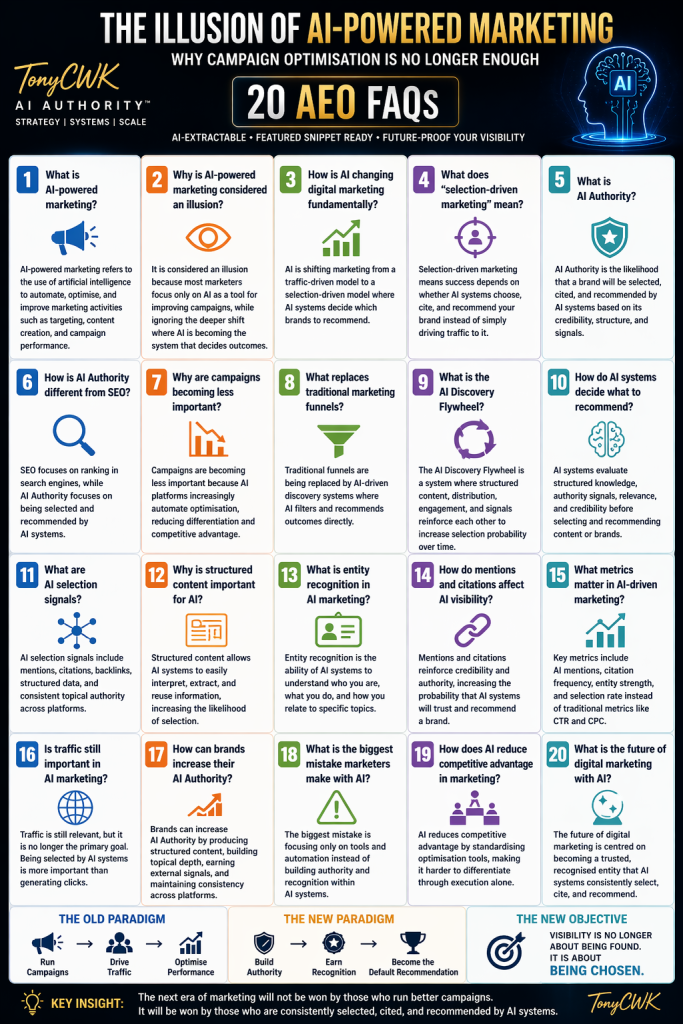
1. What is AI-powered marketing?
AI-powered marketing refers to the use of artificial intelligence to automate, optimise, and improve marketing activities such as targeting, content creation, and campaign performance.
2. Why is AI-powered marketing considered an illusion?
It is considered an illusion because most marketers focus only on AI as a tool for improving campaigns, while ignoring the deeper shift where AI is becoming the system that decides outcomes.
3. How is AI changing digital marketing fundamentally?
AI is shifting marketing from a traffic-driven model to a selection-driven model where AI systems decide which brands to recommend.
4. What does “selection-driven marketing” mean?
Selection-driven marketing means success depends on whether AI systems choose, cite, and recommend your brand instead of simply driving traffic to it.
5. What is AI Authority?
AI Authority is the likelihood that a brand will be selected, cited, and recommended by AI systems based on its credibility, structure, and signals.
6. How is AI Authority different from SEO?
SEO focuses on ranking in search engines, while AI Authority focuses on being selected and recommended by AI systems.
7. Why are campaigns becoming less important?
Campaigns are becoming less important because AI platforms increasingly automate optimisation, reducing differentiation and competitive advantage.
8. What replaces traditional marketing funnels?
Traditional funnels are being replaced by AI-driven discovery systems where AI filters and recommends outcomes directly.
9. What is the AI Discovery Flywheel?
The AI Discovery Flywheel is a system where structured content, distribution, engagement, and signals reinforce each other to increase selection probability over time.
10. How do AI systems decide what to recommend?
AI systems evaluate structured knowledge, authority signals, relevance, and credibility before selecting and recommending content or brands.
11. What are AI selection signals?
AI selection signals include mentions, citations, backlinks, structured data, and consistent topical authority across platforms.
12. Why is structured content important for AI?
Structured content allows AI systems to easily interpret, extract, and reuse information, increasing the likelihood of selection.
13. What is entity recognition in AI marketing?
Entity recognition is the ability of AI systems to understand who you are, what you do, and how you relate to specific topics.
14. How do mentions and citations affect AI visibility?
Mentions and citations reinforce credibility and authority, increasing the probability that AI systems will trust and recommend a brand.
15. What metrics matter in AI-driven marketing?
Key metrics include AI mentions, citation frequency, entity strength, and selection rate instead of traditional metrics like CTR and CPC.
16. Is traffic still important in AI marketing?
Traffic is still relevant, but it is no longer the primary goal. Being selected by AI systems is more important than generating clicks.
17. How can brands increase their AI Authority?
Brands can increase AI Authority by producing structured content, building topical depth, earning external signals, and maintaining consistency across platforms.
18. What is the biggest mistake marketers make with AI?
The biggest mistake is focusing only on tools and automation instead of building authority and recognition within AI systems.
19. How does AI reduce competitive advantage in marketing?
AI reduces competitive advantage by standardising optimisation tools, making it harder to differentiate through execution alone.
20. What is the future of digital marketing with AI?
The future of digital marketing is centred on becoming a trusted, recognised entity that AI systems consistently select, cite, and recommend.
To deepen your understanding of AI Authority and digital visibility:
• AI Authority Pyramid™ — How AI evaluates structured authority
👉 https://tonycwk.com/ai-authority-pyramid/
• AI Authority Flywheel™ — How authority compounds over time
👉https://tonycwk.com/ai-discovery-flywheel/
• SEO Alone Is No Longer Enough — Why rankings are no longer the goal
👉 https://tonycwk.com/seo-alone-is-no-longer-enough/
• AI Authority Metrics — Measuring selection, not just traffic
👉 https://tonycwk.com/ai-authority-metrics/
Written by Tony Chan (TonyCWK)
AI Authority & Digital Strategy Researcher
Leave a Reply