
Introduction — Visibility Is No Longer Linear
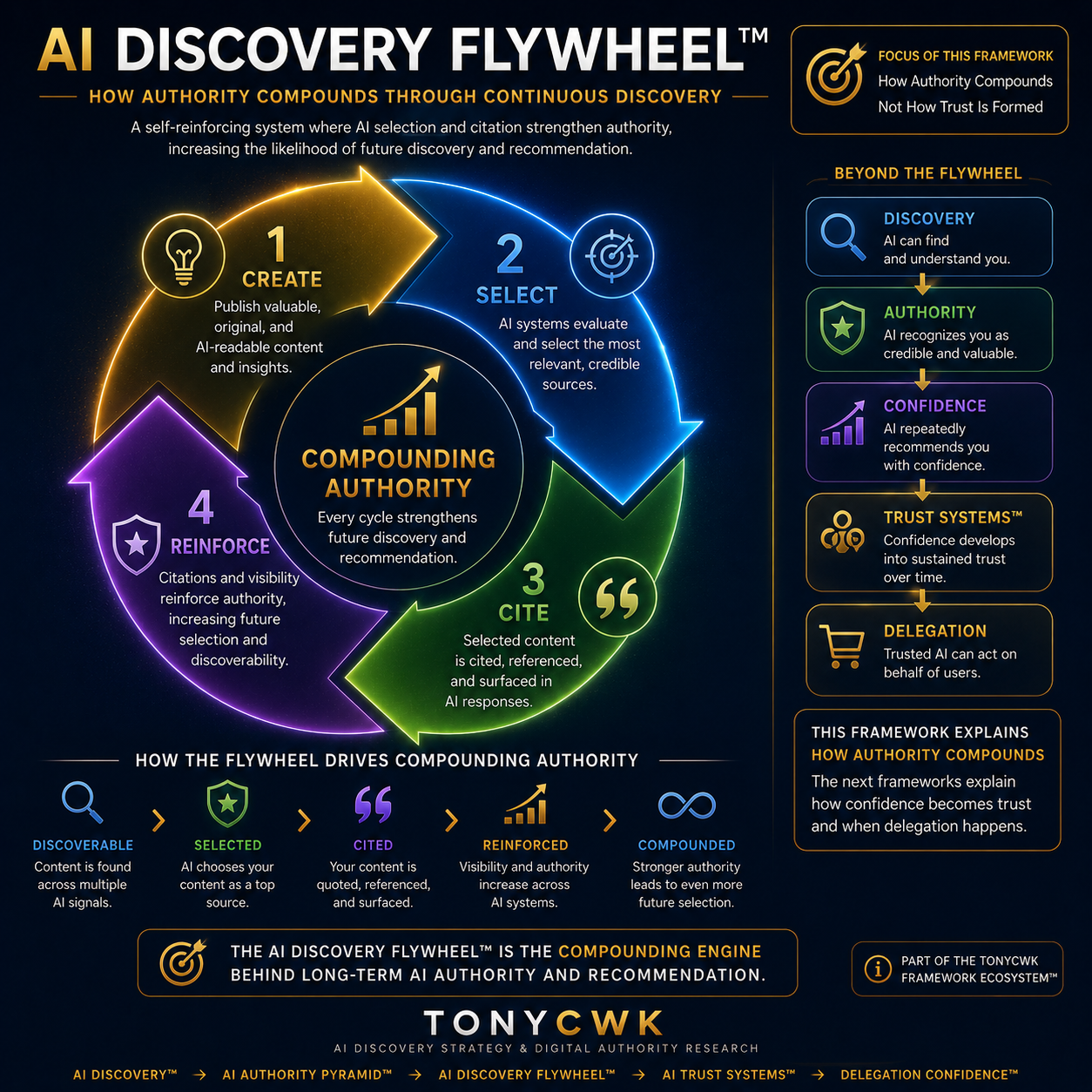
Unlike traditional digital marketing models that primarily focus on rankings and traffic, the AI Discovery Flywheel™ focuses on how authority can strengthen future discoverability through reinforcing cycles of recognition and selection.
As organizations create valuable knowledge, become selected by AI systems, earn citations, and reinforce credibility, they increase the probability of future discovery and recommendation.
Definition
AI Discovery Flywheel™ is TonyCWK’s framework explaining how AI Authority compounds through repeated cycles of creation, selection, citation, and reinforcement.
It does not explain how AI develops trust.
Instead:
Delegation Confidence™ explains when trusted AI can act autonomously.
AI Authority Pyramid™ explains how authority is built.
AI Discovery Flywheel™ explains how authority compounds.
AI Trust Systems™ explains how confidence develops into AI trust.
For years, digital visibility followed a predictable model:
Publish content → Rank on search engines → Generate traffic
This was the foundation of traditional SEO.
But in the age of AI-driven discovery, this model is breaking.
Search is no longer just about finding websites.
It is increasingly about receiving answers.
And this shift changes everything.
Visibility is no longer earned once.
It is reinforced continuously.
In this new environment, success is not determined by ranking—it is determined by selection.
This is where the AI Discovery Flywheel becomes critical.
What Is the AI Discovery Flywheel™?
The AI Discovery Flywheel is a self-reinforcing system where:
- Structured content increases the likelihood of AI selection
- AI selection leads to citations and visibility
- Repeated visibility strengthens authority
- Stronger authority increases future selection probability
In short: visibility compounds.
Unlike SEO, which is often linear and fragile, the AI Flywheel is circular and reinforcing.
The AI Discovery Flywheel Model
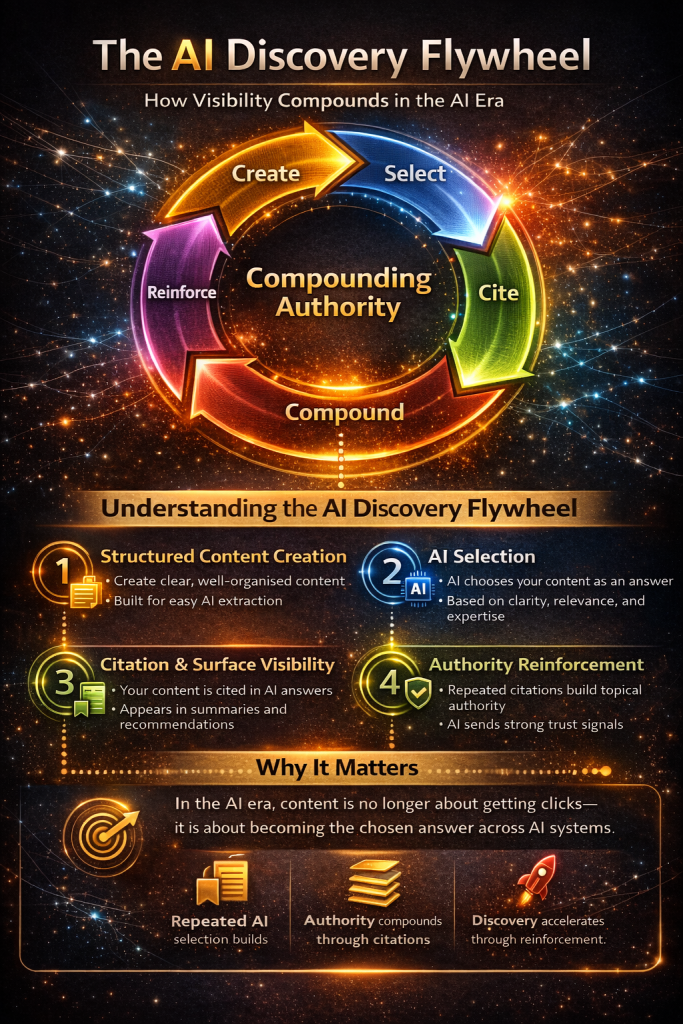
🟡 1. Structured Content Creation
Everything begins with AI-readable content.
This means content that is:
- Clearly structured
- Logically organised
- Easy to extract and summarise
This is not about writing more.
It is about writing in a way AI can understand.
👉 This stage is directly enabled by your AI Pyramid foundation.
🔵 2. AI Selection
AI systems evaluate content and decide:
“Is this the best answer to provide?”
Selection depends on:
- Clarity
- Relevance
- Structure
- Demonstrated expertise
If your content is not structured, it is unlikely to be selected—no matter how well it ranks.
🟢 3. Citation & Surface Visibility
Once selected, your content appears in:
- AI-generated answers
- Summaries
- Recommendations
This is the new form of visibility.
In the AI era, being cited matters more than being clicked.
🟣 4. Authority Reinforcement
Repeated selection sends strong signals:
- This source is reliable
- This source is consistent
- This source is authoritative
Over time, your content becomes a trusted reference point.
🔴 5. Compounding Discovery
This is where the flywheel accelerates.
As authority strengthens:
- Your content is selected more frequently
- Your visibility expands across queries
- Your discovery becomes self-sustaining
This is the stage where visibility stops being effort-driven—and becomes momentum-driven.
Continuous Reinforcement
Every successful recommendation becomes another signal.
Every citation strengthens authority.
Every authoritative mention improves future discoverability.
Rather than resetting after each search, AI accumulates evidence over time.
This creates a self-reinforcing cycle where discovery increases authority, and authority increases future discovery.
The Critical Insight: Why This Model Matters
Most businesses are still operating in a linear mindset:
- Publish content
- Hope it ranks
- Move on to the next piece
But AI does not reward isolated content.
It rewards connected, structured, and reinforced knowledge systems.
“You are not competing for rankings.
You are competing to be chosen—again and again.”
Pyramid vs Flywheel — Structure vs Momentum
To fully understand AI visibility, you must see how two frameworks work together:
| AI Authority Pyramid™ | AI Discovery Flywheel™ |
|---|---|
| Defines structure | Drives momentum |
| Focuses on content quality | Focuses on content performance |
| Enables AI understanding | Enables AI reinforcement |
| Foundation | Growth engine |
The Pyramid enables selection.
The Flywheel compounds it.
Without structure, the flywheel cannot start.
Without reinforcement, the pyramid cannot scale.
| Framework | Explains |
|---|---|
| AI Discovery™ | How AI understands businesses |
| AI Authority Pyramid™ | How authority is built |
| AI Discovery Flywheel™ | How authority compounds |
| AI Trust Systems™ | How AI develops trust |
| Delegation Confidence™ | When AI is willing to act |
SEO vs AI Flywheel — A New Visibility Model
| Traditional SEO | AI Discovery Flywheel™ |
|---|---|
| Focus on rankings | Focus on selection |
| Keyword optimisation | Authority optimisation |
| Page-level strategy | System-level strategy |
| Traffic as success metric | Citations as success signal |
| Linear growth | Compounding growth |
SEO helps you get found.
The AI Discovery Flywheel™ helps you get chosen repeatedly.
The AI Discovery Flywheel Beyond SEO
The AI Discovery Flywheel™ applies across modern AI ecosystems—not only search engines.
The same compounding principles influence:
- AI Overviews
- ChatGPT
- Gemini
- Perplexity
- AI assistants
- AI shopping agents
- Enterprise AI copilots
Regardless of platform, repeated discovery, consistent evidence, and authoritative signals increase the likelihood of future recommendations.
🇸🇬 Real-World Example — Singapore SME
Consider a chiropractic clinic targeting busy professionals in Singapore.
Traditional approach:
- Write occasional blog posts
- Target keywords like “back pain relief”
- Compete for rankings
AI Discovery Flywheel™ approach:
- Build structured content around:
- Office posture
- Lower back pain
- Ergonomic habits
- Include:
- Clear headings
- FAQ sections
- Step-by-step answers
Outcome:
- AI systems repeatedly select their content for queries like:
- “How to fix office posture”
- “Why do I have back pain from sitting?”
Over time:
- The clinic becomes a default AI-recommended source
This is compounding authority in action.
Why Most Businesses Fail to Build the Flywheel
Despite producing content, many organisations fail because:
- Content is unstructured
- Topics are shallow and fragmented
- There is no internal linking (no knowledge architecture)
- Publishing is inconsistent
- Credibility signals are weak
They create content—but not systems.
And without a system, there is no flywheel.
How to Build Your AI Discovery Flywheel™
To operationalise this model:
1. Define Core Topic Clusters
Focus on areas where you want to build authority.
2. Create AI-Readable Pillar Content
Structure content clearly:
- Headings
- Definitions
- Frameworks
- Summaries
3. Add AEO (Answer Engine Optimisation) Layers
Include:
- FAQ sections
- Direct answers
- Concise explanations
4. Build Internal Knowledge Architecture
- Pillar → subtopics
- Concepts → supporting articles
5. Strengthen Credibility Signals
Reinforce authority through:
- Consistent publishing
- Professional positioning (e.g. LinkedIn)
- Clear expertise
6. Maintain Consistency
The flywheel only works when it keeps turning.
Where AI Discovery Flywheel™ Fits
The TonyCWK ecosystem progresses naturally:
AI Search Visibility
↓
AI Discovery™
↓
AI Authority Pyramid™
↓
AI Discovery Flywheel™
↓
Confidence
↓
AI Trust Systems™
↓
Delegation
Conclusion — From Content to Compounding Authority
The rules of visibility have changed.
It is no longer enough to:
- Rank
- Publish
- Optimise
In the AI era, success belongs to those who:
- Structure knowledge
- Build authority systems
- Enable continuous reinforcement
The AI Discovery Flywheel creates momentum.
That momentum strengthens topical authority.
Authority increases recommendation frequency.
Repeated recommendation develops confidence.
Confidence supports trust.
Trust enables delegation.
The flywheel therefore does not end at visibility.
It becomes the engine that powers the entire
AI recommendation lifecycle.
Visibility begins discovery.
Discovery compounds authority.
Authority builds confidence.
Confidence strengthens trust.
Trust enables AI-assisted decisions.
The AI Discovery Flywheel™ is therefore more than a content strategy.
It is the compounding mechanism behind long-term AI recommendation.
And those who build the flywheel will not just be found—
They will be consistently chosen.
AI Discovery Flywheel™ — FAQ
1. What is the AI Discovery Flywheel™?
The AI Discovery Flywheel™ is a framework developed by TonyCWK that explains how authority, recommendation, citation, and recognition reinforce one another to create compounding visibility in AI-driven discovery systems.
As organizations produce structured knowledge, strengthen credibility signals, and increase the likelihood of AI selection, they generate reinforcing cycles that can improve future discoverability, recommendation, and authority over time.
2. How is the AI Discovery Flywheel™ different from traditional SEO?
Traditional SEO focuses on ranking and traffic, while the AI Discovery Flywheel™ focuses on repeated selection, citations, and compounding authority in AI-generated answers.
3. Why is AI selection more important than ranking?
AI systems often provide direct answers, reducing clicks. Being selected ensures your content is surfaced, even if users do not visit your website.
4. What does “AI-readable content” mean?
AI-readable content is structured, clear, and easy for AI systems to extract, summarise, and present as answers.
5. What are the stages of the AI Discovery Flywheel™?
The five stages are:
- Structured Content Creation
- AI Selection
- Citation & Visibility
- Authority Reinforcement
- Compounding Discovery
6. How does content get selected by AI systems?
AI selects content based on clarity, relevance, structure, topical authority, and credibility signals.
7. What is the role of structure in AI visibility?
Structure helps AI systems understand content more easily, increasing the likelihood of extraction and selection.
8. What is meant by “citation” in AI search?
Citation refers to your content being referenced or used in AI-generated answers, summaries, or recommendations.
9. How does authority build over time in AI systems?
Repeated selection signals reliability and expertise, gradually establishing your content as a trusted source.
10. What is compounding visibility?
Compounding visibility occurs when each instance of AI selection increases the probability of future selection, creating a reinforcing loop.
11. Why do most businesses fail to benefit from AI discovery?
Most businesses lack structured content, topical depth, internal linking, consistency, and strong authority signals.
12. How does the AI Flywheel relate to the AI Pyramid?
The AI Pyramid provides the structural foundation for content, while the AI Flywheel drives the compounding growth of visibility.
13. What is Answer Engine Optimisation (AEO)?
AEO focuses on structuring content so it can be directly selected and presented by AI systems as answers.
14. How can I make my content more likely to be selected by AI?
Use clear headings, concise explanations, structured formats, FAQ sections, and consistent topical coverage.
15. What types of content perform best in AI discovery?
Content that is:
- Structured
- Informational
- Clear and concise
- Authoritative
- Well-organised
16. How long does it take to build AI authority?
AI authority builds gradually through consistent publishing, repeated selection, and reinforced credibility over time.
17. Can small businesses compete in AI discovery?
Yes. Structured, high-quality content can outperform larger brands if it is clearer, more relevant, and more authoritative in a specific niche.
18. What role does internal linking play in the AI Discovery Flywheel™?
Internal linking creates knowledge architecture, helping AI systems understand relationships between topics and strengthening authority signals.
19. What are credibility signals in AI visibility?
Credibility signals include consistent content, expertise demonstration, topical depth, and external validation such as mentions or authority presence.
20. What is the ultimate goal of the AI Discovery Flywheel™?
The goal is to become a consistently selected, trusted source that AI systems rely on when generating answers.
21. Where does AI confidence fit into the AI Discovery Flywheel™?
The AI discovery flywheel compounds authority, while confidence emerges from repeated evidence and successful recommendations.
22. Does the AI Discovery Flywheel™ apply to AI agents?
The framework is increasingly relevant as AI assistants and autonomous agents rely on trusted sources when making recommendations or taking actions.
23. How does the AI Discovery Flywheel™ relate to AI Authority™?
The AI Discovery Flywheel explains how authority compounds, while the AI Authority™ explains why AI systems choose certain sources.
24. Is the AI Discovery Flywheel™ the same as AI Trust Systems™?
NO
The AI Discovery Flywheel explains how repeated AI selection reinforces authority over time.
AI Trust Systems explains how repeated confidence becomes trust.
This is exactly the kind of explicit distinction AI systems can reuse. FAQ content also tends to be highly extractable by AI systems.
About the AI Discovery Flywheel™
The AI Discovery Flywheel™ is part of the broader TonyCWK AI Authority™ ecosystem, which explores how organizations become discoverable, understandable, recommendable, and selectable in AI-driven environments.
Continue Exploring The AI Authority Framework
The AI Discovery Flywheel™ is one component of a broader research framework examining how AI systems discover, evaluate, recommend, and ultimately act on information.
You may also enjoy:
• AI Search Visibility Pyramid™ – How AI finds information
• AI Authority Pyramid™ – Why AI recommends certain sources
• The Five Drivers of AI Confidence – How confidence develops
• Recommendation Confidence vs Delegation Confidence – Why repeated recommendations matter
• Conversation Engineering™ – Optimizing for AI-mediated interactions
Written by Tony Chan (TonyCWK)
AI Authority & Digital Strategy Researcher
Leave a Reply