
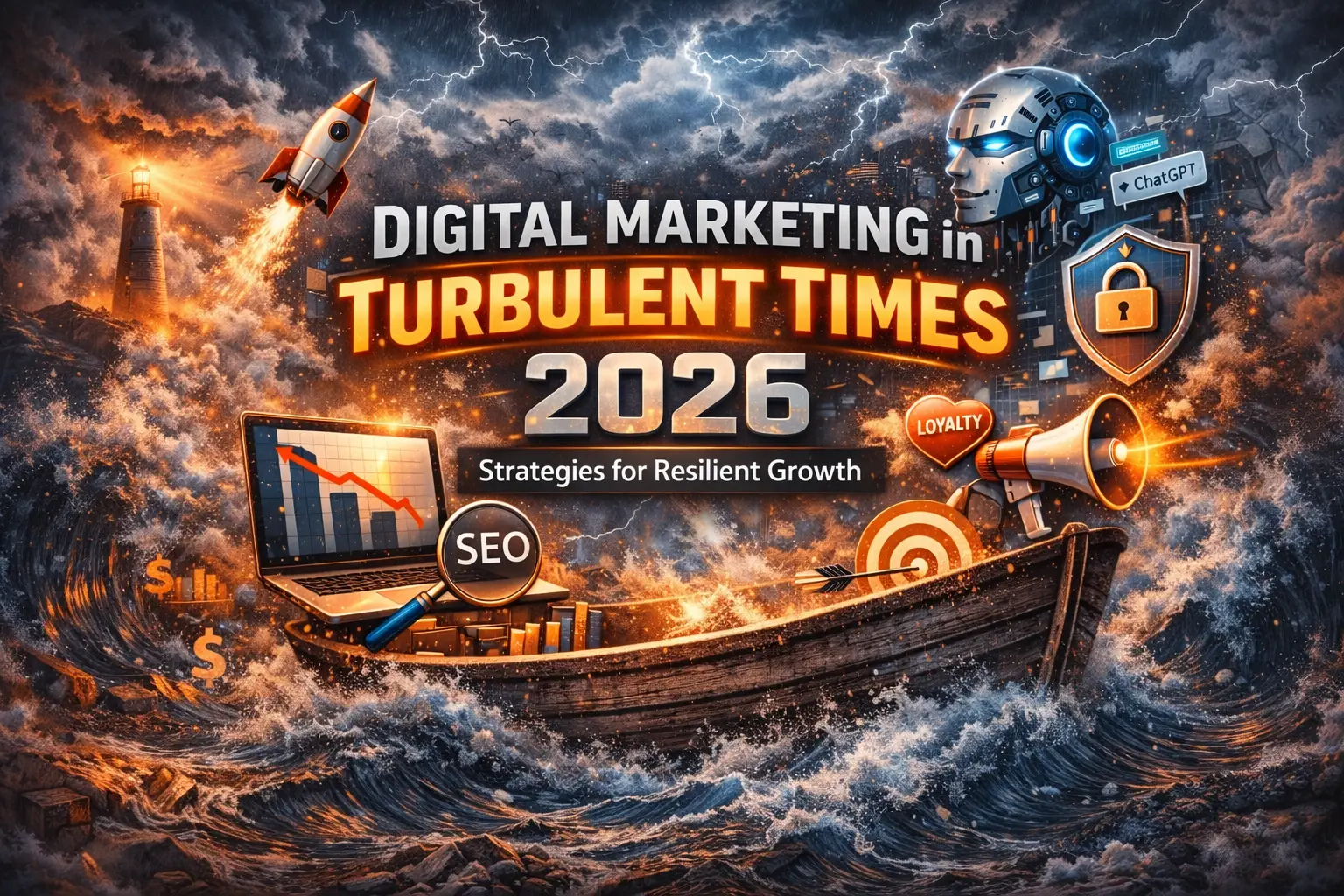
Global conflicts, tariff hikes, and trade tensions create ripple effects across markets. Businesses face rising costs, disrupted supply chains, and more cautious consumer spending.
In such environments, marketing strategies must prioritize:
- protecting existing customer relationships
- communicating clear product value
- optimizing advertising efficiency
- strengthening brand trust
Brands that adapt quickly can maintain growth even during global uncertainty.
In stable times, marketing focuses on expansion and experimentation.
But in uncertain times, the strategy shifts toward retention, efficiency, trust, and measurable value.
For marketers and business owners, the question is no longer:
“How fast can we grow?”
Instead, it becomes:
“How resilient and efficient can our growth be?”
Below are the six most important digital marketing strategies for navigating turbulence in 2026.
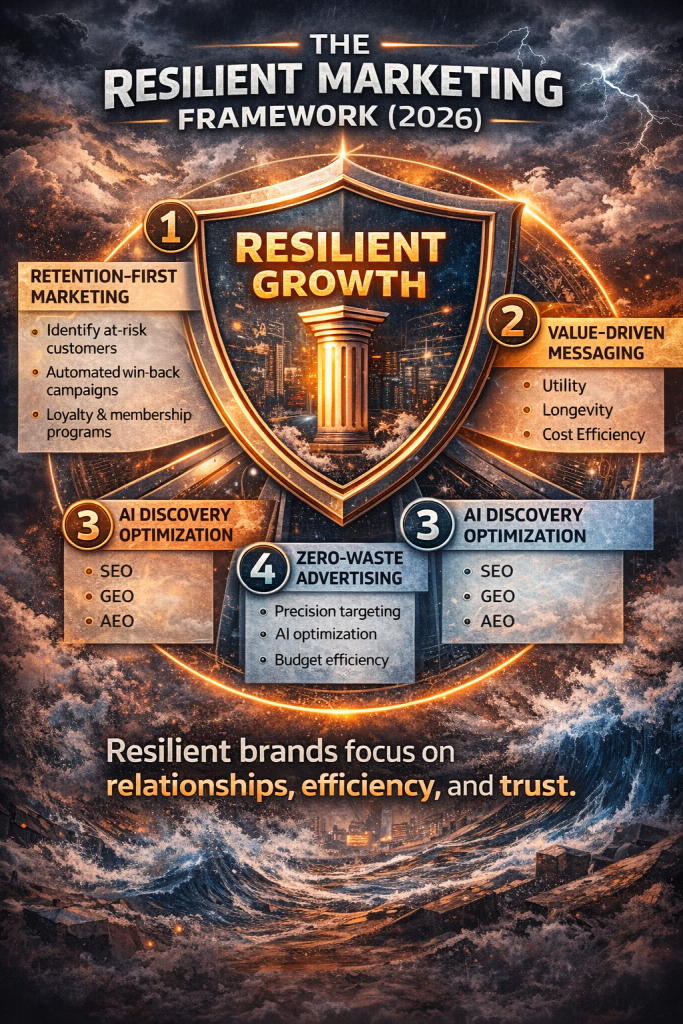
1. Retention-First Marketing
Why LTV Is the New CAC
In challenging economic climates, customer acquisition costs increase while conversion rates often decline.
Research consistently shows that:
- acquiring a new customer can cost 5–25x more than retaining an existing one
- loyal customers generate higher lifetime value (LTV) and stronger brand advocacy.
Key Strategy
Shift your focus from acquisition-heavy campaigns to customer lifecycle marketing.
Practical Tactics
- Identify at-risk customers using first-party behavioral data
- Deploy automated win-back campaigns
- Launch loyalty and membership programs
- Use personalized email & CRM journeys
Example
A SaaS company detects declining product usage and triggers a “We Miss You” onboarding refresher sequence, reducing churn by 18%.
2. Radical Value & Frugal Optimism
Messaging for the New Consumer Mindset
During economic uncertainty, consumers become more intentional with spending.
They still buy—but they need stronger justification.
Marketing therefore shifts from:
Lifestyle aspiration → Practical value
Messaging Transformation
Old Message
“Upgrade your lifestyle with premium experiences.”
New Message
“Save time, money, and effort with a product designed to last.”
High-Performing Content Formats
- Cost comparison guides
- ROI calculators
- Product longevity explanations
- “How this saves you money over time”
Winning Principle
Brands must communicate utility, durability, and economic value.
3. Answer Engine Optimization (AEO) & AI-First Search
Search behaviour is rapidly changing.
Consumers increasingly rely on AI-generated answers rather than traditional search results.
Platforms shaping the future of discovery include:
- AI search summaries
- conversational assistants
- generative AI recommendation engines
Users now search in more decision-driven ways, such as:
- “Is product X worth buying?”
- “Best budget laptop for work 2026”
- “How to reduce electricity bills Singapore”
AEO Optimization Strategies
- Build structured FAQ content
- Implement schema markup
- Write clear, authoritative answers
- Strengthen E-E-A-T signals
Content Types That Win in AI Search
- expert guides
- decision frameworks
- comparisons
- “should you buy” analysis
4. Zero-Waste Media Buying
Efficiency Over Reach
In turbulent markets, advertising budgets must become precision tools rather than broad experiments.
The old strategy:
“Scale ads until something works.”
The new strategy:
“Optimize every dollar.”
Core Optimization Techniques
1. Negative Keyword Expansion
Prevent wasted spend on irrelevant search queries.
2. Frequency Capping
Avoid ad fatigue and wasted impressions.
3. Geo-Targeting Optimization
Focus ad spend on high-converting regions.
4. AI Bid Optimization
Use automated bidding systems to adjust in real time.
Result
Higher ROI with less budget risk.
5. Ethical Data & The Trust Economy
Third-party cookies are disappearing, and privacy regulations continue to expand worldwide.
This creates a major shift:
Trust becomes a competitive advantage.
Brands must now focus on building first-party relationships with customers.
Strategic Data Sources
First-Party Data
- CRM records
- purchase behaviour
- website interactions
Zero-Party Data
- surveys
- preference centers
- voluntary user input
Community-Driven Marketing
Forward-thinking brands are building owned ecosystems:
- email newsletters
- membership communities
- exclusive content groups
- brand advocacy networks
These channels reduce reliance on algorithms and ad platforms.
6. Crisis Communication & Brand Resilience
Economic volatility increases the likelihood of reputation risks and PR challenges.
How a brand responds during crises often determines whether trust is strengthened or destroyed.
Principles of Effective Crisis Marketing
Speed
Respond quickly before narratives spiral.
Transparency
Acknowledge mistakes openly.
Humanization
Let real employees and leadership communicate authentically.
The Rise of “Fastvertising”
Brands increasingly respond to:
- cultural trends
- breaking news
- global events
with real-time content that feels human and relevant.
Marketing Strategy: Stable vs Turbulent Markets
| Feature | Stable Markets | Turbulent Markets |
|---|---|---|
| Primary Goal | Market share expansion | Retention & profitability |
| Budget Strategy | Experimental | ROI-proven |
| Content Tone | Aspirational | Empathetic & practical |
| Data Strategy | Third-party targeting | First-party relationships |
| Advertising | Scale rapidly | Optimize efficiently |
Final Insight: The Marketer’s New Role
The marketer of 2026 is no longer just a growth driver.
They are a resilience architect.
Success will come from balancing:
- efficiency
- customer trust
- AI-optimized discoverability
- long-term relationships
Brands that master these principles will not only survive turbulent markets — they will emerge stronger.
Case Study: How a Singapore SME Shifted from Growth to Resilience
Example:
A mid-sized Singapore e-commerce brand selling office productivity tools experienced declining ad performance during economic uncertainty.
Customer acquisition costs increased by 32%, while conversion rates dropped.
Instead of increasing advertising spend, the company implemented three strategic changes:
- Retention Campaigns
They launched personalized email sequences targeting repeat customers. - Content for AI Search
The company published comparison guides such as
“Best Productivity Tools for Remote Work 2026” optimized for AI search answers. - Zero-Waste Media Buying
The team cut underperforming ad channels and focused only on high-ROI campaigns.
Results After 4 Months
- Customer retention increased 21%
- Ad spend reduced 18%
- Revenue stabilized despite reduced marketing budget
This shift from aggressive growth to resilient marketing strategy allowed the company to maintain profitability during market volatility.
The Future of Marketing Is Resilient, Not Just Scalable
Economic turbulence is not a temporary disruption—it is becoming a structural feature of the modern economy.
The marketers who succeed in 2026 and beyond will be those who:
- build strong customer relationships
- optimize for AI-driven discovery
- operate with data transparency and trust
- treat marketing budgets with strategic precision
In uncertain times, resilience becomes the ultimate competitive advantage.
Frequently Asked Questions: Digital Marketing in Economic Uncertainty
1. What is the best digital marketing strategy during economic uncertainty?
The most effective digital marketing strategy during economic uncertainty is retention-focused marketing. Businesses should prioritize customer lifetime value (LTV), strengthen loyalty programs, and use first-party data to personalize communication with existing customers. Retaining customers is significantly more cost-effective than acquiring new ones and helps stabilize revenue when consumer spending becomes more cautious.
2. Why is customer retention more important than acquisition during turbulent times?
Customer retention becomes more important during turbulent times because acquiring new customers often costs 5–25 times more than keeping existing ones. Loyal customers already trust the brand and are more likely to continue purchasing even during economic uncertainty. By focusing on retention strategies such as loyalty programs and personalized communication, businesses can maintain revenue while reducing marketing costs.
3. How should marketing budgets change during economic uncertainty?
During economic uncertainty, marketing budgets should shift from experimental campaigns to ROI-driven strategies. Businesses should prioritize high-performing channels, reduce wasted advertising spend, and invest more in retention marketing, customer experience, and data-driven targeting. The goal is to maximize efficiency while maintaining strong relationships with existing customers.
4. What is resilience marketing?
Resilience marketing refers to a strategic approach focused on maintaining stable growth during uncertain economic or geopolitical conditions. Instead of prioritizing rapid expansion, resilient marketing emphasizes customer retention, efficient media spending, trust-building, and adaptable messaging that aligns with changing consumer needs.
5. How can businesses maintain growth during economic turbulence?
Businesses can maintain growth during economic turbulence by focusing on customer retention, optimizing marketing efficiency, and emphasizing value-driven messaging. Brands that strengthen customer relationships, leverage first-party data, and invest in high-performing marketing channels are better positioned to sustain revenue and remain competitive during uncertain market conditions.
6. How does consumer behaviour change during economic uncertainties?
During economic uncertainties, consumers typically become more cautious with spending and prioritize essential purchases. They conduct more research before buying, compare prices carefully, and seek products that offer long-term value. As a result, brands must shift their messaging toward practicality, reliability, and cost efficiency.
7. Why do consumers prioritize value over lifestyle branding during economic uncertainty?
In periods of economic uncertainty, consumers become more financially cautious and seek products that provide clear functional benefits. Lifestyle or aspirational branding may become less persuasive, while messaging focused on durability, practicality, and return on investment becomes more effective in influencing purchasing decisions.
8. What messaging works best when consumer confidence is low?
When consumer confidence is low, marketing messages that emphasize value, reliability, and practical benefits perform best. Brands should highlight how their products solve real problems, save money over time, or improve efficiency. Transparent communication and empathy toward customer concerns also help build trust during uncertain times.
9. How can brands communicate value without discounting too much?
Brands can communicate value without excessive discounting by focusing on product longevity, quality, and cost savings over time. Educational content, product comparisons, and case studies can demonstrate how a product delivers long-term value. This approach protects brand positioning while still addressing consumer price sensitivity.
10. What type of content performs best during uncertain economic periods?
During uncertain economic periods, content that provides practical guidance and decision support performs best. Examples include comparison guides, expert advice, cost-saving tips, and “best value” product recommendations. Educational and authoritative content also tends to rank better in search engines and AI-driven discovery platforms.
1. What is Answer Engine Optimization (AEO)?
Answer Engine Optimization (AEO) is the practice of structuring digital content so it can be easily understood and summarized by AI-powered search engines and conversational assistants. Instead of focusing only on ranking in search results, AEO aims to provide clear, authoritative answers that can appear directly in AI-generated summaries and voice search responses.
12. How does AI search affect SEO strategies in 2026?
AI-driven search platforms increasingly deliver direct answers instead of traditional search result lists. As a result, SEO strategies must focus more on structured content, authoritative expertise, and clear answers to user questions. Businesses should create FAQ sections, use schema markup, and produce expert-level content to remain visible in AI search results.
13. How can businesses optimize content for AI-generated search results?
To optimize content for AI-generated search results, businesses should structure their articles with clear headings, concise answers, and well-organized information. Using FAQ sections, structured data markup, and authoritative sources helps AI systems interpret and summarize the content more effectively.
14. What type of content appears in AI summaries like Google AI Overviews?
AI summaries typically prioritize content that is clear, authoritative, and structured. Articles that provide direct answers to common questions, include expert insights, and present well-organized information are more likely to appear in AI-generated summaries. FAQ sections, step-by-step guides, and comparison articles perform particularly well.
15. What is zero-waste media buying?
Zero-waste media buying refers to an advertising strategy focused on eliminating inefficient ad spending. This approach involves identifying high-performing audiences, using negative keywords to filter irrelevant traffic, optimizing bidding strategies, and focusing advertising budgets on channels that consistently deliver measurable results.
16. How can companies reduce wasted advertising spend?
Companies can reduce wasted advertising spend by analyzing campaign performance data, eliminating underperforming channels, and refining audience targeting. Implementing negative keywords, frequency caps, and AI-driven bid optimization can also help ensure that marketing budgets are allocated toward high-converting audiences.
17. What are the most efficient digital advertising strategies during economic downturns?
During economic downturns, the most efficient digital advertising strategies include performance-based campaigns, remarketing, and highly targeted search advertising. These approaches focus on audiences who already show purchase intent, helping businesses generate better results with smaller marketing budgets.
18. Why is first-party data important for digital marketing?
First-party data is essential because it comes directly from a company’s own customers, making it more accurate and privacy-compliant than third-party data. As privacy regulations increase and third-party cookies disappear, businesses that build strong first-party data strategies gain better insights into customer behaviour and can deliver more personalized marketing experiences.
19. What is zero-party data and how can businesses collect it ethically?
Zero-party data refers to information that customers voluntarily share with a brand, such as preferences, interests, or product needs. Businesses can collect zero-party data ethically through surveys, preference centers, quizzes, and personalized onboarding experiences while maintaining transparency about how the information will be used.
20. How does customer trust influence brand loyalty during economic uncertainty?
Customer trust plays a critical role in brand loyalty, especially during uncertain economic conditions. When consumers trust a brand’s transparency, reliability, and product quality, they are more likely to continue purchasing even when budgets are tight. Brands that communicate honestly and respect customer privacy build stronger long-term relationships.
Leave a Reply