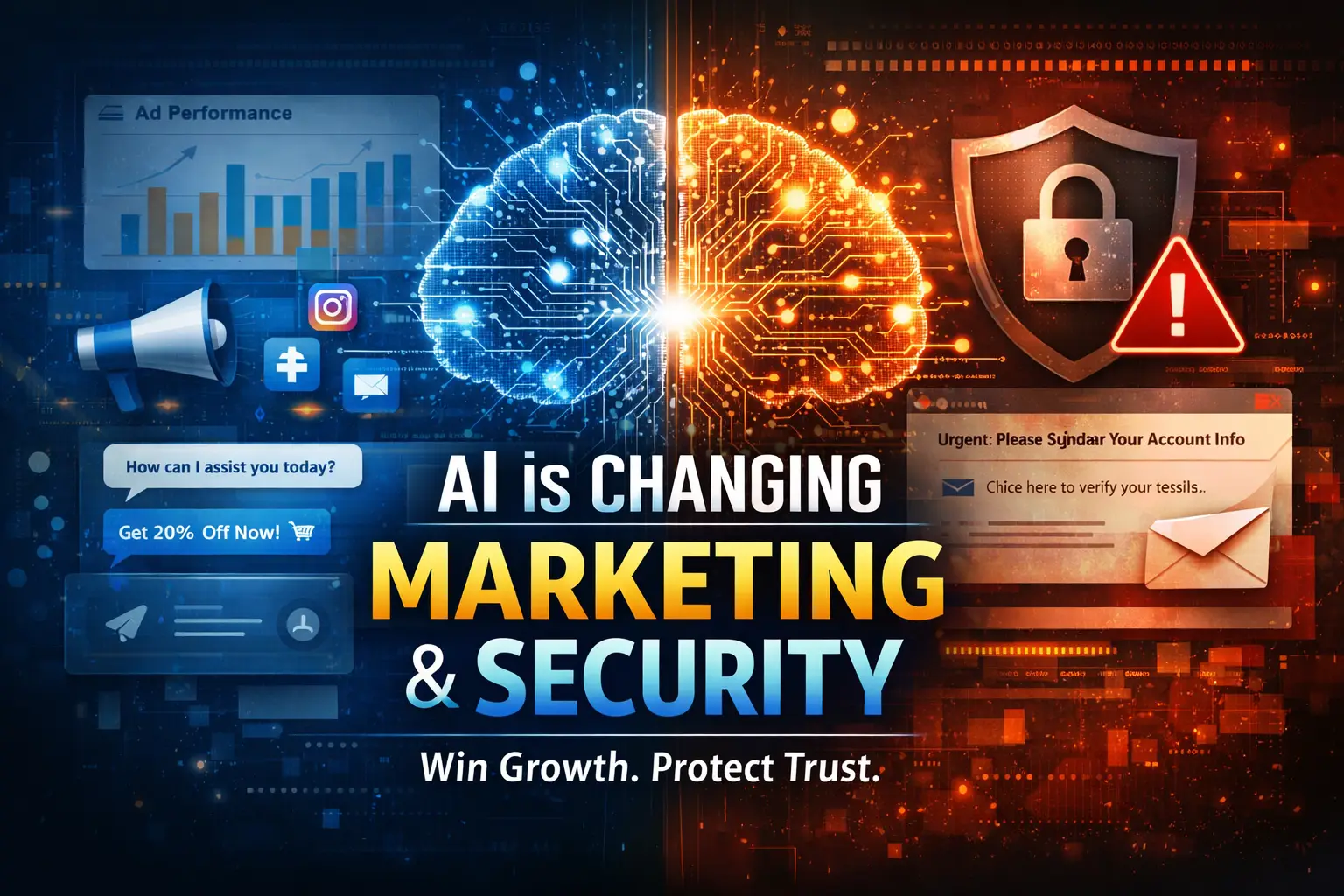
AI isn’t just another marketing tool — it’s reshaping the way businesses attract customers, run campaigns, and protect data.
In 2026, AI is transforming digital marketing through speed, automation, and personalization. At the same time, it’s also upgrading cybersecurity threats by making phishing attacks, scams, and hacking attempts faster and more convincing.
So the real question is no longer:
“Should we use AI?”
It’s:
✅ “How do we use AI to grow faster — without exposing our customers, reputation, and business systems?”
Let’s break it down clearly.
1) How AI Is Transforming Digital Marketing
✅ AI makes marketing faster and more automated
AI tools can generate content, ad creatives, and emails in minutes. Marketers can now launch campaigns quicker than ever.
Examples include:
- AI ad copy generation for Google Ads and Meta Ads
- AI-powered landing page variations for higher conversions
- Automated email workflows based on customer behavior
The advantage: you move faster than competitors.
The risk: everyone can create content fast, so only quality stands out.
✅ AI pushes personalization to the next level
In the past, personalization was mostly “Hi [Name]”.
Now AI can personalize based on:
- user behavior
- interest signals
- buying intent
- browsing history
- engagement patterns
This allows:
- Dynamic product recommendations
- Personalized offers
- Content based on user stage in the funnel
But here’s the key:
📌 Personalization must feel helpful, not creepy.
The most successful brands will be the ones that balance:
AI + customer trust + data protection
✅ Search is changing: AI Overviews and “answer-based SEO”
Google search is becoming more AI-driven (AI Overviews and generative answers).
This changes how people discover brands.
Instead of typing:
- “best marketing strategy”
They ask:
- “What is the best marketing strategy for SMEs in 2026?”
- “Which marketing channels work for small businesses in Singapore?”
That means your blog posts should include:
✅ FAQs
✅ clearer headings
✅ short direct answers
✅ real examples and experience-based insights
✅ Paid advertising becomes more AI-controlled
Platforms like Google and Meta rely heavily on automation:
- Smart bidding
- Automated targeting
- AI creative testing
So marketers win by improving:
- offers
- landing page conversion
- tracking setup
- creative hooks
The new marketing advantage is no longer “who targets best” — it’s:
🎯 who feeds the best inputs into the AI system.
2) How AI Is Transforming Cybersecurity (And Why It Matters to Marketers Too)
Most businesses think cybersecurity is an “IT department” issue.
But today, cyber threats often enter through:
- emails
- WhatsApp messages
- ads and fake landing pages
- social engineering
And AI makes these attacks more dangerous.
⚠️ AI makes phishing scams more convincing
Old phishing emails were easy to spot because they were badly written.
Now AI can generate emails that look:
- natural
- professional
- emotionally convincing
- extremely realistic
Even worse, AI can personalize scams using public information from:
- company websites
- social media
This increases risks like:
- credential theft
- account takeovers
- fraudulent payments
- customer data leaks
⚠️ AI deepfakes increase business fraud
AI can mimic voices and faces.
This is why businesses globally are seeing more cases of:
- “CEO voice fraud”
- fake video calls
- fake invoices and confirmations
The result:
📌 People become the weakest link — not technology.
✅ AI also improves cybersecurity defense
On the defense side, AI helps security teams by:
- detecting abnormal login activity
- identifying suspicious network behavior
- reducing alert fatigue in monitoring systems
- spotting threats earlier
Tools like EDR/XDR and SIEM systems use AI for faster threat detection.
But even with AI defense tools:
✅ policies, training, and secure practices still matter.
3) The Overlap: AI Links Marketing and Cybersecurity Together
This is the biggest shift most businesses don’t realize:
✅ Marketing data is highly valuable to hackers
Marketing teams hold:
- lead lists
- CRM records
- customer contacts
- campaign analytics
- business accounts (Meta Business Manager, Google Ads)
If attackers gain access, they can:
- steal leads
- run fake ads
- impersonate your brand
- scam your customers
A cyberattack isn’t only a “technical issue” anymore.
It becomes a brand trust crisis.
✅ Trust becomes a competitive advantage
In a world of AI scams and fake ads, people prefer brands that feel secure.
Businesses that can communicate:
- safe payment
- verified websites
- secure login
- privacy protection
…will win customer confidence.
In 2026, trust is no longer optional — it’s marketing.
✅ Mini Case Example (Singapore SME Style)
Case: A Singapore home-service business running Meta Ads
Imagine a small Singapore SME that provides:
Aircon servicing + chemical wash packages
They use AI tools to:
- create Facebook ad copy quickly
- launch new offer campaigns every week
- use a chatbot to collect leads
Growth results:
✅ leads increase because campaigns are faster and more consistent
But then something happens…
A scammer creates a fake page:
- uses the same business name and logo
- runs fake ads promising “$9.90 service”
- directs customers to a fake WhatsApp number
Customers complain:
- “I paid deposit but nobody came”
- “your company scam me”
Even though the business didn’t do it, the damage is real:
❌ lost trust
❌ refunds and disputes
❌ brand reputation hit
❌ ad account problems
What the SME should do:
✅ verify Meta Business Manager security (2FA)
✅ secure domain + website forms
✅ educate staff to spot AI phishing
✅ add official verification links on website
✅ update cybersecurity policy even as a small team
This is exactly why marketing + cybersecurity must work together now.
4) What Businesses Should Do Now (Simple Checklist)
Here’s a practical action list for SMEs:
✅ Use AI for speed (content + ads + automation)
✅ Keep human review for quality and brand voice
✅ Secure your ad accounts (2FA + admin access control)
✅ Protect customer data (CRM permissions + password hygiene)
✅ Add anti-phishing awareness training for staff
✅ Ensure landing pages are secure (HTTPS + form protection)
✅ Monitor fake pages / impersonation scams
✅ Build a trust-first brand message
Final Thoughts: AI Will Reward Smart Businesses, Not Just Fast Businesses
AI can help you scale marketing faster than ever — but it also increases cyber risks, scams, and brand impersonation.
The businesses that win in 2026 will be those who master both:
🚀 Growth (Marketing)
🔐 Trust (Cybersecurity)
Because in the AI era, trust is the strongest conversion strategy.
✅ FAQ Section (For Google AI Search + Featured Snippets)
1) How does AI change digital marketing in 2026?
AI changes digital marketing by automating content creation, improving personalization, optimizing ads, and enabling predictive insights for better targeting and conversions.
2) Does using AI in marketing increase cybersecurity risk?
Yes. AI increases risk when marketers use unapproved tools, expose customer data, or connect insecure plugins and forms. AI also helps attackers create more convincing scams.
3) What is the biggest cybersecurity threat caused by AI?
One of the biggest threats is AI-powered phishing, where scammers generate highly realistic emails, messages, and impersonations to steal logins or money.
4) How can SMEs in Singapore protect themselves from AI scams?
SMEs can use 2FA, limit admin access to business accounts, secure landing pages, train staff to detect phishing, and monitor brand impersonation on social platforms.
5) Is cybersecurity important for digital marketers?
Yes. Digital marketers manage valuable assets like ad accounts, customer databases, and CRM access—making them a prime target for cyberattacks.
6) How can AI help cybersecurity teams defend faster?
AI helps detect anomalies, automate threat alerts, reduce noise in security monitoring, and speed up incident response through pattern detection.
7) Can cybersecurity be used as a marketing advantage?
Yes. Brands that demonstrate secure payment, data protection, and privacy transparency often gain higher customer confidence and better conversions.
Leave a Reply