
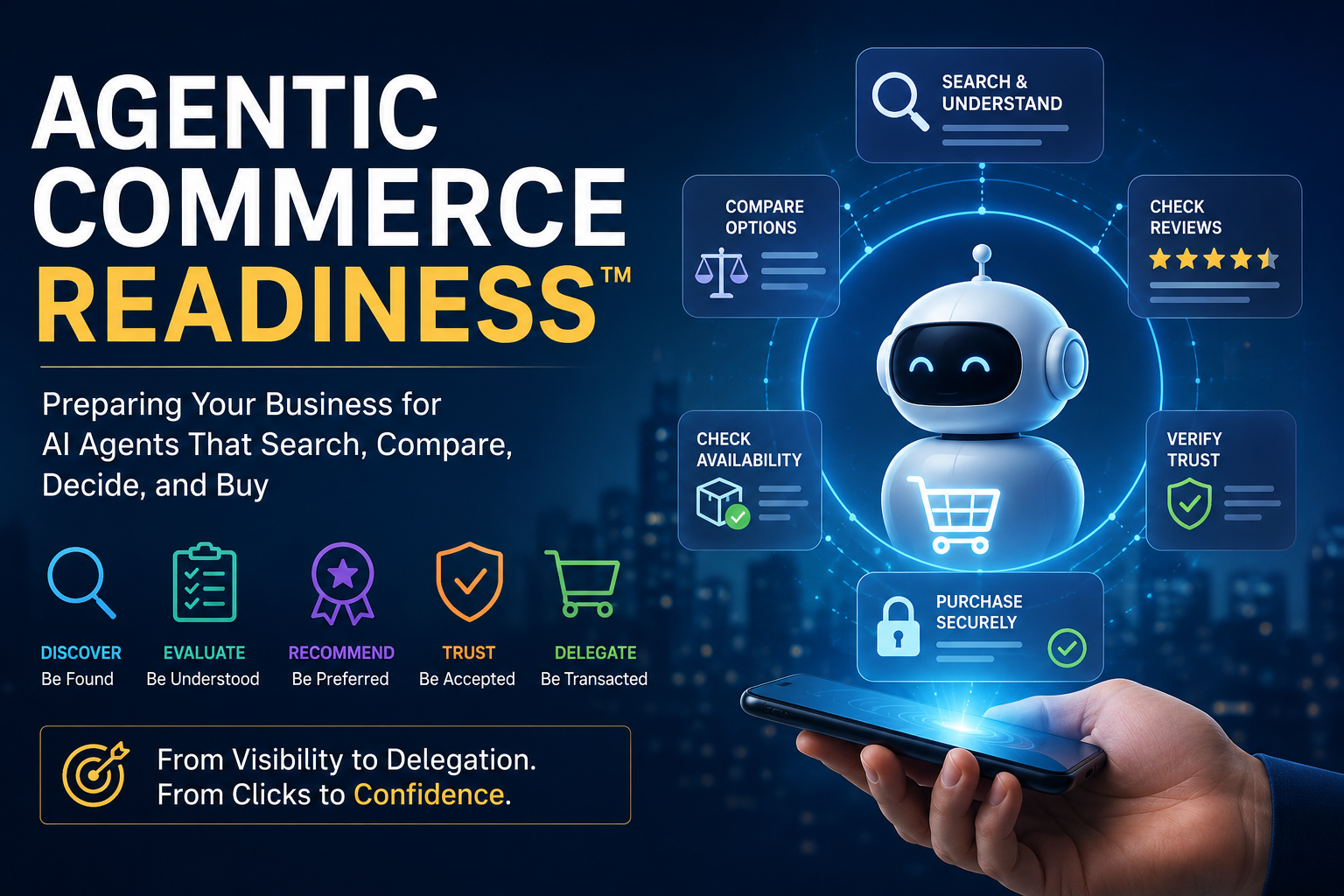
How To Prepare Your Business For AI Agents That Search, Compare, Decide, And Buy
The AI era is no longer just about helping people search for information.
It is increasingly about enabling AI agents to complete tasks on behalf of people.
Today’s AI assistants can already compare products, recommend services, summarize reviews, generate purchase options, and assist users throughout the buying journey. The next phase—often called agentic commerce—extends this capability further by allowing trusted AI agents to make transactions with user approval or within predefined permissions.
This represents a fundamental shift in digital strategy.
Businesses that were optimized for search engines may not automatically be ready for AI agents.
Businesses that became visible in AI search may still not be selected.
Businesses that are selected may still not be trusted enough for AI-assisted purchasing.
This is why Agentic Commerce Readiness™ matters.
It is the systematic preparation of an organization so AI agents can confidently discover, evaluate, recommend, and eventually transact with the business.
What Is Agentic Commerce Readiness™?
Agentic Commerce Readiness™ is the organizational capability to support AI-assisted purchasing by combining technical accessibility, structured knowledge, operational reliability, trust signals, and transaction readiness.
It extends beyond traditional SEO or e-commerce optimization.
Instead of asking:
“Can customers find us?”
Businesses must now ask:
“Can AI agents confidently choose us?”
The Evolution Of Digital Commerce
The evolution can be viewed as five distinct stages.
| Era | Primary User | Business Goal |
|---|---|---|
| Traditional Search | Humans | Be found |
| SEO Era | Humans | Rank higher |
| AI Search | Humans using AI | Be recommended |
| Agentic Commerce | AI + Humans | Be delegated |
| Autonomous Commerce | AI Agents | Be continuously preferred |
Each stage requires stronger confidence signals than the previous one.
Visibility alone becomes progressively less valuable without trust.
Why Traditional SEO Is No Longer Enough
SEO remains essential.
Without crawlability, indexing, semantic understanding, and content quality, AI systems cannot reliably discover your business.
However, discovery is only the beginning.
Agentic commerce introduces additional requirements:
- Machine-readable product information
- Reliable pricing
- Inventory accuracy
- Fulfillment confidence
- Transparent policies
- Reputation consistency
- Structured business knowledge
- Secure transactions
AI agents evaluate far more than webpages.
They evaluate operational confidence.
The Five Pillars Of Agentic Commerce Readiness™
1. AI Discovery Readiness
AI must first understand your business.
This includes:
- Structured data
- Entity relationships
- Knowledge graph consistency
- Product schemas
- Service schemas
- Organization schemas
- Semantic content architecture
Without machine-readable information, AI cannot reliably reason about your business.
2. Recommendation Readiness™
Being discoverable is different from being recommended.
Recommendation depends on confidence generated through:
- Expertise
- Authority
- Relevance
- Credibility
- Consistency
These signals help AI decide which businesses deserve higher confidence.
3. Trust Readiness
Trust extends beyond information quality.
AI agents increasingly evaluate:
- Review quality
- Reputation
- Transparency
- Customer support
- Refund policies
- Privacy
- Security
- Brand consistency
Trust determines whether recommendations become acceptable purchasing options.
4. Operational Readiness
An AI agent needs confidence that execution will succeed.
Operational signals include:
- Inventory availability
- Delivery reliability
- Service availability
- Appointment systems
- Pricing consistency
- Payment support
- API accessibility
- Order tracking
Operational uncertainty reduces recommendation confidence.
5. Delegation Readiness™
The final stage prepares businesses for AI-assisted transactions.
This includes:
- Secure authentication
- Permission management
- Transaction transparency
- Identity verification
- Compliance
- Auditability
- User approval workflows
Delegation only occurs when confidence exceeds acceptable risk.
The Agentic Commerce Readiness™ Framework
The readiness model progresses through five levels.
| Level | Outcome |
|---|---|
| Discoverable | AI can find you |
| Understandable | AI knows what you offer |
| Recommendable | AI prefers you |
| Trustworthy | Humans accept recommendations |
| Delegatable | AI can safely transact |
Each level builds upon the previous one.
Skipping stages creates weak foundations.
Common Business Gaps
Many organizations believe they are AI-ready because they have:
- A website
- SEO
- Reviews
- AI-generated content
Unfortunately, these alone rarely prepare a business for agentic commerce.
Common gaps include:
- Poor structured data
- Conflicting business information
- Weak entity relationships
- Limited trust signals
- Unclear policies
- Inconsistent pricing
- Outdated product information
- Fragmented customer experience
AI agents quickly detect inconsistency.
Confidence decreases accordingly.
How Agentic Commerce Changes Marketing
Traditional marketing focused on influencing human attention.
Agentic commerce increasingly focuses on influencing AI confidence.
Future marketing priorities include:
- Knowledge engineering
- Entity optimization
- Structured content
- Trust architecture
- Confidence accumulation
- Operational transparency
- Recommendation optimization
The objective shifts from generating clicks to earning delegated decisions.
The Relationship With AI Authority™
Within the TonyCWK framework, these concepts build upon one another:
- AI Discovery Strategy™ enables AI to find your business.
- Recommendation Readiness™ prepares your business for AI selection.
- AI Trust Systems™ strengthen confidence.
- Delegation Confidence™ determines whether AI can safely act.
- Agentic Commerce Readiness™ integrates these capabilities into a commerce-ready operating model.
Rather than replacing earlier frameworks, it represents their practical convergence.
Preparing For The Next Generation Of Commerce
AI agents will not replace human decision-making overnight.
Instead, they will increasingly assist with research, comparisons, bookings, renewals, subscriptions, procurement, and routine purchasing.
Businesses that prepare early will be better positioned as these capabilities mature.
Preparation involves more than deploying AI tools.
It requires building an organization that AI systems can confidently understand, recommend, trust, and transact with.
The businesses that thrive in agentic commerce will not necessarily be those with the most content or the biggest advertising budgets.
They will be the organizations that consistently reduce uncertainty for both humans and AI systems.
Because in the emerging AI economy:
Visibility gets you discovered.
Authority gets you recommended.
Trust gets you accepted.
Delegation enables action.
Agentic Commerce Readiness™ transforms that action into sustainable business outcomes.
Key Takeaways
- Agentic Commerce Readiness™ prepares businesses for AI-assisted purchasing and transactions.
- SEO remains foundational, but operational trust and structured knowledge become equally important.
- Readiness depends on five pillars: Discovery, Recommendation, Trust, Operations, and Delegation.
- AI agents evaluate confidence across information, reputation, and execution—not just webpage relevance.
- Organizations that reduce uncertainty are more likely to be recommended and delegated to as AI commerce evolves.
Please provide FAQ and schema for the article
FAQ
1. What is Agentic Commerce Readiness™?
Agentic Commerce Readiness™ is the ability of a business to be discovered, understood, recommended, trusted, and eventually transacted with by AI agents.
2. How is agentic commerce different from traditional e-commerce?
Traditional e-commerce is mainly driven by human browsing and decision-making. Agentic commerce involves AI agents helping users compare, decide, book, subscribe, or purchase based on user goals and permissions.
3. Does Agentic Commerce Readiness™ replace SEO?
No. SEO remains foundational. Without discoverability, crawlability, structured content, and clear entity signals, AI agents may struggle to understand or recommend a business.
4. Why is trust important in agentic commerce?
Trust determines whether a recommendation becomes an acceptable action. AI agents may surface options, but users are more likely to approve transactions when the business demonstrates reliability, transparency, and credibility.
5. What are the main pillars of Agentic Commerce Readiness™?
The five pillars are AI Discovery Readiness, Recommendation Readiness™, Trust Readiness, Operational Readiness, and Delegation Readiness™.
6. What does Delegation Readiness™ mean?
Delegation Readiness™ refers to whether a business has the trust, security, transparency, and operational systems required for AI agents to act on behalf of users safely.
7. Why is structured data important for agentic commerce?
Structured data helps AI systems understand products, services, policies, pricing, reviews, availability, and business identity more accurately.
8. Can small businesses prepare for agentic commerce?
Yes. Small businesses can start by improving website clarity, structured data, reviews, policy transparency, service information, and operational consistency.
9. What business gaps reduce agentic commerce readiness?
Common gaps include inconsistent business information, poor structured data, unclear policies, outdated pricing, weak reviews, limited trust signals, and unreliable product or service availability.
10. What is the final goal of Agentic Commerce Readiness™?
The goal is to reduce uncertainty so AI agents can confidently discover, evaluate, recommend, and eventually transact with a business.
Leave a Reply